Healthcare Software Development Services
Custom healthcare software development services
Our compliant custom healthcare software, pragmatic AI-strengthened functionality, and connected platforms make clinical processes more efficient, support drug discovery, and improve patient engagement, so healthcare enterprises can deliver more personalized, preventive care.


Medical imaging and PACS engineering
Develop and modernize diagnostic imaging software, including DICOM-based PACS applications. Our expertise covers image processing algorithms, workstation functionality, performance optimization, and imaging platform upgrades.


Healthcare legacy modernization
Modernize aging healthcare applications without losing essential functionality. We assess existing architecture, recover requirements, refactor or replace legacy components, and migrate systems to more maintainable platforms.
Healthcare software engineering for health-tech ISVs and digital health platforms
For health-tech ISVs, healthcare SaaS vendors, and digital health companies, Intellias provides healthcare product engineering services to help vendors launch, extend, and scale their platforms while keeping control of their product roadmap.


Healthcare AI software development services
Bring AI into healthcare products where it can improve clinical workflows, reduce administrative work, and make information easier to use. Intellias integrates AI capabilities into new and existing software, with security, testing, and human oversight built into delivery.

Develop AI-assisted documentation, clinical summarization, and information retrieval tools that help healthcare professionals work with patient information and medical records.

Build AI-enabled analytical tools that help clinicians interpret relevant data, identify patterns, and access information for clinical decisions, with appropriate validation and professional oversight.

Create conversational assistants for patient education, caregiver support, and information access, using approved content and knowledge bases.
Develop image processing and pattern detection capabilities for medical imaging applications and solutions designed to augment radiologists and clinical teams.

Apply AI to repetitive administrative workflows, including information processing, referral management, and appointment-related tasks, with defined controls for exceptions and human review.

Build AI quality, safety, and governance directly into every stage of development, from data prep and model evaluation to access controls, human oversight, continuous monitoring, and change management, ensuring full alignment with clinical use cases and healthcare compliance standards.
How our AI Engineering Pods work
AI Engineering Pods: AI-native healthcare software development
Intellias AI Engineering Pods bring together 3–5 product, design, and engineering specialists working with governed AI agents across requirements, development, testing, and deployment. The model helps speed up software delivery while keeping architecture, security, code quality, and release decisions under human oversight.
-

Foundry Pod — from existing product to clear requirements
Analyzes applications, maps workflows, recovers undocumented requirements, and breaks complex modernization projects into manageable development tasks.
-
Builder Pod — from requirements to working software
Develops and validates product functionality using AI-assisted coding, automated testing, and established engineering practices, with human review throughout delivery.


AI Engineering Pods in action: Alzheimer’s caregiver platform
A health-tech company needed to replace its aging caregiver support application before a $700K legacy license renewal. With no reusable source code and thousands of active users to support, Intellias used AI Engineering Pods to reverse-engineer, redesign, and rebuild the platform on a cloud-native architecture


Why Intellias as your healthcare software development company
Intellias combines healthcare domain expertise, AI-native healthcare engineering services, and end-to-end product development capabilities to deliver software for health-tech ISVs, digital health platforms, and healthcare enterprises.

Our healthcare engineering services portfolio covers diverse technologies and delivery requirements, from clinical platforms and medical imaging to connected care and embedded software, including FDA-regulated medical device development.

We combine product strategy, UX, architecture, development, quality engineering, and ongoing support in one partnership, helping you launch healthcare software products, manage complex integrations, and modernize established platforms.
From security posture assessments to automated quality controls, our experts build regulatory-grade protection, continuous compliance, quality standards, and intelligent defense directly into your clinical operations.

Intellias combines healthcare AI development with governed AI-assisted engineering to build and modernize digital health platforms, support clinical workflow automation, and improve software delivery efficiency.

Intellias is an AWS Advanced Tier Services Partner with AWS competencies in AI Services, Data & Analytics, and Migration Services. Our validated expertise helps healthcare organizations modernize legacy systems, connect clinical data, and bring AI into daily processes, with patient data security and regulatory requirements built in.

We draw on deep expertise in cloud, data engineering, enterprise platforms, embedded systems, and AI/ML to deliver integrated solutions that address complex healthcare integrations, legacy modernization, and evolving product needs.
Our experts

Global Head of HCLS, Med Devices & Strategic Partnerships
Roy is the Global Head of Healthcare & Life Sciences at Intellias, where he leads global strategy, growth, and innovation across payer, provider, pharmaceutical, and medical technology sectors. He is responsible for aligning digital engineering, data, and AI capabilities with measurable business and clinical outcomes, helping organizations reimagine care delivery and patient engagement. As the P&L leader for the vertical, Roy builds value-based partnerships with industry executives and guides clients in translating technology investments into scalable, ROI-driven transformation.
With more than 25 years of leadership experience and over 15 years building and scaling global teams, Roy defines and executes Intellias’ Healthcare & Life Sciences go-to-market strategy across cloud, interoperability, automation, and Generative AI. He works closely with R&D, Centers of Excellence, and delivery organizations worldwide to create next-generation digital health and connected care solutions.
Senior Client Executive Director, Digital, Healthcare
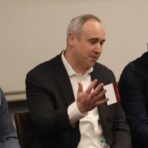
Chris Clark is a Senior Client Executive Director for USA Healthcare & Life Sciences. In these industries, he guides and assists Intellias clients to develop and launch world-leading digital products, leveraging our advanced engineering capabilities and AI. Chris brings over 20 years of experience enabling the bleeding edge of digital innovation for healthcare and life sciences, building modern software, digital platforms, data platforms, AI/ML solutions, designs, and product strategy. Chris obtained his MBA from Vanderbilt University, and his BBA from The University of Dayton. Chris lives in the western suburbs of Chicago.

Senior Director, Medical Devices, Pharma & HCLS
Tom is a Business Development Executive at Intellias, combining strong technical aptitude with strategic business insight to help clients accelerate their organizational success. He partners with customers to identify effective business strategies and scalable technology solutions that drive measurable outcomes and long-term value.
Tom is responsible for expanding business development practices, establishing strategic partnerships, and strengthening Intellias’ trusted relationships with clients. He leads with empathy and a results-oriented mindset, ensuring successful project delivery while fostering sustainable, long-term collaborations.
With more than two decades of experience in business development and leadership, Tom has consistently contributed to company growth by mentoring teams, supporting clients, and shaping a culture built on trust, excellence, and partnership. His commitment to delivering tangible results has helped build a strong portfolio of satisfied clients and enduring business relationships.
Healthcare software engineering insights and perspectives





Frequently asked questions about healthcare software development
Healthcare software development services cover product strategy, UX design, custom application development, system integration, testing, and ongoing support. Intellias provides healthcare software development solutions for SaaS platforms, EHR/EMR integrations, telehealth, remote patient monitoring, clinical AI, medical imaging, and medical devices, tailored to technical, operational, and regulatory requirements.
Intellias combines healthcare product engineering with AI-assisted software delivery. Our AI Engineering Pods support requirements analysis, development, testing, and deployment under human oversight. In a caregiver application modernization project, this approach helped reduce change lead time by 30–40% and production defects by 40–60%.
An AI Engineering Pod is a small team of 3–5 product, design, and engineering specialists working with governed AI agents. Intellias uses Foundry Pods for product analysis and requirements recovery, and Builder Pods for implementation and validation. Engineers retain responsibility for architecture, security, quality, and release decisions.
Yes. Intellias provides healthcare software product development services for health-tech ISVs, digital health platforms, and healthcare SaaS vendors. Our expertise covers custom healthcare software development, third-party integrations, legacy modernization, and AI-enabled applications. We offer team extension, dedicated development teams, and full project outsourcing.
Intellias incorporates HIPAA-related security requirements throughout healthcare software development, from governance and threat modeling to access controls, automated testing, and penetration testing. Our approach also addresses operational security. Specific compliance obligations depend on the product, deployment environment, and organizations handling protected health information.
Intellias provides FHIR integration services and healthcare data exchange solutions using HL7 and FHIR, alongside engineering for DICOM-based medical imaging environments. Our healthcare interoperability expertise covers integration architecture, APIs, data mapping, and validation. Support for specific standards versions and EHR vendor interfaces is determined during technical scoping.
Healthcare AI development may require de-identification, data minimization, and controlled access to sensitive information. The appropriate safeguards depend on the data and intended use. Under HIPAA, Safe Harbor and Expert Determination are recognized de-identification methods. The specific implementation approach is established during project scoping.
Intellias supports medical device software development through firmware engineering, requirements management, verification, automated testing, and documentation. Our specialists contributed to a pulsed field ablation device program that obtained FDA approval. Development processes and regulatory requirements depend on the device’s intended use and applicable standards.
Custom healthcare software development costs depend on product complexity, integrations, security requirements, testing, and the engagement model. A focused application extension, multi-tenant healthcare SaaS platform, and regulated medical device project require different levels of effort. Intellias estimates costs based on the agreed scope, technical dependencies, and delivery responsibilities.
Evaluate healthcare software development companies based on relevant projects, interoperability expertise, security practices, and experience with applicable regulations. Ask about team composition, architecture ownership, testing evidence, and post-launch support. For healthcare AI software development services, also assess model evaluation, governance, monitoring, and measurable delivery outcomes.