The automotive industry is not just changing tires; it’s changing its core. We are moving from building machines to creating connected digital ecosystems that depend on continuous software updates, cloud integration, and AI-driven intelligence. While Software-Defined Vehicle (SDV) may sound like a marketing label, it has become a practical response to the technological limits of traditional automotive architectures. And as the shift accelerates, SDV cybersecurity moves from an afterthought to the foundation of trust.
In this new reality, SDV cybersecurity and functional safety are tightly linked. A modern vehicle is increasingly similar to a distributed computer system. It processes massive amounts of sensor data, communicates with cloud platforms, and makes decisions in real time. As this complexity grows, so do security expectations. While a software bug in your laptop is just a nuisance; a software flaw in a vehicle can cause physical harm and even become life- threatening. This shift demands an engineering approach that treats safety, security, and AI behavior as interconnected responsibilities, not separate disciplines.
Cybersecurity threats and challenges in SDVs
Software-defined vehicles operate in an environment that is both technologically advanced and exposed to entirely new categories of SDV cyber threats. As vehicles become “servers on wheels,” their attack surface expands dramatically: connectivity modules, mobile apps, over-the-air updates, in-vehicle networks, and cloud services all become potential entry points. This means software-defined vehicles security is now a critical engineering priority, not only for compliance but for protecting drivers and maintaining trust in the entire SDV ecosystem.
The risks are practical, not theoretical. Cyberattacks on telematics units, keyless entry systems, and infotainment platforms have demonstrated how vulnerabilities can spread across vehicle domains. Attackers no longer need physical access; they can exploit weaknesses remotely. SDVs face a wider and more dynamic range of threats, including spoofing, tampering, denial-of-service, and unauthorized access to safety-critical functions.
In this environment, securing SDVs requires more than reactive approach to exposed weaknesses. It requires designing architectures, processes, and governance that anticipate failure modes and limit their impact. Automakers must balance performance, security, and reliability under real-world conditions while supporting continuous software delivery. The challenge is not only about preventing attacks but ensuring a compromised system cannot cause physical harm. The notion of safety and SDV security as we’ve known is no longer sufficient; we must build trust.
This raises the main question: How do engineers build this trust when safety, security, and AI logic converge inside one vehicle?
Cleaning up the mess: Shift to zonal architectures
For decades, OEMs added new features by simply adding another electronic box. A function as simple as heated seats required an additional ECU, extra wiring, and yet another isolated subsystem to manage it. Over time, this “add another box” philosophy created vehicles with hundreds of controllers and several kilometers of wiring harness. The result resembles a legacy IT system – functional but stretched to its limits.
This legacy approach produced four major constraints:
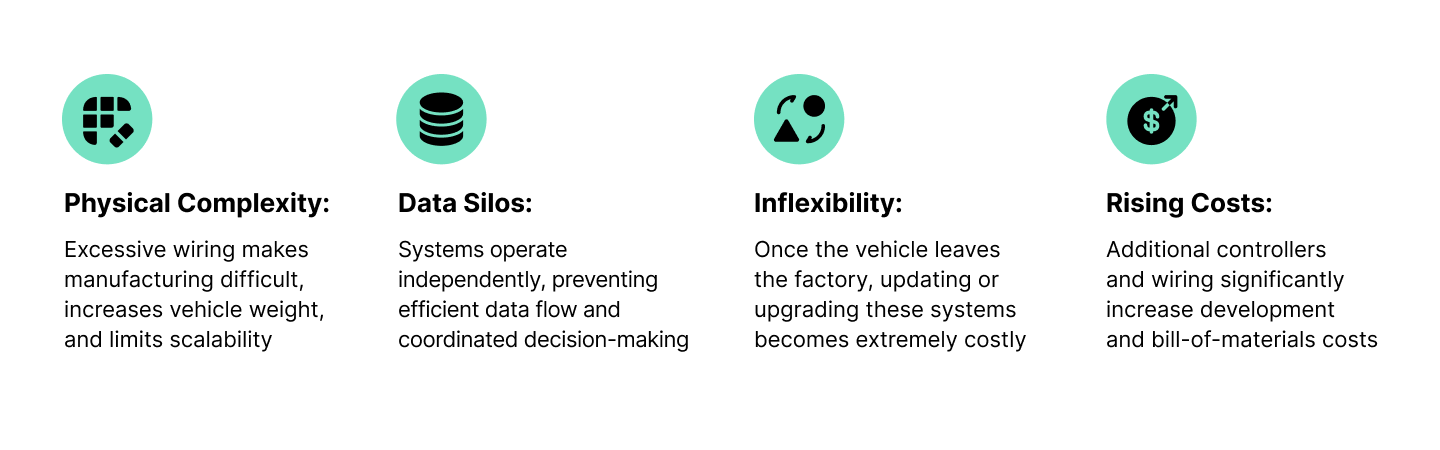
- Physical complexity: Excessive wiring makes manufacturing difficult, increases vehicle weight, and limits scalability.
- Data silos: Systems operate independently, preventing efficient data flow and coordinated decision-making.
- Inflexibility: Once the vehicle leaves the factory, updating or upgrading these systems becomes extremely costly.
- Rising costs: Additional controllers and wiring significantly increase development and bill-of-materials costs.
To overcome these barriers, the industry is transitioning to Zonal Architecture. Instead of distributing functions across many weak controllers, logic and computing power are consolidated into several High-Performance Computers supported by zonal gateways. This simplifies electrical design, reduces hardware redundancy, and enables software to evolve much more easily over the vehicle’s lifetime.
Sample of vehicle’s zonal architecture
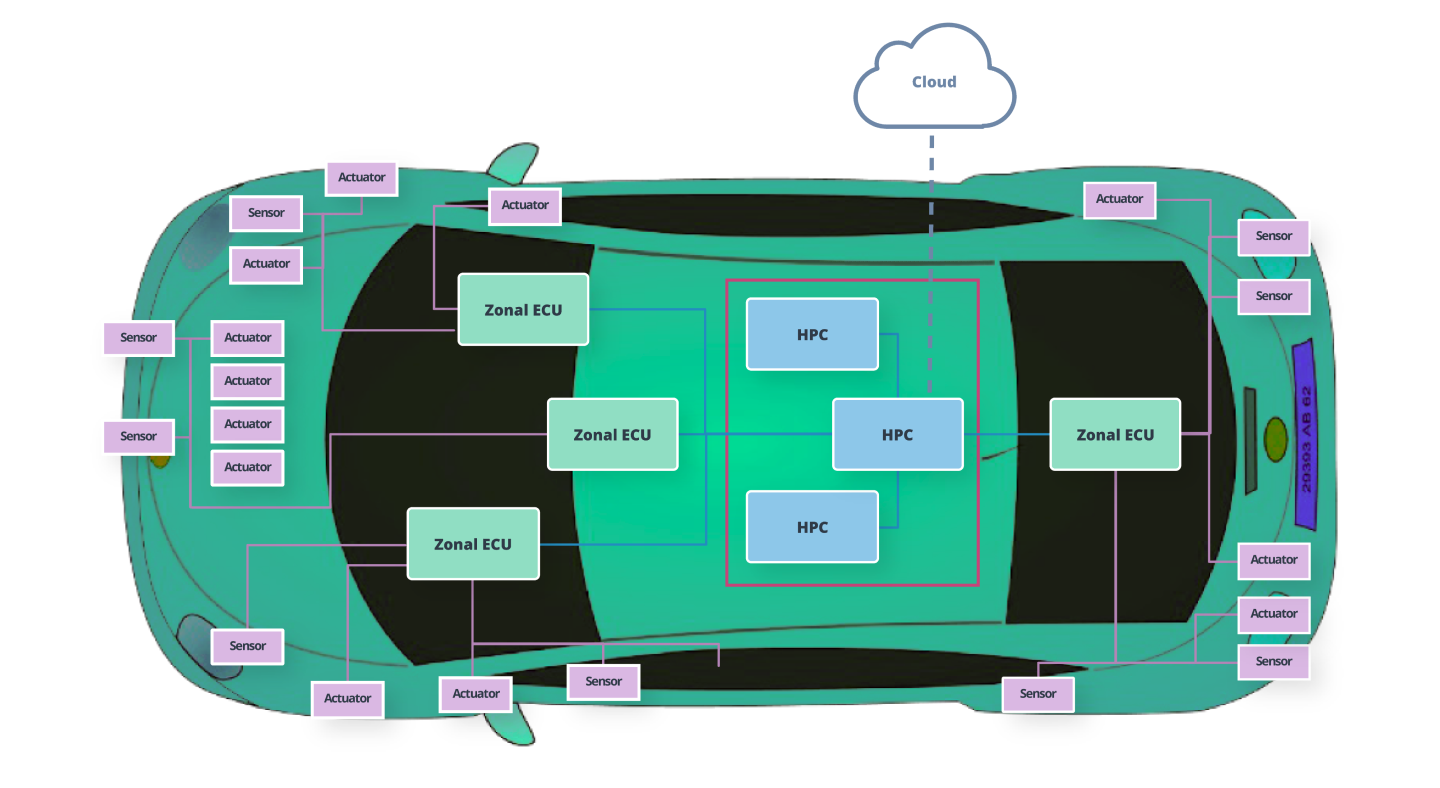
Zonal architecture is not just physical reorganization. It forms the foundation required to secure software-defined vehicles, allowing automakers to streamline updates, enforce consistent cybersecurity policies, and manage data more intelligently across domains. It also creates an environment where advanced SDV cybersecurity expertise can be applied consistently rather than scattered across isolated modules.
The centralization paradox
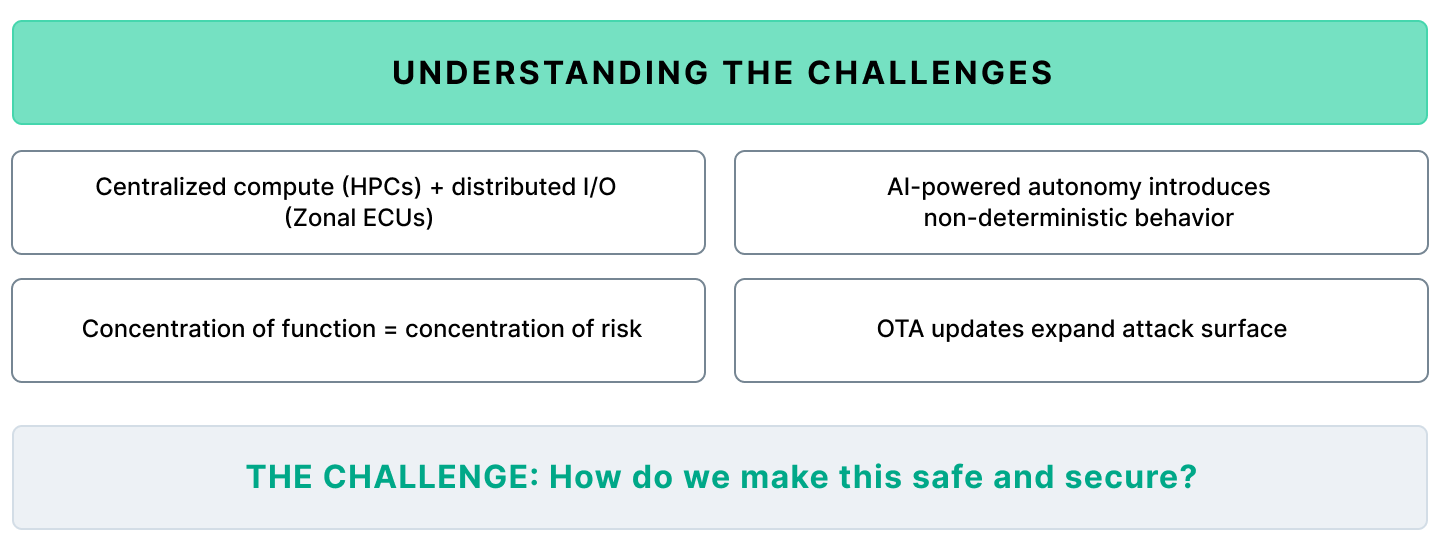
While centralization streamlines engineering, it introduces a new concern: fewer but more powerful computing units create potential single points of failure. If a central controller experiences a critical fault, large portions of the vehicle may be affected. This leads to a necessary mindset change: the walls between safety and security must come down.
Cybersecurity experts and functional safety engineers often worked independently in the past, but securing software-defined vehicles now requires close integration. A single incident may impact both safety and security simultaneously. Consider a GPS spoofing attack:
- From a security perspective, it compromises data integrity.
- From a safety perspective, it can be a physical hazard that causes incorrect positioning of a vehicle, possibly leading to a crash.
To address this, the industry now combines TARA (Threat Analysis and Risk Assessment, ISO/SAE 21434) with HARA (Hazard Analysis and Risk Assessment, ISO 26262). ASIL (Automotive Safety Integrity Level) requirements increasingly influence cybersecurity measures, such as enforcing cryptographic authentication for GPS signals or strengthening redundancy using IMUs and independent sources.
Today, we’re not just asking: “Can this be hacked?”. We ask: “If this is hacked, can it cause actual harm?” Within an SDV, a firewall is not only protecting data, it’s protecting physical lives. This difference shows why SDV security is now a safety enabler and why safety cannot be achieved without robust AI cybersecurity.
Taming the AI black box
Then there’s Artificial Intelligence. AI makes it even more complex. Unlike predictable rule-based software, AI models operate on probabilities. They handle expected scenarios well but may fail outside their training domain, especially when the situation involves human behavior. And this is exactly how normal people act – unpredictable by nature, which AI systems cannot always anticipate. This unpredictability makes certification difficult.
This is where the new ISO/PAS 8800 standard steps in, providing guidance for governing AI-based functions. It emphasizes:
- Rigorous evaluation of training data to ensure representativeness and quality.
- Clearly defined Operational Design Domains (ODDs) describing when and where automated functions can safely operate.
- Architectural safeguards such as deterministic fallback algorithms that assume control when the AI system becomes uncertain.
This approach acknowledges that AI does not need to be perfect to be safe. Instead, safety comes from treating AI as a component that may fail under certain conditions and designing systems that can intervene. Think of a driving instructor sitting next to a student driver: the student drives, but the instructor has a separate brake pedal, grabbing the wheel if the student makes a dangerous move. The goal is to ensure automated decisions remain transparent, controllable, and aligned with safety requirements across all driving scenarios.
Defense-in-Depth: A practical security strategy
No software is flawless, and no hardware platform is immune to failure. With this in mind, how do we sleep at night? To mitigate these realities, SDVs adopt a Defense-in-Depth strategy that applies multiple layers of protection. This layered approach ensures that even if one component is compromised, additional controls prevent an attacker from escalating their impact. We build the car like a submarine, with multiple watertight compartments, including:
- Virtualization: Type-1 hypervisors ensure “freedom from interference” by isolating safety-critical functions (e.g., braking) from non-critical applications (e.g., infotainment) even when they share the same compute platform.
- Network protection: Zonal gateways act as internal firewalls, using deep packet inspection (DPI) to stop attacks from moving laterally through the vehicle.
- System-level resilience: As vehicles progress toward L3+ autonomy, fail-safe strategies are no longer enough. Instead, fail-operational designs are required, meaning the system must continue operating safely even after an internal failure. This often involves heterogeneous redundancy, different software implementations running on different hardware paths.
Together, these measures help secure software-defined vehicles and limit the impact of vulnerabilities. Trustworthiness is not achieved by eliminating all risks but by ensuring that individual failures do not cascade into disaster.
Conclusion
The transition to software-defined vehicles is redefining automotive engineering. Yeah, it is much more than just a dashboard update. It requires integrating functional safety, SDV cybersecurity, AI governance, and continuous software delivery into one coherent strategy. By strengthening architectures, addressing SDV cybersecurity threats, and expanding system resilience, automakers can create vehicles that are safer, more secure, and more reliable throughout their lifecycle.
As the industry continues to evolve, the focus remains clear: building vehicles that earn trust through transparent engineering, strong cybersecurity, and a design philosophy that prioritizes safety at every layer. When we combine safety, security, and intelligent systems effectively, we not only build smarter cars – we build vehicles that deserve the confidence we place in them on every journey.