It’s the time of year when retailers finalize their budgets and reflect on lessons learned during the past 12 months. As the planning wraps up, retail technology trends begin to take shape. These are the modern technology applications, services, and other resources that have enjoyed popularity in commerce near the end of 2025. While pragmatic AI applications and automation top the list of trending retail technologies, they are not alone. In the new year, retailers will create unified commerce platforms. They will also ensure purchase and return experiences are the same whether customers shop at the store or online. Furthermore, the retail industry will apply analytics to improve daily decision-making and long-term forecasting.
New technology comes at a price. According to Gartner, worldwide retail technology spending is expected to reach $388 billion by 2026, while AI-related investments are likely to grow at nearly 25% annually. This spending surge reflects a change in the way retailers view technology. The question is no longer which companies are investing in new technologies, but instead which companies are investing in technology most strategically. The retail technology trends in 2026 will be challenging for those who have not updated their systems in many years. However, retailers with strong data foundations and intelligent retail technology will excel in the new year. From AI agents that autonomously manage inventory to computer vision cameras that eliminate checkout lines, the retail store has matured its technology as it prepares for the future.
Here are the top 8 technology trends for the retail industry at the dawn of 2026.
1. Pragmatic AI and automation
AI retail technology trends have disrupted the retail industry over the past three years as it has embraced them. Now that the dust has settled, retailers are finding practical uses for AI technologies. Generative artificial intelligence now builds product descriptions and assists with retail customer service. Meanwhile, agentic AI can execute multi-step operational tasks, such as automatically reordering stock when inventory is low.
Although AI experimentation has been encouraged, retailers will become more careful about their AI solutions in the new year. They will deploy AI and machine learning where they can be most effective: as repeatable processes that have a significant effect on business operations. For example, instead of generating analytics that require manual interpretation, AI systems can automatically provide the details. Retailers also have other practical applications for AI, such as:
- Recommendation engines: Machine learning algorithms analyze purchase history and browsing behavior to suggest products that might interest the customer, while Psykhe AI adds personality assessment to make recommendations
- Chatbots: Natural language processing (NLP) enables 24/7 customer support that handles routine inquiries, allowing retail associates to handle more complex issues than monitoring support channels
- Contextually intelligent computer vision: Cameras combine multiple AI techniques to explain shopper behavior, store conditions, product placement, and how each of those affects the others
Automation is seen more in operations than in the front of the store. AI/ML-powered technologies now manage prices and scheduling, and they optimize demand forecasting. For example, a European grocery chain recently reported a 15% reduction in food waste after deploying machine learning models for predictive resource analysis.
Retailers still using legacy systems will struggle with automation. Those that have completed a digital transformation to modernize their systems have greater data maturity and are more prepared for AI.
5 Types of Automated Retail Processes

2. Data analytics
Technology trends for retailers in 2026 require advanced data strategies. Retailers generate vast amounts of data from many sources, including transactions, loyalty programs, website visits, and in-store sensors. Data analysis provides more detail and enables data-driven decision-making. Examples include real-time resource analysis—monitoring staff allocation, inventory levels, and operational capacity as they happen—predictive resource analysis, which uses historical patterns and forecasting algorithms to anticipate future demand and optimize resource planning, and heat mapping, a visualization technique that shows customer movement patterns and engagement hotspots within physical or digital spaces. Other functions, such as sales funnel optimization, also need data analysis.
However, analyzing data from multiple sources is not only inefficient but also results in lost opportunities from siloed processes. Successful retailers treat data as a strategic asset. In addition to analyzing data and facilitating the other AI retail technology trends, retailers must build unified data platforms that eliminate silos between e-commerce, point-of-sale, and customer relationship management systems.
3. Unified omnichannel commerce
Technology trends in the retail industry now favor unified commerce over omnichannel strategies. Unified commerce integrates channels that previously were separately managed. By combining them into a single platform, they enable real-time synchronization with the data from every customer interaction.
The foundation of unified commerce is:
- MACH architecture: Short for Microservices, API-first software, cloud-native, and headless commerce architecture, MACH promotes flexible, modular retail technology systems
- Headless commerce: Separating the user interface (UI) from the back end of retail systems has many benefits, including the ability to deploy rapid updates without system-wide changes
- Composable commerce: Retailers are choosing to assemble their systems from best-in-class, specialized vendors rather than monolithic systems
- API-first software: Part of the MACH architecture, APIs connect the various technologies of composable commerce and headless retail systems
Centralized systems for inventory management, pricing, and customer data eliminate potential inconsistencies that frustrate retail managers and shoppers alike. Point-of-sale solutions integrate with inventory management, customer relationship management, and marketing platforms. Store associates have access to customer histories through these advanced POS systems and can process orders through both in-store and online channels.
Meanwhile, zero interface retail is the frontier of unified commerce. With no interface, customers participate minimally or not at all. It includes technologies like voice assistants, IoT devices, and automated replenishment systems. In some cases, customers receive products on a replenishment schedule and never have to interact with the system again.
4. Customer experiences
Retail tech trends in 2026 improve digital shopping for customers both online and in the store. They are designed to make shopping easier and faster. Customer-centric technology includes:
- Virtual clothing try-ons
- Smart cameras that recognize customers and tell associates their preferences
- Hyperpersonalized experiences based on the customer’s shopping data
- Advanced connectivity with 5G technology
Another emerging trend is experimental retail, where stores feature interactive displays, personalized consultations, and immersive experiences that customers cannot get online. These events and activities also improve brand loyalty and drive different traffic than eCommerce.
Digital trends in retail also include ambient computing, where technology blends into the background until it is needed. Sensors and smart cameras respond automatically, lighting adjusts, and customer recommendations appear on nearby displays.

5. Changing customer behaviors
Key technology trends influencing the retail sector must be able to serve rapidly changing consumer demographics and preferences. While millennials have been the focus for the past several years, Gen Z consumers now have significant purchasing power, and they are known for strong loyalty. Younger consumers also have distinct expectations for digital experiences and look for sustainable brands. Many retailers have established loyalty programs specifically to cater to Gen Z customers.
Gen-Z’s commitment to brand loyalty

Source: PWC
Several behavioral patterns are influencing retail tech investments. While most shopping in the past was done through the same channel, customers have been channel-switching for the past few years. They might see the product in-store but then purchase it online. Younger consumers also expect retailers to be transparent about environmental practices, which requires new tracking capabilities for measuring carbon emissions and other sustainability practices. Finally, younger consumers also tend to buy through social media platforms and expect same-day or next-day delivery.
Retail innovation trends reflect these behavioral changes. Retailers now choose mobile-first design as their standard. Sustainability metrics also appear along with product specifications. Finally, retailers are now selling their products via social media influencers instead of through traditional advertising.
6. Supply chain and delivery
Retail technology trends in 2026 support resilient supply chains and delivery excellence. In recent years, analyzing supply chain and delivery data has revealed vulnerabilities in just-in-time inventory models. Retailers are repairing those vulnerabilities with advanced technology. This includes digital supply chains with better visibility, machine learning algorithms to optimize routing, tracking devices to determine the real-time location for shipments, digital proof of delivery, and more flexible delivery times.
How different age groups prefer to shop
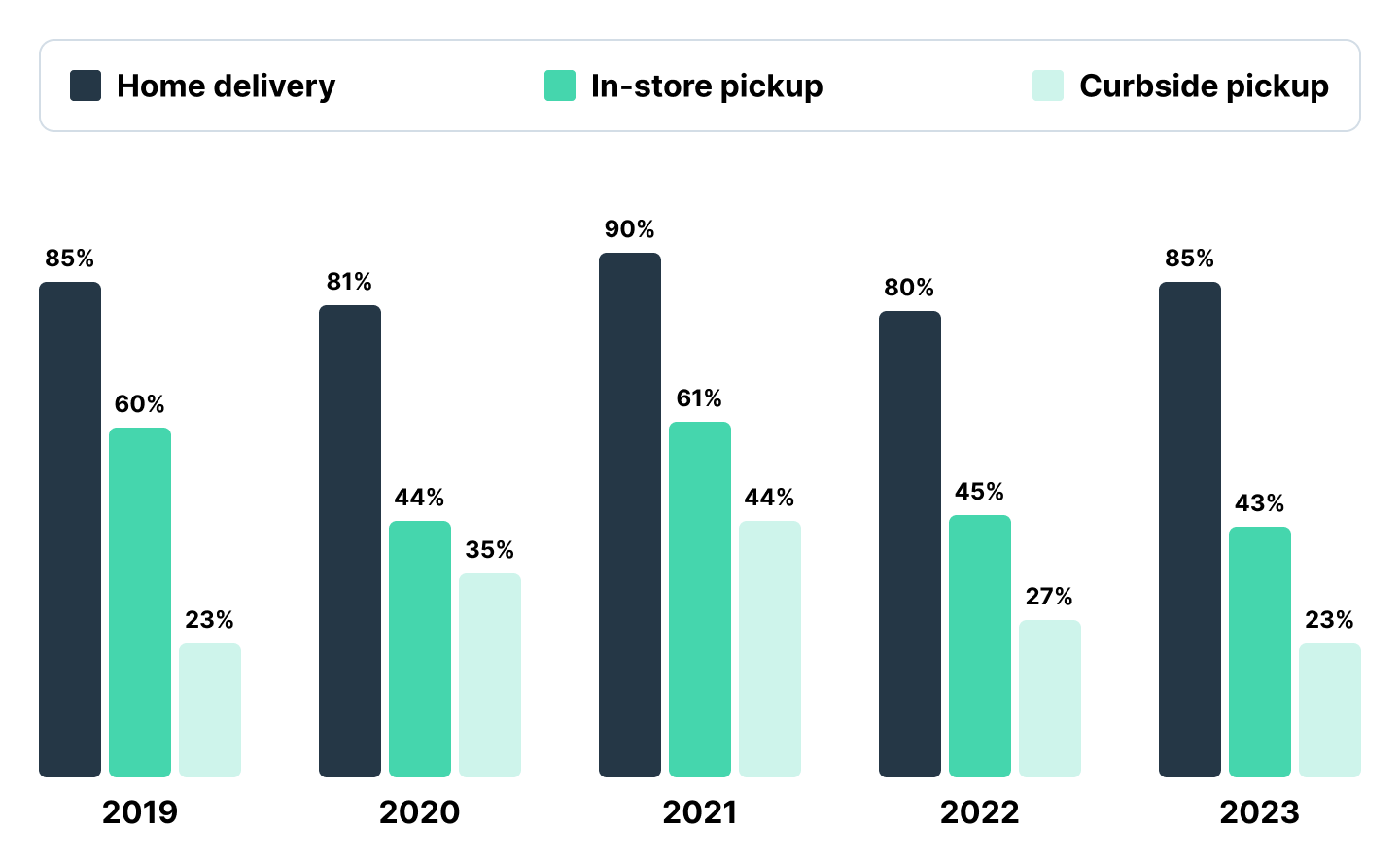
Source: PWC
Supply chain management has become competitive. Retailers that can promise and meet a delivery time grab customers from competitors that struggle with on-time deliveries. Meanwhile, automation in fulfillment centers continues to improve. The most significant gains come from intelligent orchestration—using AI to determine optimal fulfillment for each order based on inventory location, shipping costs, and customer expectations. Software also tracks sustainability efforts, minimizing waste and decreasing a retailer’s carbon footprint.

7. More ways to pay
New payment experiences are some of the more visible retail and technology trends. What once required multiple steps now happens almost instantly. Modern payment technologies include:
- Contactless payments: Tap-to-pay cards and mobile wallets complete transactions in seconds
- Frictionless payments: Systems charge customers automatically as they leave a store, eliminating checkout entirely
- Self-checkout: Kiosks allow customers to scan and pay without cashier assistance
- Buy now, pay later payment solutions: These installment options are integrated at points of sale, which expands customer purchasing power
- Biometric authentication: Fingerprint and facial recognition are replacing PINs and signatures
Among the payment improvements, self-checkout lines have become smoother and more secure with computer vision. Rather than scanning each item individually, customers place their basket on a sensor pad that instantly identifies the items in it. Errors and theft that affected earlier self-checkout systems have decreased substantially.
8. Security
Tech trends in retail must address the persistent challenge of shrinkage from theft, fraud, and operational errors. New technology has greatly improved security for data-driven retailers. They now have AI-powered computer vision cameras that detect suspicious behavior, smart cameras that identify known shoplifters, and Radio Frequency Identification (RFID).
However, retailers don’t want to scare away customers with too much visible technology. Some AI solutions, such as machine learning to analyze transactions for fraud, work in the background rather than on the sales floor. These trends in retail technology also reduce internal theft, which heavily contributes to retail loss.
The future of retail
The trends in retail technology heading into 2026 reflect an industry rapidly adopting AI. Retailers that have invested in their data and modern architecture will thrive, while those still operating on legacy systems will struggle to catch up. During the coming year, success will reward those who move decisively to employ retail AI solutions while sticking to the fundamentals: listening to customers, managing inventory efficiently, and delivering on promises.
Are you making today’s retail decisions with yesterday’s data? Contact Intellias to build a modern retail system that transforms operations and lays the foundation for AI.