In the race to deliver better patient experiences, digital solutions hold the key to success. Yet many healthcare organizations struggle to evolve fast enough to close the gap between innovation and patient care. One thing is clear: The need for effective healthcare product engineering has never been greater.
At Intellias, we help healthcare providers, insurers, and research institutes transform operations through industry-leading healthcare software product engineering. The result is better patient outcomes, optimized clinical workflows, and built-in compliance.
If you’re looking to bring innovative healthcare products to market faster and gain a competitive edge, you’ve come to the right place. Read on to explore:
- The benefits and challenges of product engineering in healthcare tech
- Key use cases and how they bring value
- The pivotal role AI plays in healthcare software engineering
- How to choose the right healthcare tech partner for your project
What is healthcare product engineering?
Healthcare product engineering is the process of bringing digital healthcare products to market. It typically includes the following stages:
- Product design
- Product development
- Testing and QA
- Deployment
- Maintenance
Effective healthcare tech product engineering requires technical expertise in various fields, including software development, AI-driven automation, and data analytics. It also requires industry-specific knowledge and a deep understanding of the organization’s goals and pain points.
Ultimately, the goal of healthcare product engineering is to build products that align technological innovation with patient needs and business objectives. It’s about empowering medical professionals to deliver smarter, faster, more effective healthcare services — while ensuring regulatory compliance.
Challenges in healthcare product engineering
Developing healthcare software products that are innovative, compliant, and scalable represents a major challenge. Each stage of the development lifecycle brings unique complexities and considerations. Below, we’ve highlighted some of the most important ones to understand.
Regulatory compliance
The healthcare industry is tightly regulated. In the US, for example, healthcare IT solutions must comply with a range of different compliance frameworks, including:
- HIPAA
- HITECH
- FDA regulations for Software-as-a-Medical-Service (SaMD)
Engineers must also design with auditability and data traceability in mind, embedding compliance into products at the code level rather than adding it as an afterthought.
Integration with legacy systems
Many healthcare providers still rely on outdated technology that is often incompatible with modern software. Integrating AI-powered data platforms with legacy EHRs, lab systems, and billing platforms represents a major challenge.
The key to overcoming this challenge is implementing reliable integration solutions — such as API gateways or middleware — that connect new software with legacy systems and third-party tools.
Interoperability and data siloes
Data siloes are another major issue for healthcare providers. Despite the growing need for interoperability within tech ecosystems, data often remains closed off within different systems that cannot “talk” to each other.
Overcoming this issue and achieving seamless interoperability between disparate systems remains a top priority. Interoperability solutions and EHR integration solutions can help here by enabling real-time data exchange, improving care coordination and clinical decision-making.
Data security and privacy
Healthcare software products handle highly sensitive patient data. Safeguarding that data against breaches, hacks, or unauthorized access is a major challenge for healthcare providers. Failing to do so can severely damage patient trust and potentially lead to heavy penalties.
Software developers can overcome these risks by implementing data security best practices, such as:
- Zero-trust architectures
- Data encryption at rest and in transit
- Robust identity management and user permissions
User-centric design
UX is a key differentiator in software design. In healthcare, it’s particularly important — great UX leads to improved adoption, which leads to more positive care outcomes.
Delivering outstanding UX isn’t easy, however. It requires a deep understanding of the needs and challenges of users — whether that’s physicians, lab assistants, administrative staff, or patients. Strong research, pilot feedback loops, and iterative testing are also crucial.
Benefits and impact of healthcare software product engineering
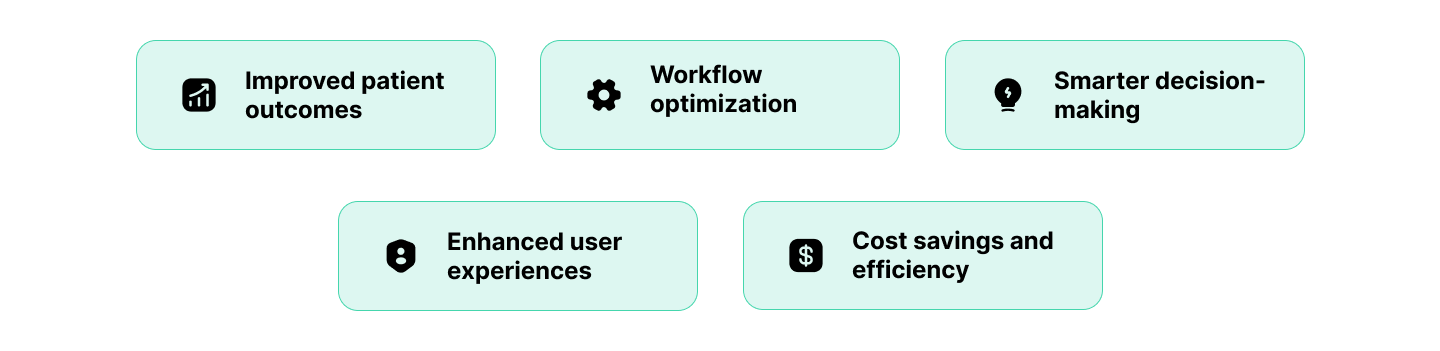
When done right, digital product engineering for healthcare can have a transformative impact across clinical, operational, and patient-facing workflows. Below, we’ll highlight the key benefits you can unlock:
Improved patient outcomes
By developing innovative software products, healthcare businesses can achieve what matters most — better patient outcomes. For example:
- Data-driven platforms enable clinicians to make faster, more accurate decisions
- Predictive analytics identifies at-risk patients earlier, enabling personalized preventative care
- Remote patient monitoring systems support early intervention and reduce hospital readmissions
- Clinical decision support tools provide evidence-based insights that minimize diagnostic errors
- Interoperable products ensure that patient data flows seamlessly across providers, improving care continuity
Enhanced user experiences
The best healthcare software enables slick, user-friendly experiences. This is typically achieved through:
- Intuitive user interfaces and navigation
- Real-time data visualizations and insights
- AI-powered personalization and recommendations
- Accessibility across users and platforms
As a result, medical professionals can get the insights they need faster. They can spend more time providing personalized patient care, and less on administrative duties.
Workflow optimization
AI-powered platforms can optimize and automate key workflows, such as patient intake, lab reporting, and claims management. This brings huge benefits for staff and patients alike, including:
- Improved operational efficiency
- Greater accuracy and medical error reduction
- Lower compliance risk
- Faster turnaround times
- Happier, more productive staff
Cost savings and efficiency
By increasing operational efficiency and reducing the need for costly maintenance, healthcare product engineering can help organizations cut costs and improve the bottom line. The result is a leaner, more agile business model, where profits can be reinvested into further innovation and growth.
Smarter decision-making
Healthcare providers have access to a treasure trove of patient and business data. Modern healthcare software products can help turn that data into actionable insights that power smarter decision-making:
- Real-time analytics dashboards provide quick insights into patient care
- Predictive analytics help identify at-risk patients early and take a more proactive approach to care
- Financial and operational analytics highlight inefficiencies and ensure optimal resource allocation
- Real-time compliance and reporting tools flag potential issues as they arise, reducing risk
Custom solutions and use cases
The healthcare industry offers broad use cases for custom healthcare software. At Intellias, we work with a range of organizations — spanning hospitals, clinics, research laboratories, and insurers — to bring custom products to market that yield measurable success. Here are some key examples and use cases:
Customized telehealth solutions
Modern telehealth solutions are transforming the way patients and healthcare professionals interact. Scalable, secure video consultation platforms allow patients to receive remote advice and support. These platforms can integrate with scheduling, billing, and EHR systems for seamless healthcare workflows and real-time data updates.
Medical billing and coding solutions
For healthcare providers, the medical billing process can be a drain on time and resources when performed manually. Custom medical billing solutions can automate and enhance the entire process, from submitting claims to assigning standardized codes. The result is faster, smoother, more accurate operations.
Pharmacy and lab management solutions
Running a pharmacy or research lab effectively requires top-down management of complex, overlapping processes. Pharmacy and pathology laboratory management solutions can help automate, streamline, and connect workflows such as:
- Inventory control and supply tracking
- Order processing and labeling
- Compliance management and reporting
Remote patient monitoring systems
Remote patient monitoring systems allow doctors and clinicians to manage care continuously from afar. By collecting data from IoT-enabled devices and wearables, these platforms provide real-time insights into patients’ vital signs, symptoms, and response to treatment. When health metrics reach warning levels, doctors get instant alerts.
Integrations and interoperability platforms
Modern healthcare ecosystems depend on seamless data exchange across multiple platforms. Integration and interoperability platforms enable this by providing a connecting layer between systems such as:
- EHRs
- Lab systems
- Billing platforms
- Telehealth applications
As a result, healthcare providers get real-time visibility into patient care and operational performance across departments and locations.
Care workflow automation tools
While care is still very much a human process, automation tools can handle much of the repetitive, time-consuming tasks, such as:
- Scheduling appointments and sending reminders
- Routing lab results to the right departments and clinicians
- Processing intake forms and verifying insurance
- Providing discharge and care plan information
By automating these tasks, healthcare professionals have more time to focus on what they do best — providing hands-on patient care and a human touch.
Design thinking and product mindset
There’s more to great healthcare product engineering than just advanced tech. For software development to be successful, it needs to start with what matters most — understanding user needs and pain points.
At Intellias, we apply design thinking to our healthcare software development projects. Design thinking is a human-centered approach to developing creative solutions. It typically comprises five core phases:
- Empathize — conducting deep user research to understand needs and challenges
- Define — analyzing research findings to define the problem that needs fixing
- Ideate — generating a range of potential solutions through brainstorming and design workshops
- Prototype — building rapid prototypes of potential solutions to explore ideas further
- Test — validating concepts with real-world users to test what works

This approach works best when coupled with a product mindset. If design thinking is a problem-solving methodology for creating impactful software, a product mindset ensures that the software delivers long-term value by:
- Continuously adapting and improving the software in line with changing needs
- Focusing on outcome-driven development over hype or adding new features for the sake of it
- Maintaining close collaboration between technical and clinical stakeholders
How AI impacts the healthcare software development lifecycle
In addition to transforming the user experience, AI is also reshaping the way healthcare software is designed, built, and maintained. At Intellias, we incorporate artificial intelligence into every stage of the healthcare product lifecycle. This allows us to accelerate time to market, spot and fix issues early, and ensure that products are continuously aligned with user needs.
Below, we’ll look at just some of the ways AI can be used throughout the product development lifecycle:
Planning and requirements gathering:
- Analyzing operational and patient data to identify unmet needs or workflow inefficiencies
- Supporting data-driven product planning and smarter prioritization of features
- Forecasting future demand and resource needs to align development with long-term goals
Design and prototyping:
- Using AI-driven design tools to simulate interfaces and anticipate user behavior
- Creating multiple design variations rapidly to identify the most intuitive user experiences
- Leveraging AI-powered analytics to validate design choices before moving on to development
Development:
- Accelerating development using AI coding assistants and model-based engineering
- Automating documentation and compliance mapping to ensure traceability
- Leveraging AI-driven code analysis to spot potential integration challenges and suggest solutions
Testing and validation:
- Automating testing using machine learning to detect bugs and compliance risks early
- Simulating real-world clinical scenarios to validate performance and reliability
- Identifying compliance risks and integration challenges before deployment
Deployment and maintenance:
- Using predictive analytics to identify issues before they cause disruption
- Monitoring live systems to optimize performance and uptime
- Continuously analyzing user and system data to guide future updates and enhancements
How to choose the right healthcare product engineering partner
Healthcare software development is a highly complex undertaking, requiring access to multidisciplinary expertise. Most healthcare organizations simply don’t have the in-house resources to bring quality software products to market. With this in mind, success often depends on choosing the right engineering partner.
So, what should you look for when teaming up with a technology expert? Here are some key factors to consider:
- Proven industry experience. Look for partners with demonstrable experience in the US healthcare sector (if that’s where you are based) and a solid understanding of HIPAA, FDA, and FHIR standards.
- Deep technical expertise. Look for partners with proven expertise in custom software development, AI, IoT, integration engineering, big data, and cloud. Ask for relevant case studies or client success stories to back up claims.
- Focus on interoperability. To ensure that your new software becomes a seamless part of your tech ecosystem, look for partners that offer third-party medical software integration, including EHR integration solutions and legacy system modernization.
- Scalability and flexibility. Look for partners that offer the flexibility to tap into the expertise you need — whether that’s hiring digital product engineers to fill talent gaps or outsourcing the entire product development process.
- Client-first mindset. Outsourcing shouldn’t mean handing over a project and hoping for the best. The best partners should feel like an extension of your team. Look for businesses that prioritize continuous collaboration and close relationships with internal stakeholders and end users.
Intellias: Your partner in healthcare product engineering success
At Intellias, we help healthcare organizations turn complex challenges into scalable, user-centric digital solutions. With over two decades of experience, we use tried-and-tested delivery models to help you bring outstanding products to market faster.
Our experts understand that product development isn’t just about exciting tech. It’s about real-world value. We build software that delivers tangible results by aligning product design, user needs, and business goals.
We can help you at every stage of your product engineering journey — from needs analysis to design, implementation, and beyond. All while focusing on security, scalability, and compliance. The result is healthcare tech that improves operational efficiency while delivering a superior patient experience.
Ready to engineer your next healthcare success story? Let’s talk.