We develop smart hospital solutions for modern healthcare needs
Our technology solutions are designed with healthcare realities in mind, strengthening your foundation for quality care. They’re precise in every aspect of care delivery and flexible to meet shifting demands, and they justify every dollar spent, with results that pay off day after day.

Our solutions coordinate facility-wide smart hospital services and operations with real-time insights into patient flow, staffing, and resource use.
- Unified operations dashboards (patient flow/staffing/capacity)
- Predictive surge modeling
- Resource allocation systems
- IoT sensor networks
- Real-time bottleneck identification

We enable secure, standards-based data sharing to simplify care alignment across clinical systems while supporting patient and provider needs.
- Context-aware data exchange (HL7, FHIR, DICOM)
- Automated workflow optimization
- Clinically tuned voice interfaces
- Team-based task management
- Adaptive integrated clinical pathways

By applying connected monitoring technology and mobile collaboration tools, we improve the patient experience and staff productivity from hospital to home.
- Mobile solutions and collaboration tools
Integrated self-service check-in - Multi-language care navigation
- IoT-enabled inpatient-to-home remote monitoring

We transform the care journey with industrial automation and digital tools that make it easier for patients to navigate hospitals, access care, and connect with providers on their terms.
- Building information modelling (BIM)
- Digital twins
- Patient education platforms
- Digital concierge doctors
Our end-to-end services for smart hospital system innovation
We provide technology services that support smart hospital strategies: building more resilient operations that anticipate patient needs, speeding up workflows, and adapting to change. To ensure accuracy, flexibility, and long-term ROI and turn hospitals into intelligent care setups where everything works in sync, we connect medical devices, real-time analytics, and interoperable systems.


Why choose Intellias for smart hospital solutions

Workflow-first design
We build around how clinicians actually work, not theoretical models. That means your staff can keep to familiar routines while technology strengthens patient care delivery.

Integration without replacement
We connect your existing systems and add features step by step. By avoiding rip and replace headaches, we protect your budget while upgrading your operations.

Clinical decision support
We provide the right information at the right time, so your clinicians get decision support without alert fatigue, minimizing burnout and helping them deliver better care.

Focus on user adoption
We focus on what makes your team actually use new tech. When your staff gets tools that fit their needs, it leads to higher adoption rates and real value from your investment.

Uninterrupted operations
We build in backup plans and fallback options fitted to clinical needs so that your functions keep running even when infrastructure fails — because downtime isn’t an option.

Practical security
We implement security that protects, not frustrates. We make sure your team gets access to what they need, when they need it, while keeping patient data fully protected and compliant.
Our experts

Global Head of HCLS, Med Devices & Strategic Partnerships
Roy is the Global Head of Healthcare & Life Sciences at Intellias, where he leads global strategy, growth, and innovation across payer, provider, pharmaceutical, and medical technology sectors. He is responsible for aligning digital engineering, data, and AI capabilities with measurable business and clinical outcomes, helping organizations reimagine care delivery and patient engagement. As the P&L leader for the vertical, Roy builds value-based partnerships with industry executives and guides clients in translating technology investments into scalable, ROI-driven transformation.
With more than 25 years of leadership experience and over 15 years building and scaling global teams, Roy defines and executes Intellias’ Healthcare & Life Sciences go-to-market strategy across cloud, interoperability, automation, and Generative AI. He works closely with R&D, Centers of Excellence, and delivery organizations worldwide to create next-generation digital health and connected care solutions.
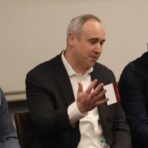
Senior Client Executive Director, Digital, Healthcare
Chris Clark is a Senior Client Executive Director for USA Healthcare & Life Sciences. In these industries, he guides and assists Intellias clients to develop and launch world-leading digital products, leveraging our advanced engineering capabilities and AI. Chris brings over 20 years of experience enabling the bleeding edge of digital innovation for healthcare and life sciences, building modern software, digital platforms, data platforms, AI/ML solutions, designs, and product strategy. Chris obtained his MBA from Vanderbilt University, and his BBA from The University of Dayton. Chris lives in the western suburbs of Chicago.

Senior Director, Medical Devices, Pharma & HCLS
Tom is a Business Development Executive at Intellias, combining strong technical aptitude with strategic business insight to help clients accelerate their organizational success. He partners with customers to identify effective business strategies and scalable technology solutions that drive measurable outcomes and long-term value.
Tom is responsible for expanding business development practices, establishing strategic partnerships, and strengthening Intellias’ trusted relationships with clients. He leads with empathy and a results-oriented mindset, ensuring successful project delivery while fostering sustainable, long-term collaborations.
With more than two decades of experience in business development and leadership, Tom has consistently contributed to company growth by mentoring teams, supporting clients, and shaping a culture built on trust, excellence, and partnership. His commitment to delivering tangible results has helped build a strong portfolio of satisfied clients and enduring business relationships.
Navigating change. Our insights





FAQ
Smart hospital technology unifies disconnected systems through integrated IoT devices, AI, and centralized platforms. Instead of staff bouncing between multiple apps or manually entering data, everything flows into a single, intuitive interface. Real-time data from EHRs, sensors, and medical devices is automatically synchronized, reducing errors and freeing hospital staff to focus on patient care, not paperwork. This connectivity transforms fragmented workflows into a fast, collaborative environment where technology supports your team.
Smart hospital software uses embedded artificial intelligence to cut through the noise. AI systems analyze patterns in patient vitals, bed occupancy, and equipment use, then deliver clear alerts directly into your team’s workflow (for example, flagging early signs of sepsis or identifying staffing gaps). It’s not just about more dashboards; it’s about machine-assisted information that prompts timely action, helping your staff make decisions quickly and confidently, all without the need for a dedicated analytics team.
Smart hospital system is built with redundancy: offline data caching, failover networks, and AI-driven diagnostics that keep critical tools running even during outages. Plus, decentralized blockchain-like backups ensure patient records stay secure and accessible, so there’s no more server room panic.
Clinicians and hospitals must demand clear documentation on how AI models are trained, validated, and updated, especially for diagnostic or triage functions. Ask a telemedicine app development services vendor three things:
What does the training data look like? (No diversity in the data? The AI will fail for certain patient groups.)
Can our clinicians override the AI’s decisions? (If not, it’s a red flag.)
How do you track real-world mistakes? (Demand a log of every AI recommendation and its outcome.)
If they hesitate, find a telehealth app development partner who treats AI as a tool — not a replacement for human judgment.
These questions push beyond the basics, challenging providers, aggregators, clinicians, and healthtech to expect more resilient, transparent, and clinically sound telemedicine software development. Why this works:
No-nonsense. Answers target specific pain points (workflow chaos, silent breaches, scaling risks, AI overreach).
Actionable. Provides clear steps for decision-makers to vet vendors or fix gaps.
Human tone. Uses relatable examples (e.g., “a doctor steps away mid-consult”) to illustrate technical risks.
No hallucinations. Grounded in real-world healthcare IT challenges and solutions.