Artificial Intelligence (AI) has the potential to redefine sports betting. But with capabilities and use cases evolving rapidly, forward-thinking iGaming operators have an important question to ask:
How can we harness the power of AI today to gain a sustainable competitive edge in tomorrow’s sports betting landscape?
At Intellias, we can help you answer this question. With deep industry experience and leading AI expertise, we help iGaming businesses like yours deploy AI use cases that:
- Improve decision-making
- Deliver hyper-personalized sports betting experiences
- Enhance operational efficiency, compliance, and profitability
Read on to explore the benefits of using AI for sports betting, key technical considerations, and how to deploy AI systems that are fair, transparent, and impactful.
How AI is transforming the sports betting industry
In recent years, the role of AI in sports betting has grown from a technological novelty to an industry-changing force.
Historically, sports betting used static models for analysis. However, these models cannot process real-time data or dynamically adjust to changing circumstances. Today’s sportsbooks and betting platforms are leveraging machine learning (ML), real-time data processing, and predictive modeling to deliver dynamic, scalable, and personalized systems that serve millions of users worldwide.
Unsurprisingly, the demand for AI-powered sports betting is booming. In 2024, the global market was valued at almost $9 billion. Over the remainder of the decade, it’s projected to grow at a CAGR of 21.1%, reaching almost $28 billion by 2030.
This data highlights an important fact: despite the huge impact AI is having on sports betting, it’s still early days. AI’s role in sports betting and the wider iGaming industry will continue to grow at pace.
One thing is clear: it has never been more important to have a clear AI strategy. With growing demand for hyper-personalized betting experiences, AI-powered chatbots, and real-time insights, fast-moving iGaming businesses will gain a clear competitive advantage.
The benefits of using AI for sports betting operations
AI’s benefits stem from its ability to turn existing data into actionable intelligence. If you’re looking to implement an AI sports betting strategy, here are just some of the benefits your business could enjoy.
Advanced risk management
For iGaming operators, sports betting represents a constant exposure to risk. In addition to balancing payouts and tight profit margins, betting platforms are natural targets for fraud, collusion, and insider activity.
AI can help here by modeling, predicting, and mitigating risks. AI models can trawl millions of transactions to identify anomalies or suspicious activity that may point to fraud. This helps iGaming operators to take a more proactive approach to risk-management and prevention.
Improved customer satisfaction and retention
Sports betting customers increasingly expect slick, personalized experiences across different devices. AI enables iGaming businesses to deliver on these expectations by offering:
- Personalized betting recommendations
- Real-time notifications
- Tailored bonuses and offers
In an increasingly crowded sports betting market, AI helps your business stand out from the crowd with highly engaging, user-centric interactions. The result is happier, more loyal customers — and a more profitable business.
Improved operational performance
AI can optimize and automate a broad range of operational workflows, enabling iGaming operators to scale seamlessly, reduce human error, and improve platform reliability. Key areas include:
- Compiling and adjusting odds
- Analyzing data in real time
- Flagging potentially fraudulent activity
- Automatically enforcing compliance rules
Automating key back-office workflows enables teams to focus on more high-value processes, like customer engagement and compliance oversight.
Key technologies behind sports betting and AI
There’s more to building an intelligent, high-performance sports betting platform than simply deploying an algorithm. It takes a combination of technologies and approaches to enable real-time processing, accurate AI sports betting predictions, and a seamless user experience.
Below, we’ll cover some of the key technologies your iGaming business will need to infuse sports betting with AI.
Artificial intelligence and machine learning (AI/ML)
AI is a broad term that covers a range of technologies, techniques, and systems designed to replicate or augment human intelligence. ML is a subset of AI and refers to the process of using algorithms that learn from data and improve their performance over time — making it a powerful technology for sports betting operators.
ML models are trained on data to recognize patterns, correlations, and trends. In sports betting, this typically involves inputting huge data sets related to market or player behavior. The more data, the better. Over time, the model becomes more accurate.
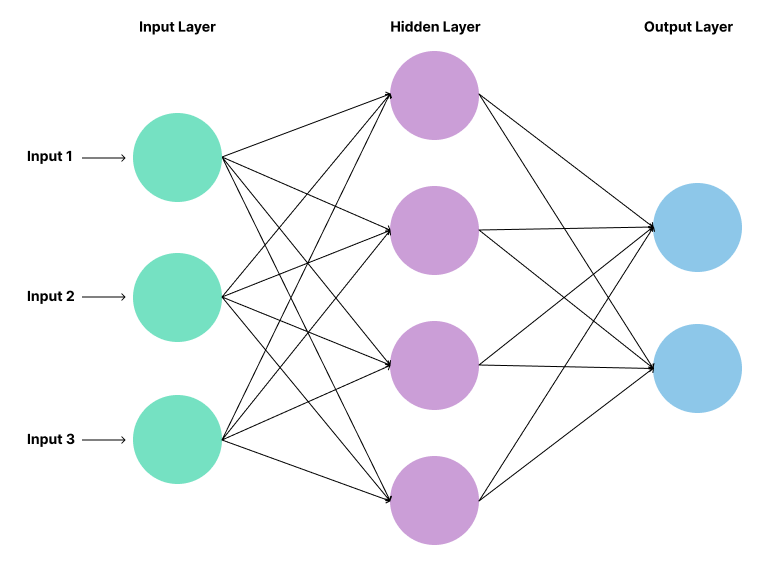
Source: Medium: Introduction to how a Multilayer Perceptron works but without complicated math
Drilling down further, there are several subsets of AI/ML, each designed to tackle different types of problems in different ways:
- Neural networks. These models mimic neural connections in the human brain. They are able to identify complex patterns in massive data sets, such as player performance, historical outcomes, or in-play metrics.
- Deep learning. A subset of neural networks, deep learning models use multiple data layers to process complex inputs. This makes them particularly effective at modeling non-linear relationships — such as predicting how multiple in-game variables combine to influence an outcome.
- Natural language processing (NLP). This is a technique that enables AI to analyze and interpret unstructured data — such as sports commentary, social media posts, or news reports. This gives AI systems the ability to gauge public sentiment and aggregate news from multiple sources, leading to better bookmaking decisions.
- Generative AI (GenAI). As the name suggests, GenAI offers the ability to generate new sports betting content — whether that’s in-game messages, images, video, or even code. Think game-changing large-language models (LLMs) like ChatGPT or text-to-image tools like Midjourney.
- Reinforcement learning. These models are adaptive and learn from feedback to improve over time. In sports betting, you can train them to fine-tune odds, optimize promotional offers, or adapt user experiences based on changing conditions or behavior.
Data infrastructure, analytics, and governance
To function effectively, AI systems must be built on robust data architecture — and underpinned by governance frameworks.
Today’s leading sports betting operators deploy modern data stacks that can collect, process, and integrate data from multiple sources in real time. This typically involves a range of technologies and processes:
- Data lake and warehouses. These provide a central repository for storing both unstructured and structured data — everything from live sports feeds and historical match statistics to user transactions and behavior data.
- ETL (extract, transform, load) pipelines. These pipelines integrate, consolidate, and prepare raw data from multiple sources. This provides a steady stream of consistent, high-quality data for ML models.
- Real-time streaming and analytics platforms. Tools like Apache Kafka, Flint, and Spark Streaming process event-driven data as it’s generated. This enables instant odds tweaking, live market monitoring, and early fraud detection.
- Data governance frameworks. Having robust governance frameworks in place ensures that data management best practices are baked into your processes and tech. In addition to improving data quality and outcomes, this helps you stay compliant in a tightly regulated iGaming industry.
Low-latency, real-time architectures
In sports betting, milliseconds can make the difference between profit and loss. Low-latency, real-time architectures ensure that updates to odds, results, or markets are delivered instantly to both users and backend systems. These architectures typically comprise the following components:
- Event-driven design. Systems respond to sporting events in real time. Every goal, foul, or substitution triggers automated updates immediately. This keeps odds, risk models, and user interfaces aligned with the current state of play.
- Microservices-based architecture. This modular approach allows different parts of the platform to be scaled and updated independently, without impacting other parts. So you can update your odds calculation engine without impacting risk management, payment processing, or the user interface.
- Real-time APIs and data streams. APIs ensure seamless data flows between external feeds, frontend apps, and backend systems. Implementing real-time data streams alongside these APIs allows platforms to process and distribute information instantly. This lays the foundation for dynamic odds and instant UI updates.
Mobile applications and UX
With most bets now placed on smartphones, mobile UX is a key differentiator. iGaming operators that get UX right will attract and retain customers seeking slick, mobile-friendly sports betting experiences.
You could have the best AI models and architecture in the industry, but if people don’t enjoy using your app, your business will struggle to compete. Here are some key factors that combine to ensure that your AI-powered features keep people coming back:
- Intuitive UI design, with simple navigation and consistent layouts
- Personalized content, delivered in a way that’s engaging, not overwhelming
- Fast, responsive performance with real-time updates
- Accessible for all people, across all types of device
The importance of responsible and secure AI in sports betting
With AI adoption accelerating, the need for its responsible usage has never been more important. This is particularly true in a high-stakes, tightly regulated industry like iGaming.
AI-powered sports betting involves handling vast volumes of user data, transaction records, and intellectual property. Operators must have robust data protection and compliance frameworks in place. Moreover, they must ensure that AI algorithms — and the outputs they generate — are fair, unbiased, and transparent.
When implementing AI sports betting, we recommend:
- Adhering to data security best practices — such as encryption, anonymization, and secure APIs — to prevent breaches
- Training algorithms on broad data sets and performing regular audits to avoid bias or unfair outcomes
- Clearly communicating how AI is used to enhance user experience, not manipulate it
- Continuously monitoring and retraining AI models over time to avoid degradation and improve reliability
- Implementing clear internal policies and procedures to ensure responsible use of AI and prevent misuse of predictive data
Top five use cases for AI-powered sports betting
We’ve covered the technical side of things. Now, let’s look at how to use AI for sports betting in practice. While the potential applications are broad and constantly evolving, here are five of the most powerful AI use cases for sports betting.
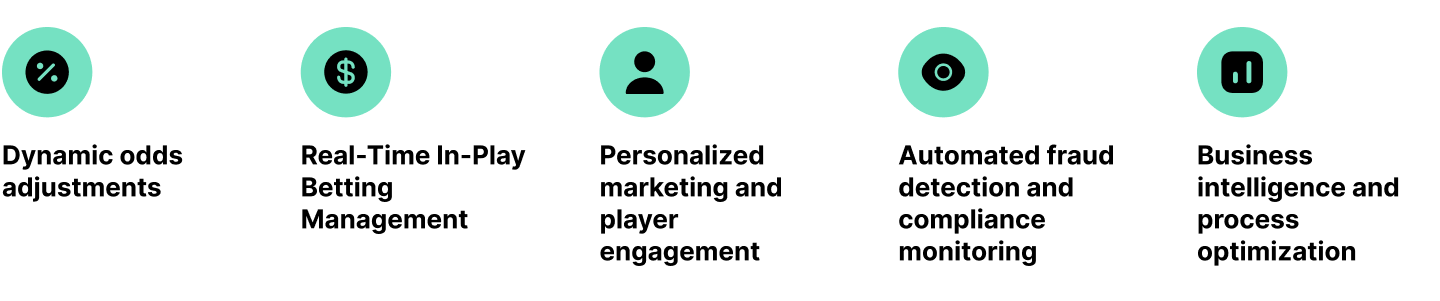
1. Dynamic odds adjustments
AI-powered odds models process real-time market data feeds and combine it with historical data and behavioral trends. This allows models to calculate highly accurate odds that reflect current in-game situations. These odds change dynamically as the game unfolds.
As a result, your business can manage risk automatically while providing fair, engaging sports betting opportunities for players.
2. Real-time in-play betting management
AI systems facilitate in-play betting, enabling your business to analyze massive data sets in real time. This includes processing live data streams on player statistics, injuries, tactical changes, and any other important metric or event.
Real-time, in-play gambling opens the door for engaging sports betting experiences. Instead of being a static, one-time process, your customers can interact dynamically with live events — and explore new markets as the game unfolds.
3. Personalized marketing and player engagement
Personalization is one of the most powerful ways you can enhance sports betting using AI. By analyzing player behavior and betting history, you can tailor the entire betting journey — from recommending new markets to delivering bespoke marketing and promotions.
AI systems allow these kinds of user-centric interactions to be delivered at scale, transforming how your business engages with customers. The result is increased customer satisfaction — and a healthier business.
4. Automated fraud detection and compliance monitoring
AI’s ability to analyze large amounts of data and spot irregularities makes it a powerful tool for fraud detection. Modern systems can analyze millions of transactions as they happen and flag potential instances of match-fixing or insider betting.
Beyond fraud detection, AI systems can help your business take a more proactive approach to compliance monitoring and governance. ML algorithms can provide real-time alerts when internal policies and procedures aren’t followed. Likewise, AI can help you uphold regulatory thresholds and responsible gambling requirements.
5. Business intelligence and process optimization
In addition to providing next-level player-facing features, AI can transform internal iGaming workflows. For example, you can use AI to automate and enhance repetitive, administrative processes — like financial reporting, compliance checks, and trading operations.
But that’s not all. AI systems can help you forecast revenue, churn rates, and the success of new campaigns by analyzing emerging trends and market behavior. The result is a more resilient and profitable business.
Intellias — an industry leader in AI-powered sports betting
For iGaming operators, adopting AI-powered sports betting is now a strategic imperative. But realizing the broad benefits that AI offers is not simple. It requires access to technical expertise spanning AI/ML, data engineering, real-time system design, UX, and compliance — expertise that most operators don’t have in-house. This is where Intellias can help.
As a leader in digital transformation and pragmatic AI adoption, we help iGaming operators harness the potential of transformative technologies to deliver tangible results. Our experts can guide you at every step of your AI journey — from developing strategies and frameworks to implementing bespoke solutions.
We can help you:
- Design and deploy high-performance, AI-powered sports betting platforms
- Implement scalable, event-driven architectures to drive dynamic sportsbook features
- Train custom ML models to predict unbiased outcomes, optimize odds, and detect fraud
- Leverage GenAI to automate content generation and power next-gen customer interactions
- Launch user-centric sports betting apps that prioritize incredible UX and personalization
Whether you’re modernizing an existing sportsbook or building a next-generation betting platform, we have the expertise and strategic vision to make it happen.
Ready to take your iGaming business to the next level? Get in touch with us today.