AI-Enabled Predictive Analytics for Supply Chain Intelligence

Intellias presents an AI-powered proof of concept (PoC) designed to demonstrate how intelligent, data-driven analytics can transform supply chain visibility and resilience. The solution showcases Intellias’ expertise in integrating AI agents into transportation management systems, enabling proactive disruption detection, accurate delivery predictions, and smarter decision-making across complex transportation networks. By leveraging this Supply Chain Intelligence Layer, Intellias highlights its leadership in developing modular, scalable AI solutions that drive innovation and operational excellence in the transportation domain.

Challenges in Supply Chain Management

In today’s hyper-connected world, global supply chains still face constant uncertainty. Incidents in ports, labor strikes, sudden policy changes, or severe weather conditions can disrupt deliveries across continents. These challenges slow down operations, increase costs, and make it harder for companies to meet customer expectations.

sun icon

Extreme weather and climate impact

Severe weather events, military tensions, and unexpected policy shifts disrupt global routes, driving logistics costs to new highs and impacting delivery reliability.

map icon

Labor and infrastructure bottlenecks

Port strikes, congestion at chokepoints, and outdated infrastructure regularly halt operations, forcing companies to constantly adjust routing and planning.

money-send icon

Soaring operational costs

Emergency rerouting and disruptions in supply chains can increase operational costs by 20–30% and reduce the accuracy of delivery predictions.

clock icon

Production and lead time delays

Inventory shortages and supply delays can extend production lead times by up to 80%, at times bringing entire operations to a standstill.

ranking icon

Customer experience and service

When delays happen, customer support spends 15% less time on value-adding tasks due to constant customer retention efforts.

Intellias Supply Chain Intelligence Layer: AI-Driven Accelerator for Predictive Supply Chain Management 

To help transportation companies navigate uncertainty across complex supply chains, Intellias has developed a Supply Chain Intelligence Layer, an AI-powered demo showcasing a modular, agent-based system for predictive supply chain management. This solution seamlessly integrates with existing Transport Management Systems, connecting diverse tracking sources and enriching them with data-driven insights from real-world events. It delivers actionable predictions, such as ETA updates, risk alerts, and disruption impact analysis, providing a real-time, intelligent view of the entire logistics landscape.

Goal

  • Deliver predictive insights based on global disruption factors such as weather, geopolitical events, labor strikes, infrastructure issues, and regulatory changes.
  • Enable proactive container tracking to minimize cold-chain disruptions, prevent goods spoilage, and reduce insurance claims or customer compensation costs.
Goal imag

Solution

  • AI-powered prediction – AI-based agents forecast delivery times and assess risk exposure by analyzing live and historical data from ports, infrastructure, and global events.
  • Customized and lightweight architecture – A modular, easily integrable layer designed for Transportation Management Systems (TMS) and tailored to specific client markets and operational needs.
  • Comprehensive tracking integration – Bridges data gaps between existing tracking systems, ensuring full visibility across seaports at pre- or post-delivery stages.
Solution image

Business Value

  • Serves as a reusable accelerator, speeding up development of AI-enhanced solutions for transportation clients
  • Integrates seamlessly with existing TMS platforms for fast adoption
  • Enhances decision-making with agentic AI and contextual reasoning
  • Reduces delivery uncertainty and improves operational resilience through predictive visibility
  • Supports more efficient and sustainable operations with proactive planning and early disruption detection
Business Value image
Connect with us to explore how AI-driven predictive analytics can empower smarter and more resilient supply chain management

Use Case Scenario: AI-Driven Delay Prediction on a High-Risk Shipping Route

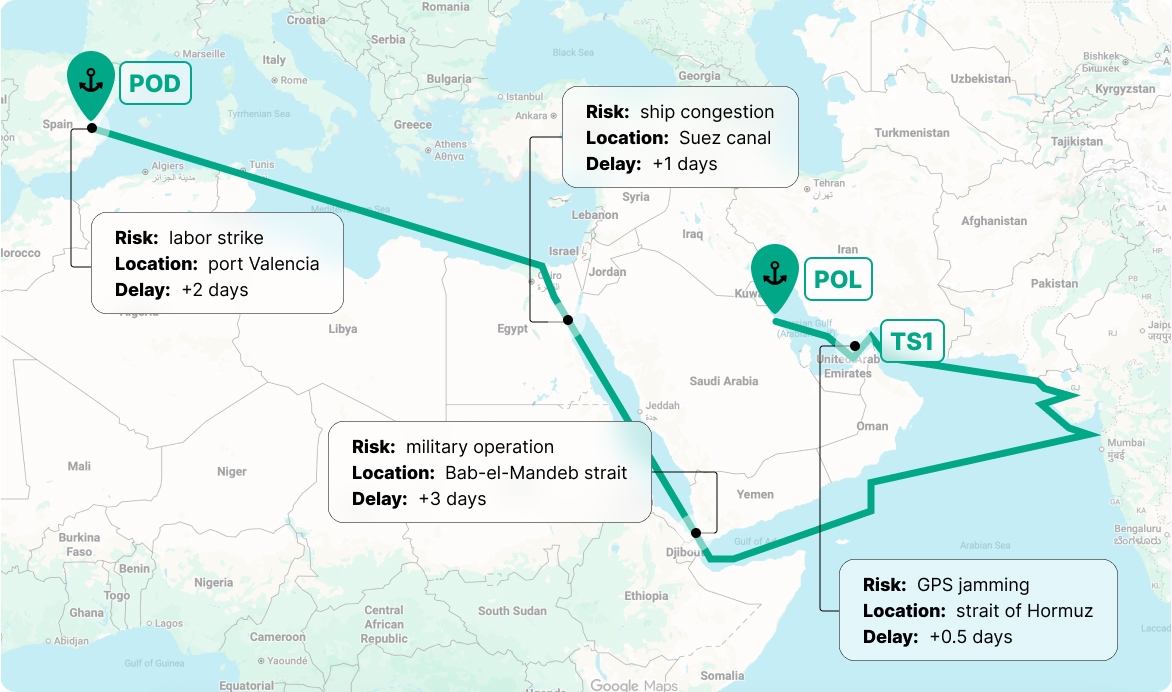
To demonstrate the real-world value of the Intellias Supply Chain Intelligence Layer, we created a custom graphic showing how the applied AI model analyzes shipment data along a long-distance maritime route from Al Jubail to Valencia, spanning approximately 18,700 nautical miles over a typical 46-day journey.
  • Port of Loading: AI Jubail
  • Distance: 18700 nautical miles
  • Port of Discharge: Valencia
  • Duration: 46 days
shipping route illustration

Objective

Validate the AI system’s ability to identify potential delay factors using historical and contextual data across multiple disruption categories.

Process

Data acquisition:

Collected import/export records including Bill of Lading IDs, carrier data, cargo details, and transaction timestamps.

Route selection:

Chose port pairs with frequent activity and known exposure to external risks such as weather, political instability, or congested bottlenecks.

Container sampling:

Extracted representative container journeys for analysis.

Anomaly detection:

Compared expected and actual delivery times to pinpoint delayed shipments.

Root-cause identification:
AI agents correlated delays with global events and external disruptions such as strikes, congestion, or GPS interference.

Reasoning and prediction

The AI system successfully identified multiple
disruption factors influencing the route:

  • Military activity near the Bab-el-Mandeb Strait → +3 days delay
  • Labor strike at Port Valencia → +2 days delay
  • GPS jamming around the Strait of Hormuz → +0.5 days delay
  • Vessel congestion in the Suez Canal → +1 day delay

Results

The PoC demonstrated the ability to accurately detect and explain the causes behind delivery-time deviations using multi-source data fusion and AI reasoning. This approach provides logistics and transportation companies with a reliable method to:
  • Predict route-specific
    risks in advance
  • Optimize scheduling
    and resource allocation
  • Strengthen resilience
    against operational disruptions

Experts

Michaela Paul image
Michaela Paul

Head of Transportation

Volodymyr Zavadko
Volodymyr Zavadko

Delivery Director, Transportation

Andriy Korpan image
Andriy Korpan

Delivery Manager, Transportation

Yevgen Kolesnichenko image
Yevgen Kolesnichenko

Senior NodeJS developer, Transportation

How can we help you?

Get in touch with us. We'd love to hear from you.

Thank you for your message.
We will get back to you shortly.