Digital Healthcare Solutions
Intellias delivers digital health solutions for providers and medical companies to make care accessible, experiences smoother, and costs manageable. We build digital solutions for healthcare across clinical systems, diagnostic tools, payment platforms, and regulatory workflows, so you can focus on patients, medical products, and services.
Trusted by leading companies worldwide











Digital healthcare technology solutions
From innovative digital health solutions and AI healthcare platforms to clinical ops automation and legacy modernization, Intellias delivers systems used in day-to-day healthcare industry operations.

Custom software for automating, managing, and protecting patient information across clinical flows. We build a digital infrastructure that connects eHealth services, lab systems, medical devices, and billing tools through compliant data exchange.


AI and ML-powered systems for medical data analysis that personalize patient care, improve diagnostic accuracy, and automate clinical decision support. Our AI healthcare platforms reduce bias, improve access, and speed up care-related operations.

Advanced software and firmware, along with UX design for remote monitoring devices, real-time vitals tracking, and frictionless equipment management. We handle IoT integration for diagnostic and therapeutic equipment across the healthcare ecosystem.

Custom software and third-party platform integration that support patient-to-provider data exchange, personalized care management, and monitoring. Built for clinics and preventive healthcare programs that need a scalable engagement infrastructure.

Compliant, secure-by-design solutions. We deliver verifiable safety, robust security, auditability, and reliability across FDA, HIPAA, HITRUST, CLIA, NIST, SOC 2, ISO 27001, and ISO 9001 for both clinical and corporate healthcare environments.

Data-intensive solutions for healthcare decision support, combining machine learning algorithms, data science, and bioinformatics. They help deliver personalized treatment, preventive care, and precision medicine, integrating genetic and clinical data.


Purpose-fit solutions for point-of-care communication, secure data exchange, and monitoring on mobile devices. Built for healthcare facilities and clinical teams needing reliable, HIPAA-compliant mHealth apps for patients and providers.
We’re a reliable partner for clients, backed by strong partnerships
Our technology expertise, market insights, digital acceleration tools and solutions for digital health allow us to deliver results for the healthcare industry, building lasting trust with our clients every step of the way.














Our experts

Global Head of HCLS, Med Devices & Strategic Partnerships
Roy is the Global Head of Healthcare & Life Sciences at Intellias, where he leads global strategy, growth, and innovation across payer, provider, pharmaceutical, and medical technology sectors. He is responsible for aligning digital engineering, data, and AI capabilities with measurable business and clinical outcomes, helping organizations reimagine care delivery and patient engagement. As the P&L leader for the vertical, Roy builds value-based partnerships with industry executives and guides clients in translating technology investments into scalable, ROI-driven transformation.
With more than 25 years of leadership experience and over 15 years building and scaling global teams, Roy defines and executes Intellias’ Healthcare & Life Sciences go-to-market strategy across cloud, interoperability, automation, and Generative AI. He works closely with R&D, Centers of Excellence, and delivery organizations worldwide to create next-generation digital health and connected care solutions.
Senior Client Executive Director, Digital, Healthcare
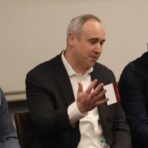
Chris Clark is a Senior Client Executive Director for USA Healthcare & Life Sciences. In these industries, he guides and assists Intellias clients to develop and launch world-leading digital products, leveraging our advanced engineering capabilities and AI. Chris brings over 20 years of experience enabling the bleeding edge of digital innovation for healthcare and life sciences, building modern software, digital platforms, data platforms, AI/ML solutions, designs, and product strategy. Chris obtained his MBA from Vanderbilt University, and his BBA from The University of Dayton. Chris lives in the western suburbs of Chicago.

Senior Director, Medical Devices, Pharma & HCLS
Tom is a Business Development Executive at Intellias, combining strong technical aptitude with strategic business insight to help clients accelerate their organizational success. He partners with customers to identify effective business strategies and scalable technology solutions that drive measurable outcomes and long-term value.
Tom is responsible for expanding business development practices, establishing strategic partnerships, and strengthening Intellias’ trusted relationships with clients. He leads with empathy and a results-oriented mindset, ensuring successful project delivery while fostering sustainable, long-term collaborations.
With more than two decades of experience in business development and leadership, Tom has consistently contributed to company growth by mentoring teams, supporting clients, and shaping a culture built on trust, excellence, and partnership. His commitment to delivering tangible results has helped build a strong portfolio of satisfied clients and enduring business relationships.
Our insights and perspectives








FAQs about our digital health solutions
Security in digital health software is non-negotiable. Reliable digital health solutions are built on a secure-by-design architecture that incorporates HIPAA-compliant data handling, end-to-end encryption, role-based access controls, and continuous vulnerability testing. At Intellias, security is embedded into the engineering process from day one. Every platform we build includes verifiable audit trails, compliant data storage practices, and regular penetration testing.
Intellias engineers digital healthcare technology solutions that comply with HIPAA, FDA regulations for medical device software, HITRUST, CLIA, SOC 2, ISO 27001, and ISO 9001. Our teams have direct experience with regulatory documentation requirements, FDA software lifecycle guidance, and the audit-readiness demands of enterprise healthcare providers.
Modern digital health platforms address interoperability through standards-based FHIR solutions, HL7 messaging protocols, and DICOM integrations that allow secure, structured data exchange across disparate health systems. Intellias builds health information exchange (HIE) platforms and API middleware that connect EHR systems, laboratories, pharmacy networks, and payer databases for care coordination that patients and providers need.
Intellias builds AI/ML for digital health across the full stack: data governance, model training on healthcare-specific datasets, explainable AI deployment, and ongoing monitoring. Clinical validation and bias reduction are built into the engineering process. The result is models that hold up in regulated environments and support real clinical decisions.
As our own experience in digital health software development shows, most digital health projects don’t fail on code quality; they fail on domain gaps that surface during integration, compliance review, or clinical validation. The right partner has seen those inflection points before: FHIR and EHR complexity, HIPAA and FDA requirements that reshape architecture decisions, AI models that need clinical defensibility, not just accuracy metrics. General software capability gets you to the first obstacle. Healthcare engineering depth gets you past it.