From engine powers to AI-powered engineering: that’s how automotive industry evolves in recent years. For more than a century, engines have defined the pace of automotive evolution. Today, a different kind of engine is accelerating the industry – Artificial Intelligence. Its influence extends far beyond intelligent features inside vehicles. AI is changing how automotive software is specified, designed, developed, tested, and validated.
The shift to software-defined vehicles has made software integral to vehicle functionality and customer experience. Shared compute platforms, connected services, and over-the-air updates introduce more software dependencies and more frequent change. Traditional engineering approaches inherited from manufacturing lines remain unrelevant, and automakers are looking for ways to handle growing software complexity without extending development schedules or compromising quality.
According to Capgemini Research Institute’s October 2026 study, 68% of surveyed automotive organizations are using or piloting agentic AI in product development, while only 5% report fully mature AI governance. The research, covering 800 senior executives in 12 countries, also found that a leading group of AI adopters reported 17% faster development cycles and 19% engineering-productivity gains.
This is the defining question for AI in automotive software development: how can engineers capture the speed of AI while preserving the traceability, safety, and accountability that vehicle programs require?
How AI is reshaping automotive software engineering
AI in automotive has two related but distinct roles. AI in the vehicle empowers capabilities such as advanced driver assistance, intelligent navigation, conversational interfaces, and predictive diagnostics. AI in automotive engineering changes the development process itself: analyzing specifications, evaluating designs, generating code, developing tests, interpreting results, and coordinating engineering tools.
This second role is becoming essential as automotive platforms evolve. A single software stack can support several vehicle models, configurations, and markets, with changes across electronic control units (ECUs), middleware, applications, and cloud services. Requirements written by different teams must align with implementation details and with verification evidence. A small inconsistency discovered late can trigger expensive rework.
McKinsey’s analysis of generative AI in automotive software development describes the opportunity to integrate generative AI into software operating models while recognizing the challenges of nondeterministic AI outputs and safety-critical systems. In practice, the evolution starts with AI-assisted software development – task-level assistance with coding, documentation, and reviews, progressing toward AI agents that understand engineering context and perform coordinated tasks.
Unlike a generic coding assistant, an automotive engineering agent must work with domain-specific data: software and system requirements, architectural decisions, defect histories, test patterns, hardware constraints, and standards-based quality gates. Retrieval-augmented generation (RAG), knowledge graphs, and tool integrations make this context accessible. For OEMs and Tier 1 suppliers, successful adoption depends as much on the quality of their engineering information and processes as on the language model they select.
AI across the automotive software development lifecycle
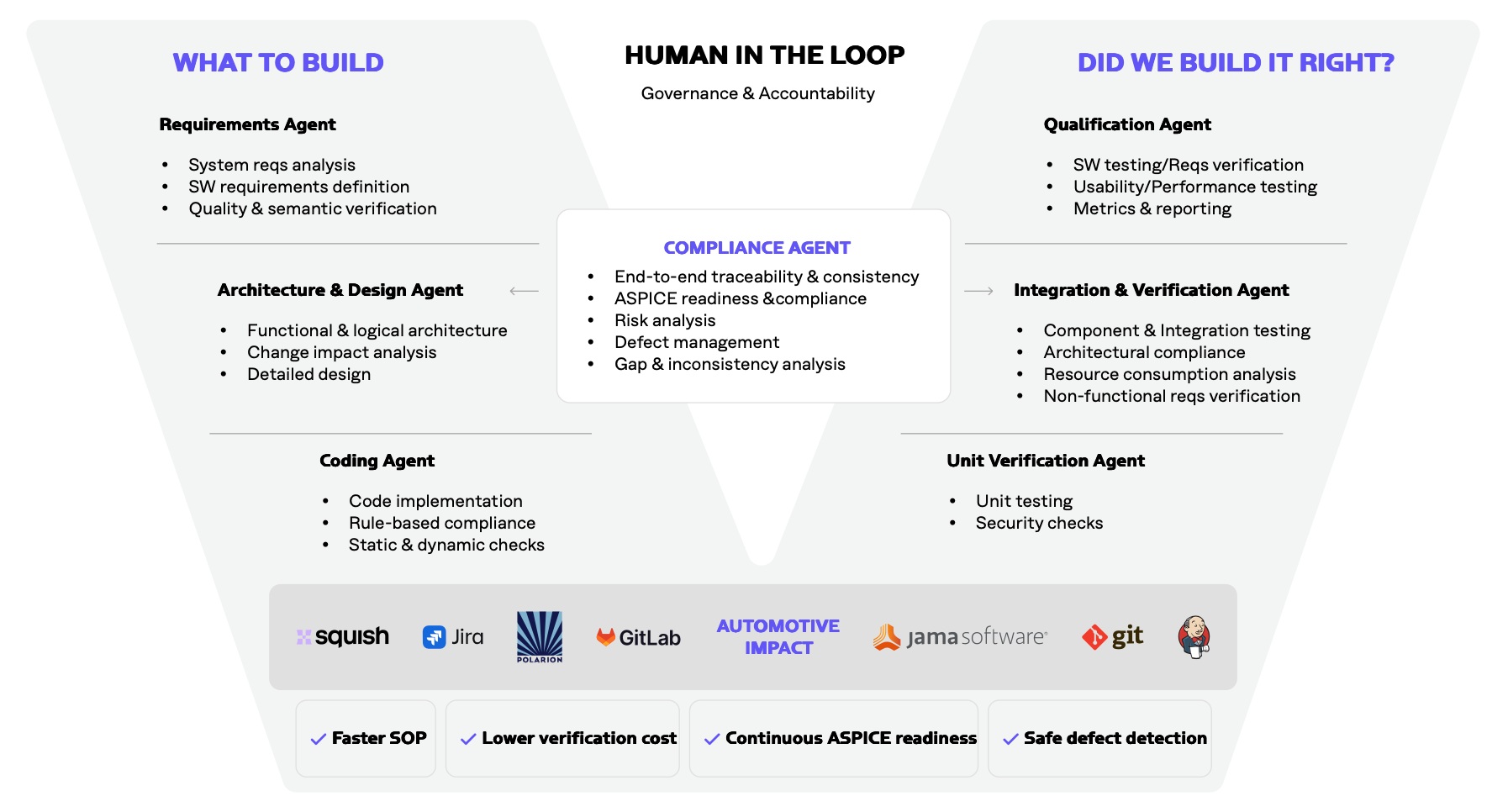
The Automotive SPICE (ASPICE) V-model offers a practical way to understand how generative AI in automotive can support both sides of the engineering lifecycle. On the development side, AI helps move from requirements through architecture to implementation. On the verification side, it supports unit tests, integration, qualification, and the evidence that connects each test to the original intent. Across these stages, human engineers retain authority over acceptance and release decisions.
Al automation for ASPICE V-Model
AI-Powered requirements analysis and engineering
Poorly formulated requirements entail uncertainty through every downstream activity. Large language models can examine natural-language specifications, identify ambiguous terminology, suggest missing acceptance criteria, detect potential duplicates, and compare related system and software requirements. They can also propose links between requirements and test scenarios, making gaps visible before test implementation begins.
At Intellias, the V-Tools approach to AI-powered automotive testing includes a Requirements Agent that checks whether requirements are testable and consistent with project context. Engineers review its findings and refine specifications iteratively; the agent can propose a traceability matrix linking reviewed requirements with planned verification. This is an example of AI in automotive software helping prevent downstream errors rather than merely producing documentation faster.
A related application addresses the challenge of finding dependable information in complex technical ecosystems. For a mapping provider, Intellias developed generative AI and knowledge graph services that combine more than 5,000 pages of documentation with a graph of over 4,000 connected map entities. Engineers can ask specification questions, investigate relationships, and validate map structures using document-grounded answers. This is a production-ready MVP and an example of how reliable context retrieval supports engineering analysis.
AI-Assisted software architecture and design
Turning requirements into an automotive architecture involves trade-offs across functions, software components, compute resources, interfaces, and safety boundaries. AI agents can draft candidate design artifacts, check for inconsistencies, compare architectural versions, and highlight the effect of a changed requirement on dependent components.
Intellias V-Tools framework maps an Architecture & Design Agent to functional and logical architecture, detailed design, and change-impact analysis. Its proposed outputs remain inputs for engineering judgment, not automatically approved designs. An architect still decides whether an interface, allocation, timing constraint, or failure-handling strategy is appropriate for the target hardware and safety concept.
The advantage is earlier visibility. Instead of discovering a mismatch during integration, teams can flag suspected inconsistencies while requirements and design decisions are still being reviewed. The value becomes greater when architecture tools, requirements repositories, and test management platforms share up-to-date context rather than exchanging static documents.
AI-Driven coding and software integration
Coding assistants can complete functions, explain unfamiliar code, generate unit-test scaffolds, and support refactoring. More advanced agents coordinate task planning, implementation, pull-request review, and test feedback. Yet AI automotive software development has constraints that general-purpose applications may not: memory budgets, real-time behavior, hardware interfaces, platform-specific libraries, cybersecurity rules, and safety-related coding practices.
A specific example is Intellias AI-based closed-loop engineering initiative for a map compiler. The team built a domain-aware RAG pipeline using format specifications, an existing codebase, and domain libraries, then coordinated planning, implementation, and review agents. The resulting proof of concept was delivered in three weeks and generated a compiler module capable of producing a real map in NDS format. Intellias estimates that the approach could reduce development effort by 40% for onboarding new geospatial inputs; that figure is a project estimate, not a validated industry benchmark.
Importantly, the final automated Validation Agent was outside the proof of concept’s scope. This distinction illustrates a practical implementation principle: agents can automate a meaningful portion of development without claiming autonomous, end-to-end production readiness. Human review, conventional build and test pipelines, static analysis, and project-specific acceptance criteria continue to determine whether generated code is usable.
AI-Powered automotive software testing and validation
AI in software testing is moving beyond scripted interactions toward systems that can interpret requirements, draft scenarios, inspect visual outcomes, and assist defect triage. AI can generate candidate test cases, identify possible coverage gaps, convert approved scenarios into executable scripts, and analyze test results. Vision-language models (VLMs) can examine what a digital cockpit actually displays: map overlays, interface states, loading indicators, or animations rather than relying exclusively on application-level selectors.
AI-powered testing and validation workflow for software-defined vehicles showcases scenarios in natural language, while an AI-supported testing environment uses existing repository patterns to draft reviewable pytest tests. VLMs then support visual verification and provide artifacts that engineers can inspect. The integration matters: a generated test has little value if it cannot be tied to a requirement, reproduced, or reviewed after failure.
Another specific example is Intellias Physical Performance Analyzer, which measures infotainment response times from recorded visual and audio events. A tester might define the beginning as a door opening and the endpoint as the navigation map becoming fully visible. The system combines a VLM for visual events, audio classification, and an LLM that translates descriptions into suitable model inputs. It then reports timestamps and elapsed time rather than relying on stopwatch reactions.
In the published test configuration, a coarse-to-fine frame search reduced VLM calls from approximately 1,800 to 100 per minute of video, about 95% fewer model calls than exhaustive frame-by-frame checking. This is a measure of processing demand for that scenario, not a claim of 95% less overall testing effort. It shows how purpose-built AI orchestration can make repeatable performance measurements more efficient while keeping engineering review in place.
AI-Enabled HIL testing and in-vehicle validation
Software-in-the-loop and virtual environments offer scale and fast feedback, but automotive software ultimately has to interact with actual hardware. Timing behavior, display rendering, peripheral interfaces, network traffic, power states, and integration issues may look different on a bench or in a vehicle than they do in simulation.
AI-assisted hardware-in-the-loop (HIL) and in-vehicle workflows can connect generated test procedures with physical ECUs, head units, instrument clusters, and pre-series prototypes. Video analysis can identify interface anomalies, while telemetry analysis helps engineers correlate observed failures with system events. Feedback can then inform defect reports, regression tests, and subsequent engineering iterations.
Intellias AI Engineering and Testing Garage in Ingolstadt connects remotely accessible test benches and secure prototype areas with an AI R&D Lab, where AI-based verification frameworks can be exercised against real hardware. These environments do not replace established HIL or vehicle testing; they help bring AI automation into the conditions where automotive software must actually operate.
From AI-generated code to human-validated outcomes
Generating more software artifacts faster does not automatically mean delivering better automotive software. An AI model can produce plausible but incorrect requirements, code that compiles but violates runtime constraints, or tests that pass without checking the intended behavior. Because model outputs are probabilistic, repeating the same task can also produce different results. In safety-related systems, those weaknesses cannot be treated as minor inconveniences.
The 2025 DORA research on AI-assisted software development, based on nearly 5,000 technology professionals across industries, found that 90% used AI at work and more than 80% perceived productivity improvements. It also observed a relationship between higher AI adoption and software delivery instability. Those cross-industry findings do not measure automotive outcomes, but they reinforce an important lesson: faster production of changes can expose weak testing, integration, and feedback processes.
Automotive engineering therefore needs an evidence-driven workflow. Requirements and designs must be version-controlled; generated code must pass deterministic checks; tests must be traceable to approved requirements; and failures must be investigated independently. Human-in-the-loop governance means engineers can inspect AI reasoning and supporting evidence, reject questionable results, and formally approve safety- or release-relevant outcomes. A language model’s explanation is not, by itself, proof of correctness.
Automotive SPICE provides a process-assessment framework, while ISO 26262 and ISO/SAE 21434 address functional safety and road-vehicle cybersecurity respectively. AI can help prepare, organize, and review evidence relevant to these obligations, but using an AI agent does not itself establish conformity or certification.
The Intellias V-Tools concept positions compliance and traceability across the V-model, alongside stage-specific development and verification agents and engineer-controlled approval gates. The important engineering principle is not that AI bypasses existing controls, but that AI-generated artifacts must pass through those controls. Mature AI in automotive engineering is measured by validated outcomes, not output volume.
Modular AI accelerators across the automotive SDLC
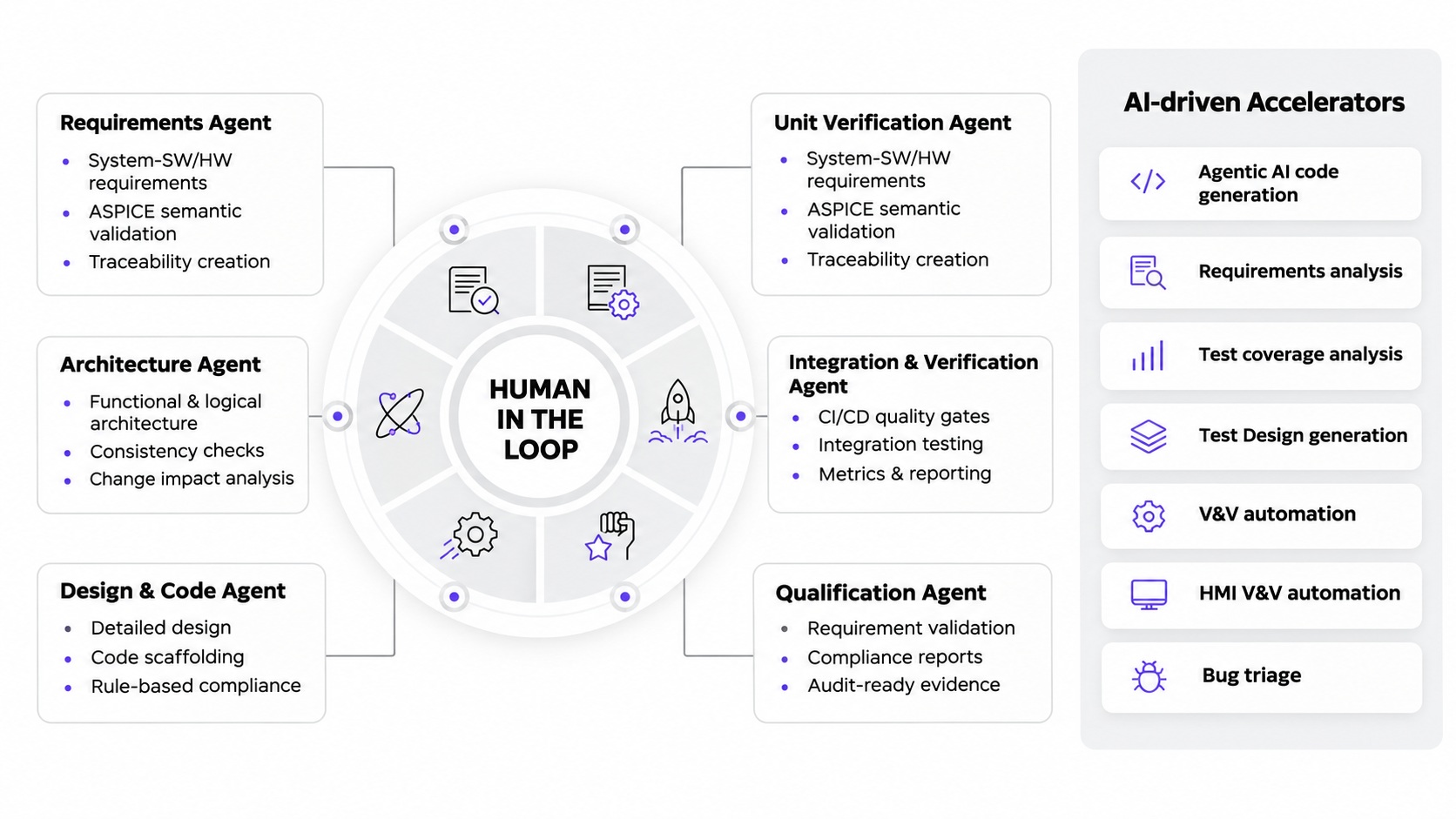
Intellias integrates AI-driven accelerators into existing automotive engineering toolchains, including Jira, Jama Software, MATLAB, and Vector tools, without replacing established workflows. Built as modular, task-specific AI agents, these accelerators support requirements analysis, architecture and design, code generation, unit verification, integration testing, and validation across the ASPICE V-model.
Our approach supports two integration modes. Static data mode uses RAG to analyze existing requirements, specifications, and design documents, generating insights and engineering artifacts without infrastructure changes. Dynamic data mode, currently being developed, connects AI agents to engineering tools through Model Context Protocol (MCP), enabling access to live project data and increasingly interconnected SDLC workflows.
Rather than relying on a monolithic AI platform, Intellias combines specialized agents that can be adapted, integrated, and upgraded independently. This modular architecture enables incremental AI adoption while preserving existing engineering processes, quality gates, and tool investments. Human-in-the-loop validation remains central: engineers review and approve AI-generated outputs to maintain traceability, quality, and accountability throughout the development lifecycle.
AI for every stage of your SDLC
From AI assistants to agentic automotive SDLC
The transition toward agentic AI in automotive is gradual. Rather than introducing one autonomous platform that attempts to replace existing practices, organizations can integrate bounded capabilities into established engineering environments, measure their results, and extend automation as confidence grows. The Intellias Mobility AI maturity framework describes three stages beyond traditional engineering.
Automotive AI engineering maturity model
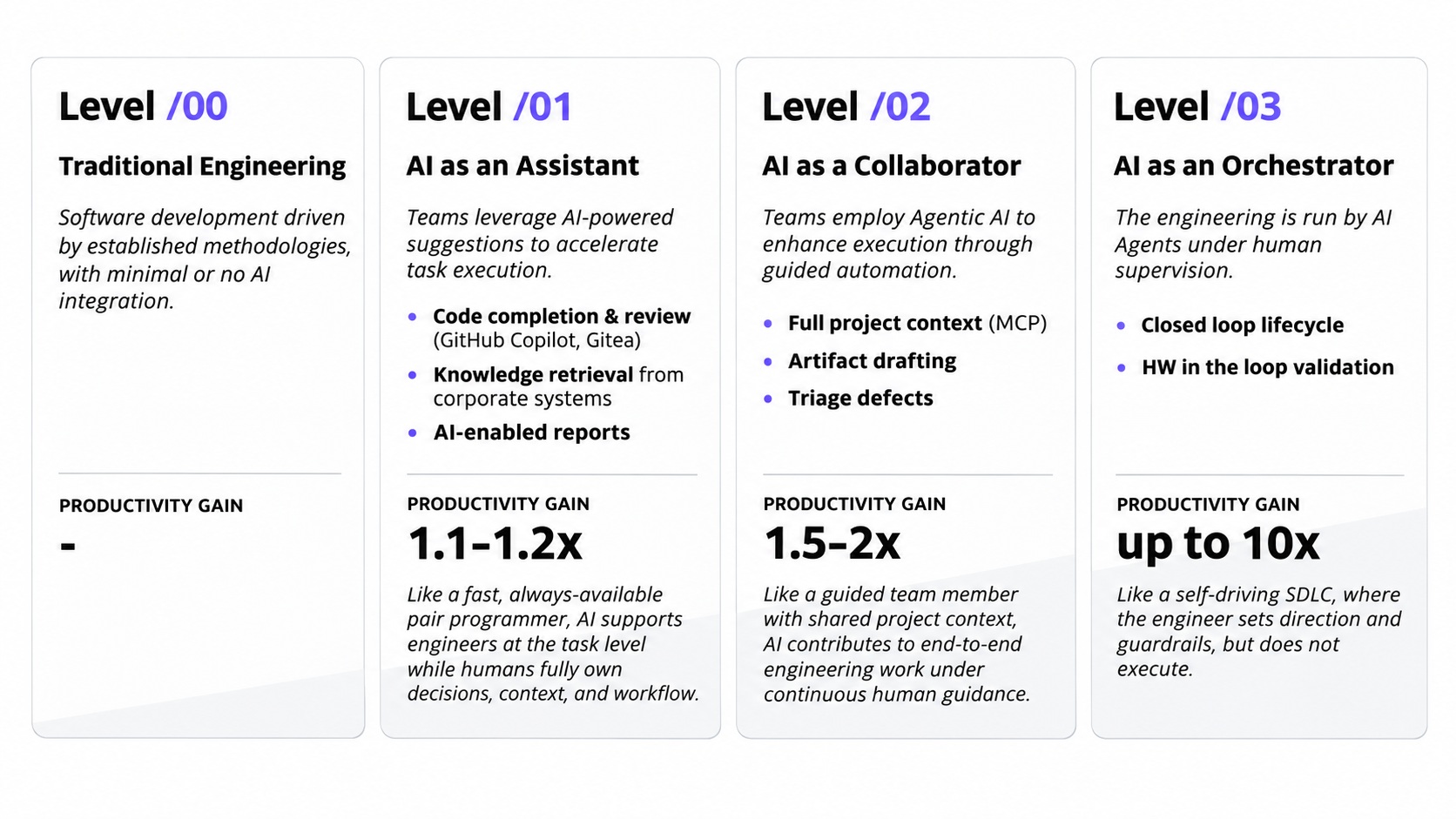
AI as an Assistant
At the first stage, AI supports individual activities: code completion, document drafting, knowledge retrieval, code review, and engineering reports. The engineer owns the workflow and every decision. This stage typically requires fewer process changes, making it a practical entry point for teams that need to establish measurable value and confidence before expanding their use of AI.
AI as a Collaborator
Context-aware agents can undertake bounded tasks such as analyzing requirements, drafting tests, preparing design documentation, or proposing defect fixes. With retrieval from project-specific repositories, they can work from approved specifications and reuse established patterns instead of relying on generic model knowledge. Engineers still guide the activity, evaluate intermediate outputs, and accept the deliverables.
At this level, composable agents are particularly useful. A requirements agent, test-design agent, and code-review agent can be improved or replaced independently. Intellias’ modular V-Tools approach reflects this philosophy, with planned and implemented capabilities mapped to different stages of the automotive V-model.
AI as an Orchestrator
The longer-term goal is a connected engineering loop. Requirements changes could trigger impact analysis, updates to proposed tests, new code tasks, CI/CD checks, and verification feedback, with an engineer approving critical transitions. RAG provides domain context; Model Context Protocol (MCP) integrations can connect agents with lifecycle management, source control, and testing tools; quality gates restrict what is allowed to progress.
A related example of governed orchestration is IntelliSpec, a broad agentic SDLC platform that coordinates targeted specification and execution agents, maintains traceable artifacts, and uses human sign-off gates. IntelliSpec illustrates the wider architectural principle of connecting AI-assisted engineering activities with transparent approvals and auditable outputs.
Fully orchestrated automotive SDLC execution remains an evolving engineering target. The Intellias presentation distinguishes production-stage static RAG workflows, developing dynamic MCP integrations, and more ambitious agentic, hardware-connected loops on the roadmap. That distinction matters: maturity should be demonstrated through actual deployment, measurable verification results, and governance readiness.
The future of automotive engineering is AI-accelerated, yet human-validated
AI is becoming an important capability throughout the automotive software lifecycle, not only in coding, but in requirements engineering, architecture, integration, testing, and validation. The greatest potential emerges when these activities become connected, allowing project context, quality findings, and verification evidence to move more consistently between engineering stages.
For OEMs, Tier 1 suppliers, and mobility technology partners, the opportunity is to shorten feedback cycles, identify inconsistencies earlier, and direct engineering capacity toward decisions that require domain knowledge. Yet accelerating a workflow is valuable only if its results remain reviewable, reproducible, and appropriate for the vehicle system being developed.
The future of AI in automotive software development will not be defined by how much code agents can generate without people. It will be defined by how effectively AI-powered workflows and experienced engineers collaborate to produce reliable, traceable, and thoroughly validated software. The strongest automotive organizations will be those that combine AI acceleration with engineering discipline—not those that trade one for the other.