Automotive software development has a paradox at its core. Vehicles are growing more complex – more software, more sensors, more interdependencies – yet the windows for validation are getting shorter. To close this “reality gap,” the industry needs innovation labs where AI models and frameworks are validated against physical hardware in real-time.
OEMs and their engineering partners are under pressure to deliver top-notch software quality, faster, within more efficient timeframes and at lower costs, while working with prototype hardware that is expensive, security-sensitive, and physically constrained.
The answer most organizations reach for is more automation and adoption of innovations. But automation built on top of simulated environments still leaves a gap: sooner or later, the software has to run on real hardware, in real conditions. The gap between simulation and reality tends to surface problems at the worst possible time.
The question worth asking is not just how to automate more – but where that automation should live, and what kind of infrastructure it needs to be credible.
Empowering engineering collaboration
In automotive engineering, hardware resources and development teams are often distributed across the globe. For large-scale OEMs and Tier 1 partners, managing access to physical test benches (head units, clusters, ECUs) while maintaining software version parity across different regions is an immense task.
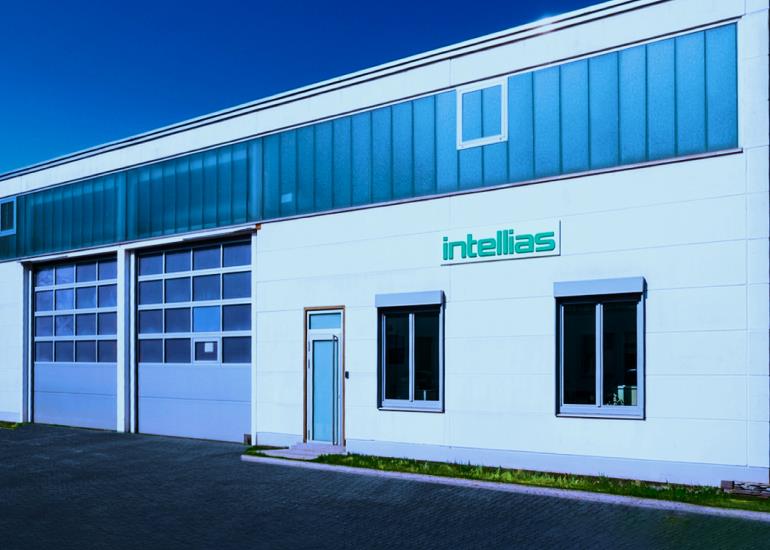
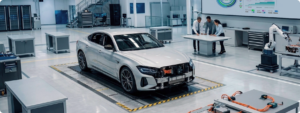
Intellias addresses this through a dedicated Engineering Garage – a TISAX Acceptance Level 3-certified facility in Ingolstadt with a laboratory housing dozens of benches and specialized prototype vehicle areas, maintained at 95% uptime. With secure remote access via two independent networks, hardware becomes a resource that engineering teams at Intellias and OEM side can update and monitor from anywhere.
In this setup, the ability to interact with hardware depends entirely on a stable network connection rather than an engineer’s physical proximity to the lab. However, simply having remote access is not enough to stay competitive. To meet market demands for faster development cycles, extended testing capabilities, and cost-efficiency without compromising safety, the industry needs to rethink its entire engineering approach.
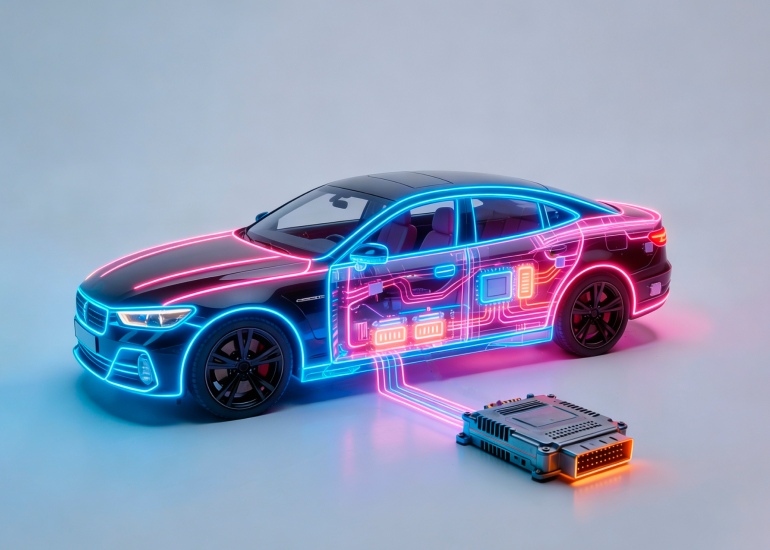
Operating within the Engineering Garage, the AI R&D Lab connects physical infrastructure with intelligent automation and AI validation capabilities – allowing AI frameworks to be tested and refined under real-world conditions, benchmarked against the expected behavior described in the requirements and not simulations alone.
What AI actually does in an AI R&D Lab
Automating the V-Model end-to-end is the one of the cornerstones of Intellias’ AI strategy for automotive engineering – and it sets the approach apart from the isolated, single-purpose tools that dominate the industry. A dedicated Intellias team is developing a framework of composable AI agents that address every phase of the V-Model – from requirements generation to test implementation and acceptance phase, delegating routine tasks a to AI and leaving critical engineering decisions under human control.
Here are examples of AI frameworks and use cases that, through refinement on real hardware in our lab, are already delivering structural advantages:
- Image and video analysis. AI and Vision-Language Models address the manual bottleneck of visual inspection directly. By analyzing camera feeds, these frameworks identify software bugs, rendering artifacts, and interface latency that previously required manual review. A key example is the Verification & Validation Accelerator – an AI-powered platform Intellias presented at CES 2026 that acts as a cognitive twin of a test engineer, generating detailed reports so engineers can focus on analysis rather than observation.
- AI-driven in-vehicle testing assistants. This use case fundamentally changes the economics of in-vehicle testing. Traditionally, this requires a tandem – a driver-tester and a test engineer to execute test scenarios and monitor telemetry. By delegating the assistant’s work to an AI system that launches scripts and monitors telemetry, the tandem can be twice as productive by testing multiple vehicles simultaneously while keeping a human in the loop. Beyond doubling throughput, this enables testing operations to run 24/7, significantly increasing cost-efficiency.
- Automating the V-Model loop. We use AI to bridge the gap between design and validation by generating test cases directly from requirements and, conversely, reverse-mapping existing test documentation into formal requirements. This removes the manual overhead that often leads to documentation drift in complex projects.
As part of the company’s broader AI strategy, these frameworks are designed to be available not only for our internal teams but also for our clients and their partners, ensuring that the innovations we prove in the lab can be seamlessly integrated into their production cycles.
Testing on real hardware changes what’s possible
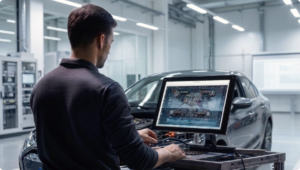
There is a meaningful difference between testing an AI solution in a controlled software environment and validating it on the hardware it will actually interact with. The approach provided by AI R&D Lab is designed specifically to close that gap.
Testing AI tooling against real hardware and inside actual vehicles replicates validation scenarios that simulation alone cannot cover. This matters for development speed: when a new AI-driven approach is validated directly on end-user hardware, the feedback loop compresses from months to days. Clients can evaluate behavior against real-world conditions and decide on adoption based on actual evidence rather than projected performance.
One hardware demo worth thousands of virtual tests
There is no shortage of AI concepts and virtual simulations in the automotive world. However, the real challenge often lies in moving these ideas from a slide deck to actual pre-series hardware.
Spaces like Intellias Engineering Garage and AI R&D Lab in Ingolstadt provide a practical environment for this transition – a working facility where AI-driven PoCs become production-grade tools through iterative testing on real ECUs and vehicles. This is where strategy meets hardware: the structured AI methodology Intellias applies across the SDLC finds its validation in the physical constraints of real automotive electronics.
The direction is clear. As the number of AI projects grows, the lab provides the infrastructure to move them from concept to validated framework faster than would be possible in a purely simulated environment. For clients and their Tier 1 partners, the gap between “exploring AI” and “tested on your hardware” is getting shorter.