Automotive Software Testing and Validation Hub
Bridging the gap between simulation and real-world SDV validation with agentic AI automotive software testing on physical ECUs, HIL setups, and pre-series vehicles in TISAX AL3-certified test infrastructure
Intellias has built an automotive software testing and validation hub for OEMs and Tier-1 suppliers, covering embedded software validation from software-in-the-loop (SIL) and software integration testing to hardware-in-the-loop (HIL) benches and pre-series vehicle prototypes.
The automotive software testing hub uses AI testing agents to automate test design, execution, log analysis, and defect triage across the ASPICE V-model, with every result reviewed and signed off by senior engineers. Physical validation takes place in TISAX Assessment Level 3-certified Engineering Garages in Ingolstadt and Wolfsburg, providing 120 test benches and 16 secure prototype slots.
Challenges of software testing in the automotive industry
The transition to SDV has consolidated compute resources and reduced ECU count, but significantly increased software complexity. A single software platform must now serve multiple vehicle lines, regions, and functional variants simultaneously. Software testing in the automotive domain now has to cover hundreds of variants, OTA releases and mixed-criticality ECUs, and most of that work can’t wait for a physical prototype.
To meet consumer expectations, OEMs and Tier 1 suppliers face unprecedented release pressures.

Consumers evaluate vehicles based on HMI/IVI experience, seamless mobile integration, and active connectivity rather than traditional mechanical performance.

Quarterly updates are the baseline, with monthly and weekly over-the-air (OTA) deployments on the horizon, which makes OTA testing and regression testing a continuous activity, not a release gate.

Physical pre-series prototypes remain scarce, cost-prohibitive, and highly confidential, creating severe hardware access constraints for distributed teams.
AI agents across the V-model:
from SIL to HIL testing
Intellias replaces isolated QA tools with a unified framework of AI agents that automate repetitive verification tasks (log analysis, test design and execution) across every stage of the V-model for SDV validation, maintaining Human-in-the-Loop oversight.
Intellias AI-enabled
automotive accelerators
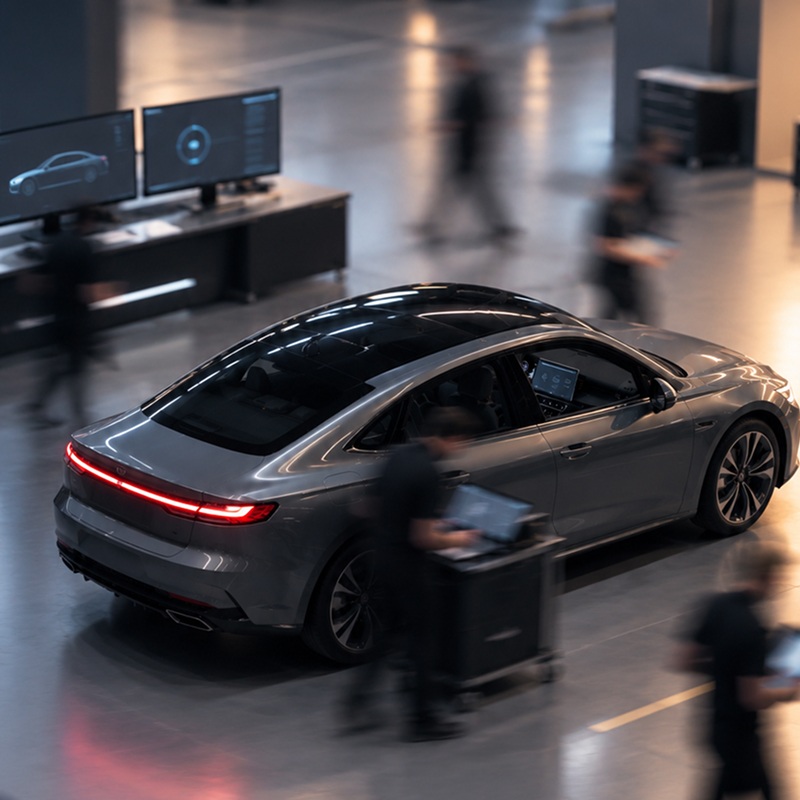
Automates HMI and IVI validation. Uses multi-modal Vision-Language Models (VLMs) and three-source element detection to perform true visual verification and generate executable pytest suites.
Business value:
- Delivers 2–4x faster test execution with 95% visual accuracy
- Cuts new OEM onboarding time by 40–60% through cross-brand pattern reuse
- Reduces manual test hours by 50–70%.
- Fully automates report generation
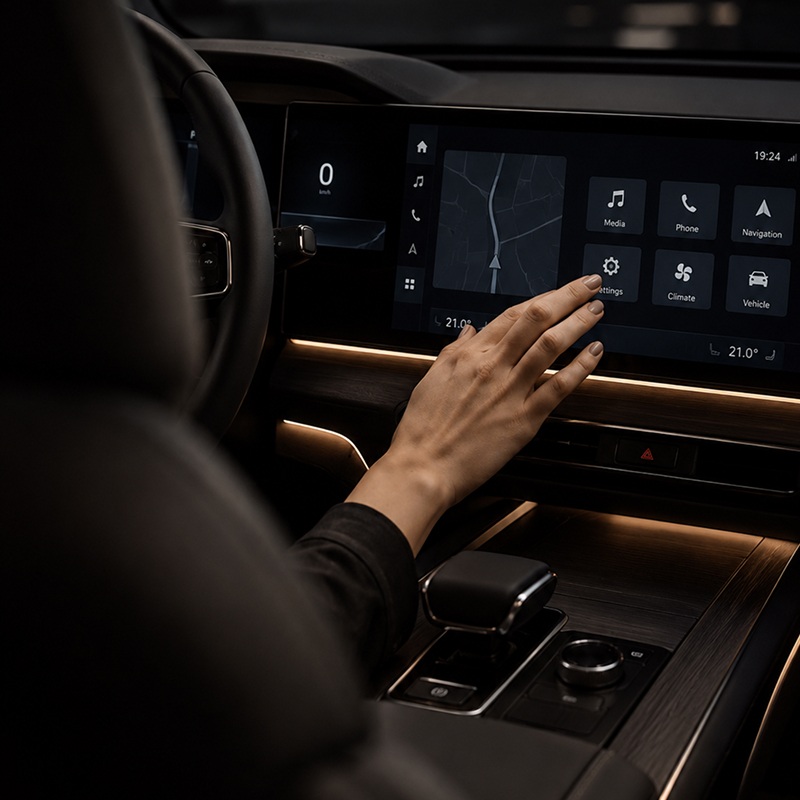
Replaces manual stopwatch measurements with automated frame-level analysis. Orchestrates VLMs, PANNs audio classification, and binary search to measure visual and audible IVI startup events in milliseconds.
Business value:
- Removes human reaction time delays, which typically add a 1-to-3-second variance in manual tests
- Replaces two-person manual recording and timing sessions with single-tester operation
- Uses coarse-to-fine search to reduce VLM calls by 95%, minimizing costly GPU cycles
- Catches sub-second performance regressions early in the lifecycle to avoid late, expensive software fixes
An MCP-equipped Agentic assistant that automates defect analysis across Jira, code repositories, and cloud monitoring. It autonomously ingests issues, detects duplicates, assesses severity, and consolidates technical context.
Business value:
- Reduces initial triage and defect routing times by 99%.
- Speeds up triage team decision-making processes by 75%.
- Eliminates manual search and context switching across fragmented tracking systems.
- Cuts down manual analysis efforts, allowing engineers to focus on resolving core system defects
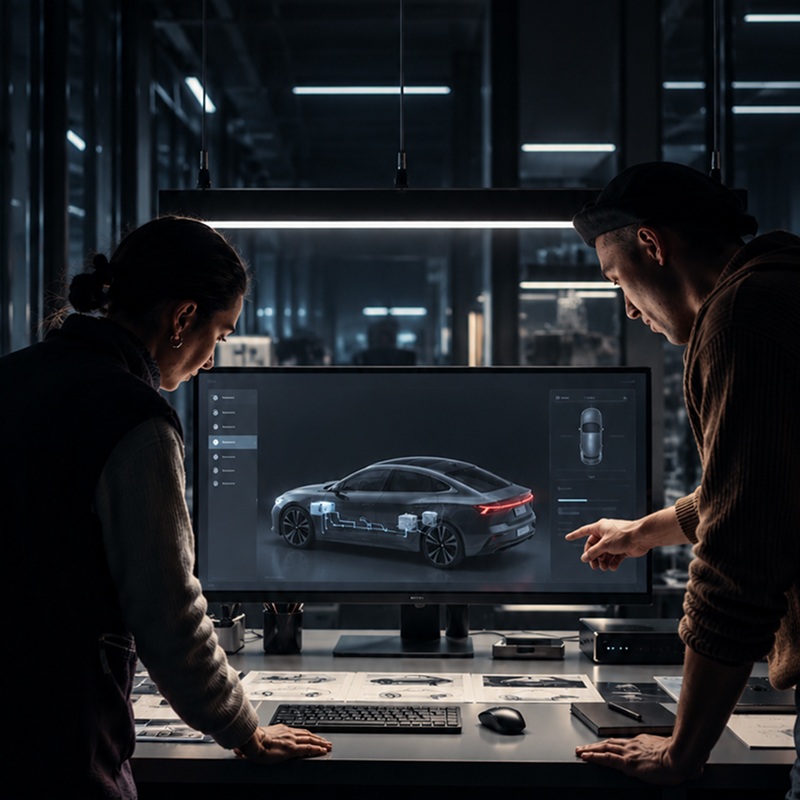
Scores requirements across seven ASPICE quality dimensions. Cross-checks functional specifications against active tests to identify coverage gaps, and generates ready-to-run test cases from raw requirements.
Business value:
- Automatically detects partial-coverage scenarios missed by manual reviews.
- Scores criteria and flags severity issues to streamline safety audits and ensure robust traceability.
- Autonomously resolves gaps, automatically drafting new test specs and generating runnable pytest code.
- Identifies logical inconsistencies during requirements engineering when changes are fast and cost-effective.
Engineering garage ecosystem for SDV validation and HIL testing on real car prototypes
To bridge the “reality gap” of pure simulations, SDV development requires validation on physical targets. Operating in close coordination with our global mobility engineering centres, the Intellias automotive testing garage ecosystem provides secure, localized environments in the heart of the German automotive industry to flash, code, calibrate, test, report defects and validate overall state of the next-generation platforms under real-world conditions.
Engineering garage
in Wolfsburg
Established in 2024, 258 m² fully equipped facility
Built specifically for handling strictly confidential data, secret classifications, and physical prototypes in the automotive industry including prototype vehicles storage, in-vehicle testing, field-testing, and prototype software updates, test bench commissioning, maintenance and onsite/remote testing.

Multiple projects secure environment
Adapted for testing multiple prototype projects simultaneously under strict privacy controls.

Integrated test bench capacity
Equipped for localized hardware test bench testing, diagnostic execution, and software flashing services.

Prototype modules validation readiness
Special set up for the evaluation of key prototype modules and integration, including Interior, Infotainment & Digital Experience, including Navigation solutions, in-vehicle gaming applications, Digital Assistants, In-vehicle application ecosystem.

Integrated OEM network
Implemented two dedicated networks. One of them customer network that gives secure remote access directly from the OEM network to Test Benches in a secure way.

EV infrastructure in-house
Engineers qualified with High Voltage systems usage, performing High Voltage checks after Compound releases and garage infrastructure equipped all necessary charging tools for independent operation of vehicles.

Core activities
prototype and non-prototype vehicle maintenance and testing / field testing, test bench storage, management, commissioning, testing, software flashing and update services.
Engineering garage
in Ingolstadt
Established in 2026, 1,000 m² dual-level facility
Built specifically for secure prototype vehicles -level and component-level SDV software validation. At Ingolstadt Engineering Garage strong focus on: handling strictly confidential data, secret classifications, and physical prototypes in the automotive industry including prototype vehicles storage, in-vehicle testing, field-testing, and prototype software updates, test bench commissioning, maintenance and onsite/remote testing.

Segregated Project space
16 secure prototype slots divided into two isolated, TISAX AL3 certified zones for handling strictly confidential prototype vehicles and parts.

120-test bench laboratory capacity
Dedicated laboratory with a scalable setup designed for parallel HIL, ECU, and cluster testing onsite/remote, test bench maintenance, storage and commissioning zones.

Powertrain & EV validation readiness
Equipped with 6 standard AC charging stations, High-Power Charger (HPC), and an integrated exhaust extraction system for combustion engine testing.
Prototype modules validation readiness
Special set up for the evaluation of key prototype modules and integration, including Interior, Infotainment & Digital Experience, including Navigation solutions, in-vehicle gaming applications, Digital Assistants, In-vehicle application ecosystem.

OEM network integration
Features two independent network links enabling direct, secure tunnels into the automaker’s development network.
Core activities
Field testing, stationery and test bench testing activities, hardware laboratory operations, parts management, fleet management, TechOps support, assembly, calibration, coding, parameterization, flashing, and test bench commissioning.
Distributed engineering footprint
Intellias supports SDV prototype testing and validation through a global network of mobility engineering centers and specialized facilities. In Germany, TISAX-assessed Engineering Garages in Ingolstadt and Wolfsburg provide secure environments for testing vehicle prototypes, ECUs, HIL benches, and integrated software systems, while the Munich location extends local engineering support at the heart of Europe’s automotive industry.
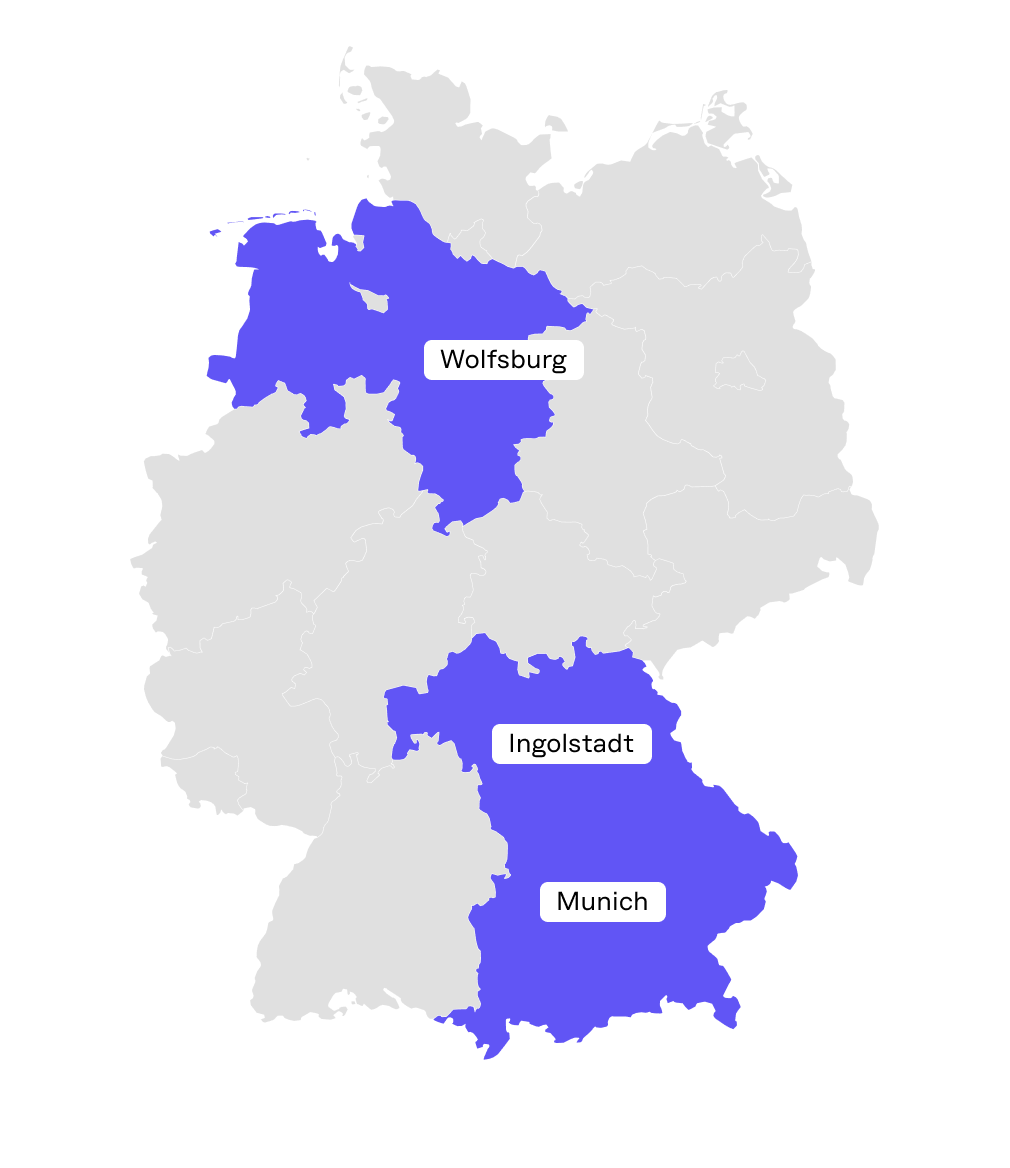
Wolfsburg Garage
Address: Klauskamp 4
Capacity: 258 sq. m.
TISAX AL 3 label | ISO 9001 | ISO 27001
LABELS: Info High, Very High, Strictly Confidential,
Proto parts, Proto vehicles
Prototype/Non-Prototype Vehicle testing
Test Bench testing and SW update services
Wolfsburg Office
Address: Klauskamp 2
Capacity: 550 sq. m.
TISAX AL 3 label | ISO 9001 | ISO 27001
LABELS: Info High, Very High, Confidential, Strictly Confidential
Prototype/Non-Prototype Test Bench testing andSW update
Ingolstadt Garage
Address: Manchinger Str. 105
Capacity: 1000 sq. m.
TISAX AL 3 label | ISO 9001 | ISO 27001
LABELS: Info High, Very High, Confidential StrictlyConfidential, Proto parts, Proto vehicles
Prototype/Non-Prototype Vehicle / bench testing
Test Bench laboratory, HW/SW maintenance
Hardware Parts storage
Ingolstadt Office
Address: In-Campus Alle 18
Capacity: 220 sq. m.
TISAX AL 3 label | ISO 9001 | ISO 27001
LABELS: Info High, Very High, Confidential, StrictlyConfidential
Prototype/Non-Prototype Test Bench testing andSW update
Munich Office
Address: Wilhelm-Wagenfeld Str.28
Capacity: 230 sq. m.
TISAX AL 3 label | ISO 9001 | ISO 27001
LABELS: Info High, Very High, Confidential, StrictlyConfidential
Prototype/Non-Prototype Test Bench testingand SW update
Automotive software testing certifications:
TISAX AL3, ISO/SAE 21434, ASPICE
Software-defined architectures must comply with rigorous functional safety and cybersecurity standards. We enforce complete asset and data protection across our global operations to enable certified software testing in automotive industry.
-

Unified cybersecurity management system (ISO/SAE 21434:2021)
Intellias scaled a TÜV NORD-certified CSMS across all 7 primary mobility engineering centers: Porto, Ingolstadt, Munich, Wolfsburg, Krakow, Lviv, and Cairo. This ensures systemic alignment with UNECE WP.29 cybersecurity requirements.
-
TISAX Assessment Level Assessment Level 3 certified premises
Our dedicated testing garages and offices in Ingolstadt, Wolfsburg, Munich, Krakow, Porto, and Cairo operate under verified TISAX AL3 scopes.


Engineering value built
for the future of mobility
We keep AI compute layers separated: large, cloud-based reasoning models are utilized for offline test design, while lightweight VLMs run locally on-premise at the test bench. This keeps latency predictable and ensures sensitive data never leaves your secure network perimeter.

We virtualize physical infrastructure, transforming hardware into a shared global resource. Distributed engineering teams can flash firmware, execute test runs, and extract logs remotely via secure, redundant networks.

Our AI agents automate verification workflows but do not bypass engineering review. Every generated test case and compliance report undergoes senior engineering sign-off, satisfying the rigorous documentation and audit requirements of ASPICE. If your SDV software safety expertise is shallow, AI amplification does not help; we ensure senior-level engineers lead the review process.
Related insights

FAQ
Automotive embedded software testing is the verification and validation of vehicle software, including ECU firmware, middleware, HMI and IVI systems, and connected services. It checks software against functional, safety, performance, and cybersecurity requirements across the automotive V-model, from unit testing and software-in-the-loop (SIL) testing to HIL and vehicle-level validation.
Software-in-the-loop testing in automotive runs production software in a simulated environment before the target ECU or vehicle hardware is available. SIL testing helps detect defects early, validate software logic, and accelerate development before moving to hardware-in-the-loop testing and physical vehicle validation.
SIL testing runs automotive software in a simulated environment, while HIL testing executes software on the real ECU and simulates the surrounding vehicle systems and signals. Intellias supports both SIL and HIL testing, including secure remote access to a network of 120 automotive test benches.
Software integration testing in automotive verifies how individual software components, ECUs, middleware, and vehicle networks work together. Intellias validates interfaces, AUTOSAR components, CAN and other in-vehicle communication, and system behavior using tools such as CANoe, while maintaining traceability between requirements, test cases, defects, and validation results in line with ASPICE processes.
Relevant automotive software testing frameworks and certifications include ASPICE for software development and validation processes, TISAX Assessment Level 3 for protecting sensitive automotive data and prototypes, ISO 26262 for functional safety, and ISO/SAE 21434 for automotive cybersecurity. Engineer-level qualifications such as ISTQB Certified Tester Automotive Software Tester (CT-AuT) can further demonstrate specialized testing expertise. Intellias performs physical automotive testing in TISAX Assessment Level 3-certified Engineering Garages and applies ASPICE-compliant engineering processes.
Automotive embedded software testing can be performed remotely through secure access to HIL benches and other test infrastructure. Intellias provides remote testing environments with direct secure connections to customer engineering networks, enabling distributed teams to perform software integration testing, execute test suites, analyze logs, and validate ECU behavior without being physically present in the test facility.
Intellias uses AI testing agents to support test design, test generation, execution, log analysis, and defect triage across automotive software testing workflows for SDV validation. AI accelerates repetitive engineering tasks, while senior engineers review and sign off the resulting test outputs, preserving human accountability, requirements traceability, and ASPICE-aligned validation processes.
Intellias operates automotive software testing and validation facilities in Ingolstadt and Wolfsburg, Germany. The Ingolstadt Engineering Garage covers approximately 1,000 m² and opened in 2026, while the Wolfsburg facility covers 258 m² and has operated since 2024. Together, they support software integration testing, HIL testing, ECU validation, and pre-series vehicle testing, backed by Intellias mobility engineering centers worldwide.