Predictive analytics in fleet management becomes critical when one unexpected delay can trigger missed delivery windows, idle assets, emergency rerouting, rising costs, and frustrated customers. Yet many logistics companies still discover problems only after a vehicle breaks down, a route becomes unavailable, or a delivery promise is already at risk.
Fleets generate enough data to detect many of these risks earlier. The challenge is connecting vehicle, route, maintenance, shipment, traffic, and weather data and turning it into timely action. So let’s examine how AI-based predictive analytics can help companies anticipate disruption, improve visibility, and make better operational decisions.
Challenges causing disruption in fleet operations
Fleet operators face frequent disruptions, fragmented technology ecosystems, and rising delivery expectations. These pressures are interconnected: a single route disruption can increase operating costs, affect service quality, and expose gaps in visibility and decision-making.
Climate and geopolitical disruptions
Extreme weather, conflicts, sanctions, labor strikes, and tariff changes can quickly make established routes slower, more expensive, or unavailable. During the Red Sea crisis, the World Bank reported that rerouting around the Cape of Good Hope could increase travel distance by up to 53%, while UN Trade and Development estimated that rerouting increased maritime ton-miles by 6% in 2024. These changes affect ports, warehouses, inventory, and first- and last-mile fleets across the network.
Soaring operational and logistics costs
Disruption adds further pressure to already narrow margins. The average cost of operating a US truck reached $2.336 per mile in 2025, up 3.4% year over year. At the enterprise level, a survey of large US and European companies estimated average annual revenue losses from supply chain disruptions at $184 million per organization, illustrating the value at risk when problems are detected too late.
Technology and integration barriers
Fleet data often remains divided across telematics, maintenance, transportation management, warehouse, and external traffic or weather systems. In the 2025 Third-Party Logistics Study, 28% of 3PLs cited integration with existing systems as an AI adoption barrier, followed by a lack of skilled personnel at 25% and initial investment costs at 14%. Without consistent data and secure connectivity, predictive models cannot provide a reliable operational view.
Service delivery and cost pressure
Logistics providers are expected to improve service while reducing costs, even when delays require additional labor, expedited transport, or replacement capacity. Although 82% of shippers said working with a 3PL improved customer service, only 66% reported lower overall logistics costs. Limited visibility also forces dispatch, warehouse, and customer service teams to investigate the same exception manually.
Change management and visibility demand
Introducing AI changes operational roles and decision-making processes, consequently, 61% percent of shippers and 73% of 3PLs consider supply chain change management needs critical or significant. Visibility is the leading priority, cited by 69% of shippers and 68% of 3PLs. Companies therefore need trusted data, clear responsibility for each alert, and defined processes for acting on recommendations.
Customer delivery expectations
Customers increasingly expect faster delivery without accepting the full additional cost, for example, 48% of shippers and 53% of 3PLs report routine expectations for delivery in less than two days, while only 44% of shippers and 38% of 3PLs are willing to absorb even a small share of the extra expense. Fleets must therefore improve speed through earlier risk detection, better routing, and more efficient use of existing capacity.
What predictive analytics means for fleet management
Predictive analytics within fleet management combines historical patterns, current operational data, statistical methods, and machine learning to estimate what is likely to happen next. Depending on the use case, the output may be the probability of a component failure, a predicted arrival time, a demand forecast, an abnormal fuel-consumption alert, or the likelihood that a route will miss a delivery window.
This is different from simply displaying current vehicle positions. Descriptive analytics shows what happened. Diagnostic analytics helps explain why it happened. Predictive analytics estimates the next probable outcome. Prescriptive analytics then recommends a response, such as changing a stop sequence, assigning another vehicle, scheduling an inspection, or notifying a customer.
AI supports this process when outcomes depend on many changing variables. A machine learning model can learn patterns across fault codes, weather, traffic, driving behavior, vehicle age, cargo, dwell time, and route history. Generative AI can summarize the likely cause of an exception or help a user compare response options. Deterministic rules still matter: geofences, mileage thresholds, safety limits, and approval policies should not be mislabeled as AI.
How the process works behind the scenes
- Collect data. Telematics units, vehicle sensors, mobile applications, maintenance systems, TMS platforms, orders, traffic feeds, maps, and weather services provide operational signals.
- Integrate and normalize. APIs and data pipelines align vehicle IDs, timestamps, location formats, units, and quality rules so that different systems describe the same event consistently.
- Create predictive signals. Raw events become useful indicators such as temperature drift, abnormal fuel use, repeated harsh braking, route deviation, growing ETA variance, or changes in component performance.
- Predict and explain. Models calculate a forecast, risk probability, anomaly score, or remaining-useful-life estimate and surface the factors that influenced the result.
- Trigger action. The platform can prioritize an alert, update an ETA, suggest a route, open a maintenance task, rebalance capacity, or pass the result into an existing operational workflow.
- Learn from outcomes. Actual arrival times, completed repairs, user decisions, and false alarms help teams monitor model performance and improve rules or retrain models.
How fleet predictive analytics turns data into action
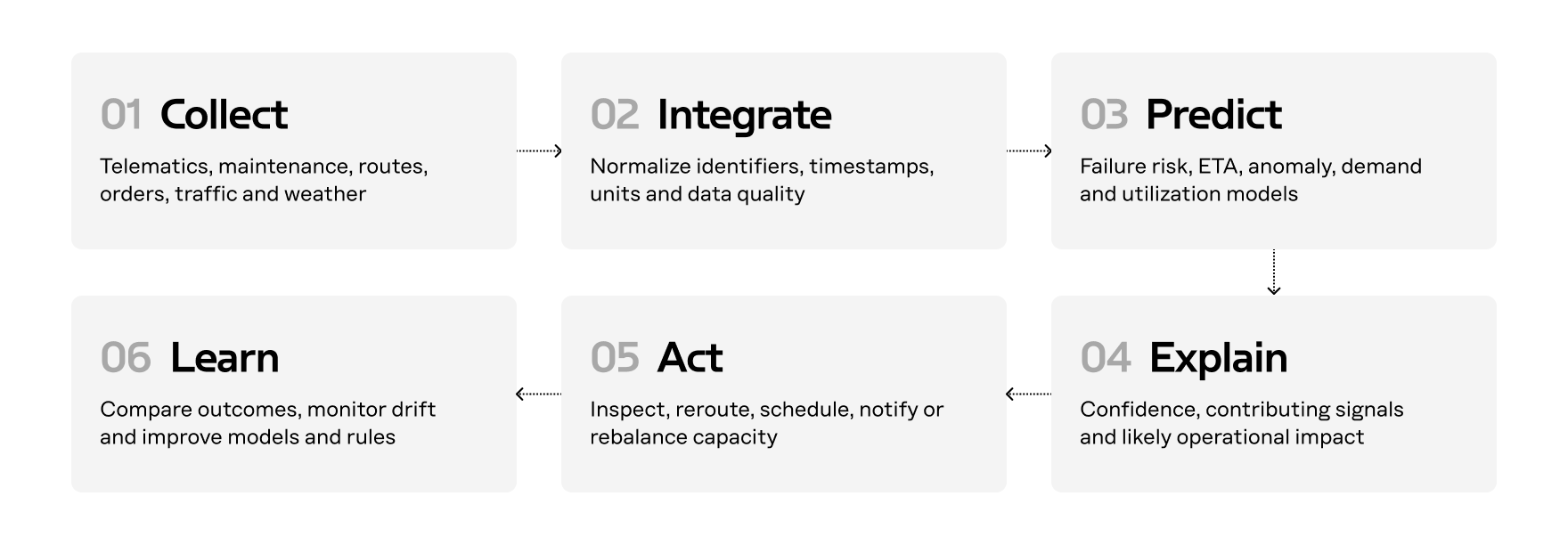
The value of predictive analytics in fleet management does not come from the prediction alone. It comes from giving the right person enough time, context, and confidence to make a better decision.
Visibility as the foundation for predictive operations
Supply chain visibility connects vehicles, shipments, orders, assets, and external events in one operational context. It supports efficiency by revealing avoidable mileage and idle time, risk management by exposing vulnerable routes and assets, customer satisfaction through more credible ETAs, and inventory optimization by showing when inbound goods are likely to arrive.
For fleet predictive analytics, visibility is the foundation rather than the final product. A map full of dots may show where vehicles are now. A predictive platform should explain which vehicle, route, order, or component needs attention next and what action can still change the outcome.
AI-based solutions for more predictable fleet and supply chain operations
AI-enabled control tower platforms
A control tower combines fleet locations, orders, routes, predicted arrival times, asset status, and external disruptions in a shared operational view. Control tower visibility was identified as a desired capability by 68% of respondents in the 2025 3PL research.
AI strengthens the control tower by ranking exceptions according to probability, urgency, and business impact. Instead of treating every delay equally, teams can see which event threatens a high-value order, a production line, or a strict delivery window. This shifts work from monitoring dashboards to managing the exceptions that matter.
Unified data integration and API connectivity
Integration connects telematics, maintenance, transportation, warehouse, order, and customer systems with external traffic, weather, map, and disruption feeds. A common data layer also manages access, lineage, data quality, and consistent asset identifiers.
This foundation allows companies to add new use cases without building another isolated dashboard each time. Intellias supports this work through fleet management software development that connects vehicle data, cloud platforms, operational applications, and third-party services around the decisions a fleet needs to make.
AI-driven demand forecasting and planning
Demand forecasting models can combine order history, seasonality, promotions, locations, market signals, weather, and operational constraints to estimate future capacity needs. The objective is not a perfect forecast. It is a more credible planning range that helps a company position vehicles, schedule drivers, reserve warehouse capacity, and maintain enough inventory without relying on excessive buffers.
The 2025 3PL research found that 33% of shippers were seeking AI implementations for supply planning and demand forecasting, while 19% of 3PLs planned deployments in this area. Cloud platforms make these models easier to scale across business units and data sources.
Intelligent route and network optimization
Conventional route optimization considers known constraints such as distance, road rules, vehicle type, cargo, delivery windows, and driver availability. Predictive models add uncertainty: future congestion, weather exposure, dwell time, border delays, disruption probability, and the risk of a missed slot.
This helps a platform recommend the route most likely to work in practice, not merely the shortest route on a map. Twenty-seven percent of shippers in the 2025 3PL Study were seeking AI for transportation and route optimization, while 22% of 3PLs planned implementations. Effective predictive analytics for fleet operations can also recalculate a plan as conditions change, keeping dispatchers in control of the final decision.
Predictive maintenance and asset intelligence
To implement predictive maintenance, fleets can combine fault codes, battery voltage, coolant temperature, tire pressure, engine hours, load, driving style, repair history, and environmental conditions. Models look for patterns associated with degradation and estimate when an inspection or repair should be considered.
This approach complements rather than immediately replaces scheduled maintenance. It helps maintenance teams move selected interventions into planned stops, prepare parts and workshop capacity, and avoid withdrawing healthy vehicles too early.
Advanced analytics and performance intelligence
Advanced analytics brings operational and financial measures into the same context. Teams can compare planned and actual mileage, arrival-time accuracy, detention, fuel or energy use, asset utilization, maintenance lead time, alert acceptance, and delivery performance.
This is how fleet predictive analytics becomes measurable. Teams can see whether earlier warnings reduced unplanned downtime, whether route recommendations improved delivery reliability, and whether an alert arrived early enough to be useful. The same data also reveals recurring causes that deserve a process, network, or supplier-level response.
Agile change management frameworks
When implementing predictive analytics, companies should begin with one bounded operational decision: predict a late arrival, identify a vehicle at elevated failure risk, or forecast capacity for a defined network. The team must agree on the prediction horizon, the person responsible for action, the acceptable level of false alerts, and the business outcome to measure.
Training and feedback are as important as model accuracy. Fleet managers and frontline users need understandable explanations, clear escalation rules, and a way to report when a recommendation was useful or wrong. Scaling should follow demonstrated workflow value, not an impressive laboratory result that never changes an operational decision.
Intellias use case: adding an intelligence layer to supply chain operations
Intellias developed the Supply Chain Intelligence Layer as an AI-enabled proof of concept that demonstrates how predictive insight can enrich an existing transportation management system without forcing a company to replace its core platform.
The PoC combines shipment records, bill-of-lading identifiers, carrier and cargo details, timestamps, routes, and external disruption signals. It compares expected and actual delivery progress, detects anomalies, and uses AI agents to connect delays with contextual events such as congestion, labor action, security incidents, or GPS interference. The result is not only a late-shipment warning but also a clearer view of the probable cause and operational impact.
In the demonstration scenario, the system analyzed a journey from Al Jubail to Valencia covering approximately 18,700 nautical miles over a typical 46-day route. It correlated deviations in delivery time with multiple disruption factors and presented the findings through a route-based interface that could support faster investigation.
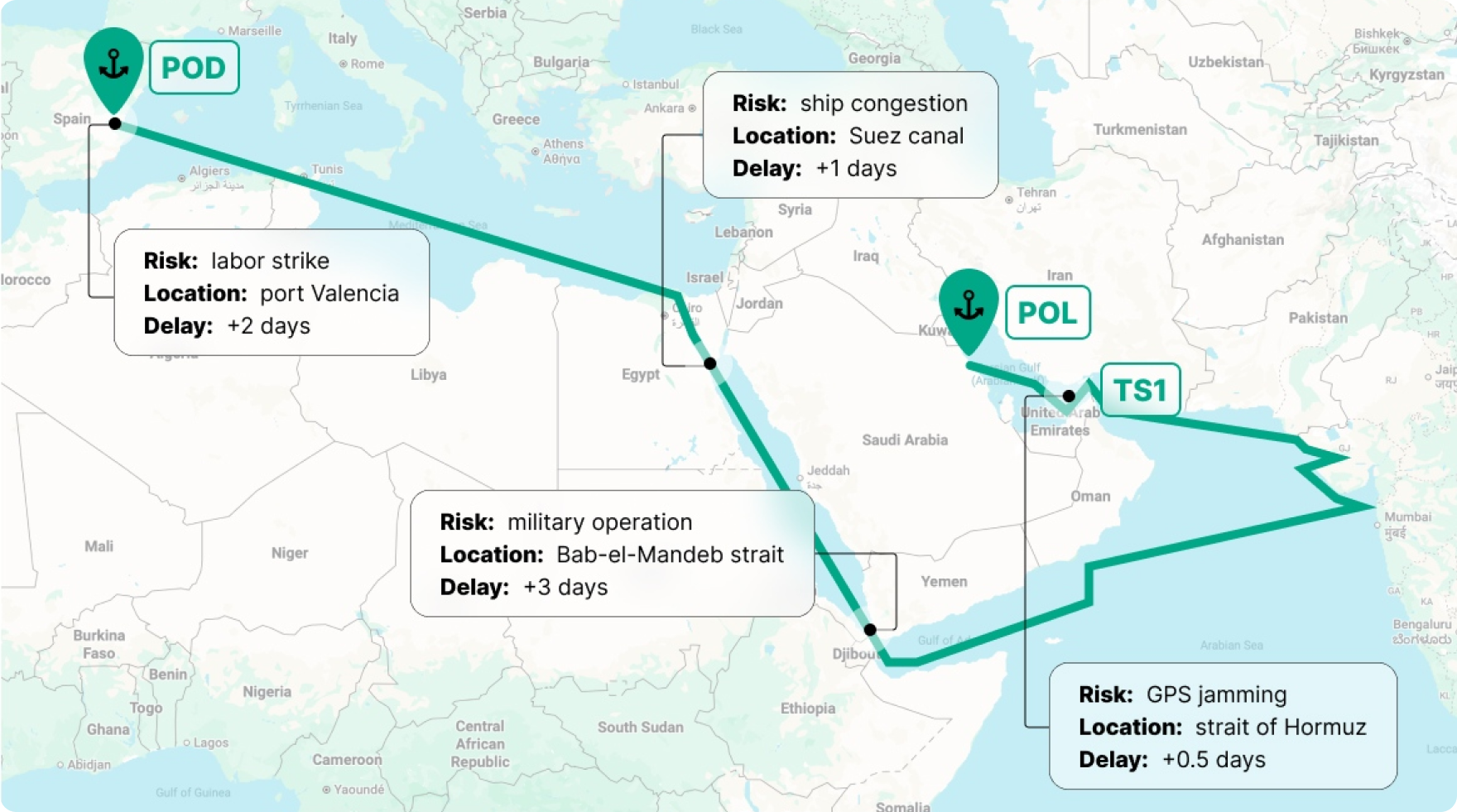
For fleet and freight platforms, the architectural principle can be reusable. A modular intelligence layer can combine TMS and vehicle data with external network events, identify which assets and deliveries are exposed, and return risk alerts or updated ETAs to the tools dispatchers already use. Because this is a PoC, the scenario should not be read as measured production performance. It demonstrates the approach, integration model, and potential workflow.
From prediction to business action
Predictive analytics in fleet management helps logistics companies replace part of the daily firefighting with earlier, better-informed action. It can give maintenance teams more time to inspect at-risk assets, help dispatchers manage uncertain routes, support more efficient capacity planning, and provide customers with earlier and more credible delivery updates.
Successful adoption starts with trustworthy data and a specific decision, not with AI for its own sake. Intellias combines mobility-domain experience with data engineering, cloud, IoT, location services, platform integration, and AI/ML to build fleet predictive analytics around real operational workflows.
Whether the first priority is maintenance, ETA intelligence, route risk, asset utilization, or disruption response, predictive analytics in fleet management should connect every forecast to a person, an action, and a measurable outcome. Talk to Intellias mobility experts about turning fragmented fleet data into a practical path from visibility to foresight.