Enterprise AI initiatives tend to fall apart between teams, even when the model was good. A team trains something genuinely useful, another team owns the deployment pipeline, and a third controls the infrastructure. Six months later, the prototype is still a prototype, the engineers who built it have moved on, and the business is no closer to production than it was the day the model was first demoed in a boardroom. Thus, the delivery structure issue surfaces.
This structural failure is the very first reason for the new operating model existence – AI pods.
What are AI pods?
An AI pod is a small, self-contained, cross-functional team, typically three to five senior engineers and product specialists, paired with dedicated AI agents that handle the structured, repeatable portions of the software delivery lifecycle.
The division of labor is intentional and clear. AI agents handle code generation, requirements drafting, test scaffolding, documentation, and deployment preparation. The humans handle architecture decisions, business logic, security judgment, and anything where the cost of a wrong call is high.
Think of it as the difference between a distributed restaurant kitchen and a food truck. A restaurant kitchen runs on handoffs: prep, line cooks, expeditors, QA. When one station slows, the whole system backs up. A food truck operates differently: fewer handoffs, tighter accountability, one environment responsible for the finished output.
Intellias AI pods are built on AI adoption framework logic. Rather than distributing AI workloads across large, siloed teams where handoffs accumulate into delays, a pod concentrates ownership, compresses cycle time, and makes output measurable at the team level.
What are AI pods in practice? They’re the answer to a question enterprises keep avoiding: why does it take so long to move from “we have a working model” to “it’s live in production and performing”?
How AI pods operate in real life
Adding a coding assistant or platform to an existing team doesn’t create an AI pod. It creates a team with a coding assistant.
The operational core of a well-designed pod is what practitioners call a harness — the system of rules, validation checkpoints, and escalation paths that defines what agents can do, how their output gets reviewed, and when humans must make the call. Without a harness, bugs that used to take weeks to accumulate appear in days.
A well-designed harness converts raw agent speed into delivery leverage.
Within that harness, agentic AI workflows handle the predictable work: generating code from specs, writing and running tests, flagging dependency conflicts, preparing deployment artifacts. Parallel processing lets multiple agents work simultaneously on different components, without slowing down as the workload grows. That’s what drives the cycle-time compression that makes pods economically interesting.
AI pods as a service remove one of the most persistent pain points in enterprise AI development services: rebuilding infrastructure from scratch every time a new initiative starts. The tooling, orchestration layers, and AI-ready infrastructure are already in place, so teams start closer to production.
Where pods deliver, and where they don’t
Honest scope matters here. AI pods perform well on certain work and are genuinely less suited to others. Bain’s analysis of AI-native pod models notes they are a great fit for development, testing, and automation needs, but that it’s less settled whether clients see equivalent value applying this model to UX architecture or strategic product design. Enterprises that ignore that boundary tend to get governance headaches instead of productivity.
Where pods consistently earn their keep:

Software development and deployment
Code generation, refactoring, CI/CD automation pipeline management are structured enough for the agents to carry large portions autonomously, with human engineers owning architectural decisions. This is where AI-assisted engineering backs its pitch with numbers.
Automated testing
Agents generate, update, and run test suites continuously, catching problems earlier than any human-driven QA cycle reliably can. In one Intellias digital health application rebuild, this produced a 40% reduction in defects at UAT.
AI model training and dataset processing
Pods with embedded data engineering capability manage dataset preparation, labeling, and model refinement cycles without a separately managed data science team sitting three org-chart layers away.
Retrieval augmented generation (RAG)
RAG pipelines, where a model pulls relevant context from an enterprise knowledge base before generating a response, call for careful data pipeline management, prompt engineering, and ongoing evaluation. Splitting that work across functions creates the coordination drag that pods are designed to minimize.
Real-time AI inference
Production systems serving model predictions at low latency run better when the team that built the model and the team running it are the same team. Less handoff distance means faster diagnosis when something behaves unexpectedly in production.
The economic argument: paying for effort
The traditional services math is familiar and expensive for every business: need 30% more output, hire 20–25% more people. Cloud costs, coordination overhead, and management drag scale with every addition, killing the margin.
Intellias AI pods change the underlying equation. When agents absorb the structured, repeatable work, a smaller team handles the throughput that previously required a much larger one. And because agent-assisted delivery doesn’t fluctuate the way individual contributors do, output quality is more predictable, which turns out to matter as much as speed.
Bain documents that this is heading commercially to outcome-based pricing. Clients paying for deliverables and throughput rather than hours is beginning to displace time-and-materials billing. The same analysis notes AI-native delivery models are already driving 20–30% renewal compression as clients price expected productivity gains directly into contract renewals.
For enterprise buyers, the more immediate question is total cost of ownership. Intellias AI-enabled engineering services offer concrete reference points.
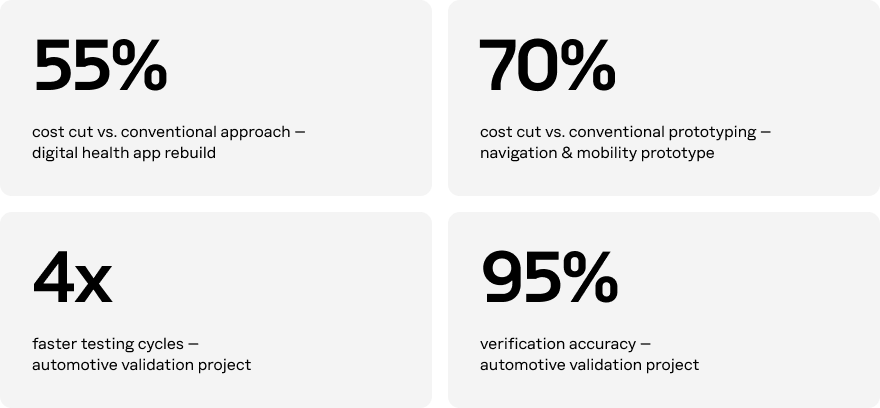
In a digital health application rebuild, the AI pod model delivered a 55% reduction in investment versus a conventional engineering approach, a 1.5x reduction in time-to-market, and a 40% reduction in defects at UAT.
In a navigation and mobility prototype for a global location technology company, Intellias used agentic AI workflows to build a demo-ready UI from open-source map data. A working prototype in one day. A full API/SDK integration cycle compressed from three to four months down to six weeks with a 70% reduction in investment versus conventional prototyping.
In an automotive testing initiative with a premium, global electric vehicle brand, Intellias deployed an AI-powered validation system that reads vehicle hardware behavior directly from video input and automates the verification and documentation workflows that previously ran on pure manual effort. The results were concrete: testing cycles ran 4x faster, verification accuracy reached 95%, and operational costs came down across both cloud and on-premise environments.
These specific cases showcase real numbers achievable when the infrastructure underneath is built to support it.
However, as the Intellias own experience shows, return on investment from pods is not automatic. They have to be treated as a delivery architecture, with the underlying quality of the harness design, the seniority of the humans inside the pod, and the maturity of the AI infrastructure. Organizations that treat pods as a staffing shortcut see neither the cost savings nor the throughput gains.
Governance, security, and observability as instruments
Without visibility, speed hides problems instead of solving them.
One of the most vivid mistakes in early pod implementations is assuming that small, autonomous teams require less governance. In reality, they need more intentional governance, just structured differently from traditional delivery models.
Observability keeps AI pods operationally accountable. In a AI pod environment, observability means having visibility into what AI agents are doing, what they generated, how outputs were reviewed, and where humans stepped in. Without that level of instrumentation, teams can’t properly audit agent behavior, identify recurring errors, or demonstrate compliance to regulators and internal stakeholders.
Token transparency matters just as much. When AI usage is consumption-based, enterprises need pod-level tracking to understand what each workflow actually costs and to keep an accountability trail if an agent’s output is questioned later.
AI pods require security boundaries at the agent level. Security in the pod model means applying the same controls used for human access to enterprise systems directly to the agents themselves: access controls, data isolation, and policy enforcement at the agent level. The idea of a secure AI factory, where agents operate within defined policy boundaries and outputs are validated before reaching production reflects the direction responsible AI governance is moving toward.
Pods designed with those controls from the beginning tend to scale more responsibly. Teams that try to layer governance on afterward usually discover the cost of that shortcut much later, when the operational or compliance risk is harder and more expensive to fix.
Program management needs rethinking too. In a pod model, the most useful metrics are throughput, cycle time, defect rate, and the ratio of agent-handled work to human-reviewed work ( and not task completion against a Gantt chart).
Reliability becomes something teams can measure across the system itself, not just evaluate person by person. Organizations that adjust their tools and reporting around those signals usually get a clearer picture of performance and make better decisions about where scaling makes sense.
On a final note: Structure is the strategy
The reason AI pods work is the structure itself.
They redesign the productive unit itself: concentrate ownership, embed agents directly into the workflow instead of layering them onto existing teams, and measure output at the team level rather than across departments.
As the Intellias practical experience shows, success depends on clear guardrails around what agents can and cannot do, experienced human oversight inside each pod, infrastructure that can optimize agentic AI workloads, and governance that gives real-time visibility into what agents are producing and why.
Organizations that treat AI pods as a staffing shortcut are unlikely to see these gains. Those that treat it as a delivery architecture change, with the infrastructure, governance, and program management to match, will find the productivity argument holds in production.
Figuring out where to start? Contact our experts today, and let’s do AI the right way.