The amount of money being spent on AI is rising so quickly that many organizations cannot keep up. Teams are deploying copilots, chatbots, recommendation engines, search assistants, and agentic workflows, creating new challenges for AI spend management.. At the same time, finance teams get cloud invoices that do not indicate which features, customers, or business processes are causing these expenses. This means that AI costs often end up in a shared cost pool that is difficult to connect with business value.
The challenge increases as AI ecosystems become more complex, with numerous models, vendors, and applications creating fragmented usage data. Agentic systems introduce additional factors such as context size, model routing, tool calls, retries, and workflow complexity. Without a consistent governance model organisations struggle to identify the sources of their costs, assign responsibility, and work out which AI investments deliver measurable returns.
TokenOps emerged to address this gap.
TokenOps (token operations) is the engineering and financial field concerned with measuring, controlling, and improving the number of LLM tokens an organization uses, aiming to allocate AI spend to the features, teams, and customers that cause it and ensuring that it remains within set limits. While FinOps deals with cloud infrastructure, TokenOps deals with inference—that is, which model responds to each request, how many tokens it uses, and whether that feature recoups its own cost.
What is TokenOps?
TokenOps extends traditional AI cost management by focusing on the consumption unit of modern AI systems: tokens. It combines engineering controls, governance practices, financial accountability, and optimization techniques into a single operating model.
Organizations increasingly rely on AI-powered product features such as chatbots, recommendation systems, content generation tools, and classification pipelines. These workloads generate API-based inference costs that cloud invoices rarely attribute to individual features, teams, or customers. As AI adoption grows, spending often accumulates in a shared cost pool that product and finance teams struggle to connect to business value.
A TokenOps framework addresses five common challenges:
- limited visibility into AI cost drivers
- opaque AI spending
- fragmented usage and reporting across vendors
- unpredictable agentic AI consumption
- missing governance models for budgets, alerts, and accountability.
So, in practice, TokenOps combines governance, attribution, and token optimization into a single operational discipline.
TokenOps vs FinOps for AI
TokenOps and AI FinOps share the same goal: improving economic efficiency. Their operational focus differs.
According to the FinOps Foundation’s FinOps for AI framework, FinOps for AI extends cloud financial management practices to AI workloads through allocation, forecasting, optimization, and governance. TokenOps operates at a more granular level. It focuses on inference requests, model selection, prompt structures, token consumption, agent activity, and per-feature economics.
In practical terms, FinOps answers, “What did we spend on AI?” TokenOps answers, “Which feature, customer, workflow, prompt, or agent generated that spend, and how can we improve it?”
For organizations already investing in MLOps engineering, LLMOps, and cloud cost optimization, TokenOps provides the operational layer that links AI usage to business outcomes.
Why AI spend becomes an opaque cost pool
AI invoices often show deployment-level consumption while product teams need feature-level accountability. This disconnect creates a visibility gap between usage and value generation.
Large organizations usually operate several models, providers, and AI-powered products at the same time. As a result, finance teams focus on invoices, engineering teams monitor requests and infrastructure metrics, and product teams evaluate user outcomes, often without a unified view that connects AI consumption to business value. This separation makes it difficult to attribute costs accurately, identify optimization opportunities, and establish clear ownership of AI spending.
Organizations need both observability and control: observability provides the data required to understand consumption patterns and cost drivers, while control mechanisms ensure that insights translate into budgets, limits, and optimization actions that keep AI spending aligned with business objectives.
Two cost pools: developer tools vs product-feature AI
Developer tools such as GitHub Copilot, Cursor, and Claude Code operate as vendor-managed services. Organizations manage spending through seats and subscription tiers because token generation, context management, and model routing remain within the vendor platform.
Product-feature AI introduces a different challenge. Customer-facing chatbots, recommendation engines, search assistants, and content generation features generate direct inference costs. Every request carries measurable token consumption and a business outcome. TokenOps focuses on that runtime layer because organizations can influence architecture, governance, routing, caching, and budgets.
Why agentic AI makes cost non-linear
Modern agentic AI systems perform multiple model calls, tool invocations, planning steps, retries, and workflow actions during a single task. As a result, costs grow with workflow complexity rather than request volume alone.
This explains why agent governance appears as a dedicated TokenOps optimization lever. A single runaway agent can generate significant spend through repeated tool calls and recursive workflows.
The TokenOps governance framework
AI cost governance succeeds when measurement and enforcement operate as a connected system. The Intellias framework combines observation, control, and telemetry-driven adaptation.
Observation: measurement and attribution
The first layer captures telemetry across tokens, latency, costs, and request patterns, creating the foundation for AI cost monitoring and attribution. Organizations then attribute consumption to specific features, services, and teams. Aggregated telemetry produces attribution alerts, anomaly detection, and visibility into high-cost workloads.
This creates the foundation for AI unit economics. Teams gain visibility into which workloads generate value and which consume disproportionate resources.
Control: policy enforcement and guardrails
The second layer defines quotas, budgets, and consumption policies. Enforcement occurs through deployment-level token-per-minute (TPM) and request-per-minute (RPM) limits. These controls apply before application logic and create predictable spending boundaries.
Controls enforced at the deployment level cannot be bypassed by application code.
Telemetry-driven adaptive control
Telemetry-driven adaptive control emerges when real-time signals immediately trigger enforcement actions. Instead of relying on monthly reviews, organizations gain continuous regulation of consumption patterns and cost behavior.
Organizations also often combine TokenOps practices with LLM observability platforms to correlate token consumption, latency, cost, and application performance.
Cloud-native governance: three layers
The framework includes three governance layers:
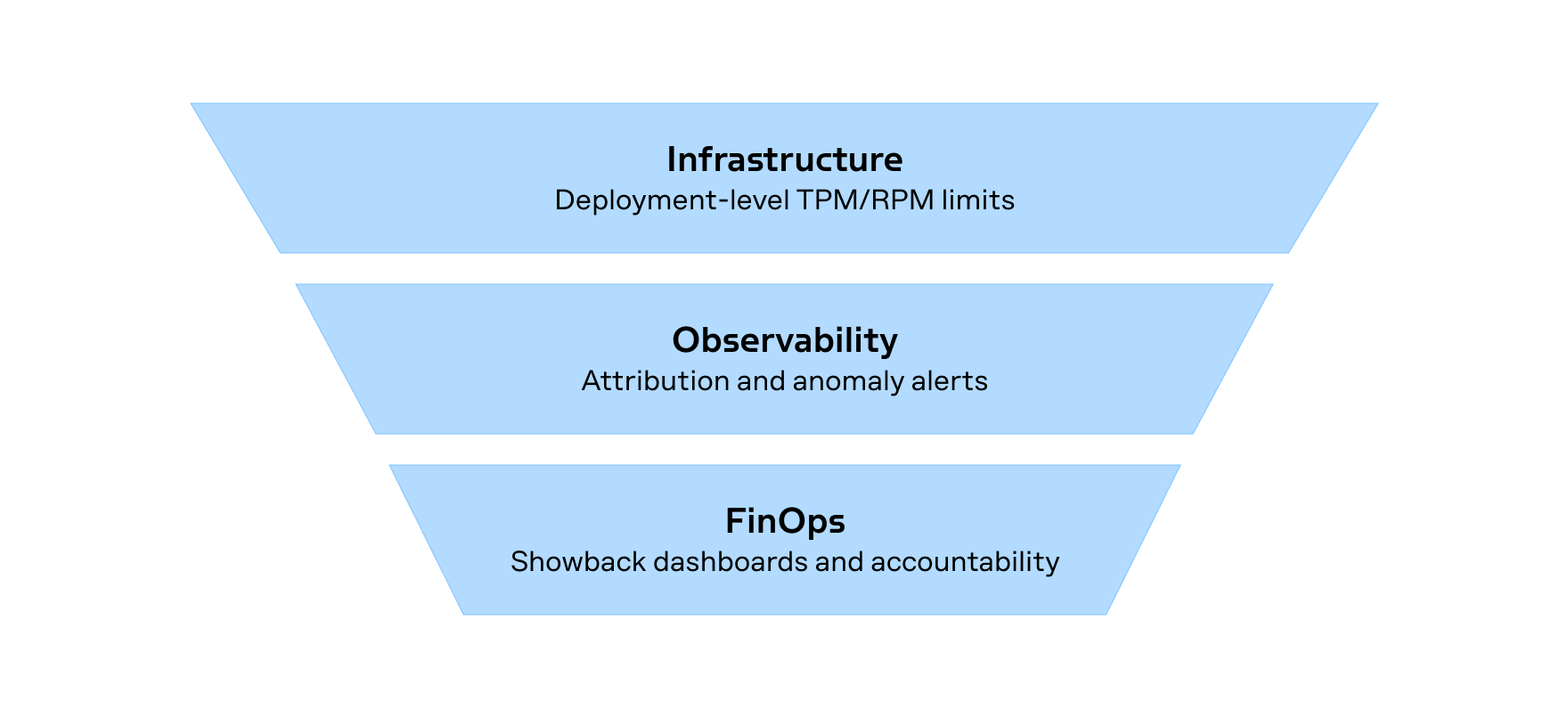
The FinOps layer aligns with the FOCUS specification from the FinOps Foundation, which promotes standardized cost allocation and usage visibility across teams and services.
This layer supports both AI showback and AI chargeback models, allowing AI costs to be allocated back to individual teams, products, and business units.
TokenOps optimization levers and typical savings
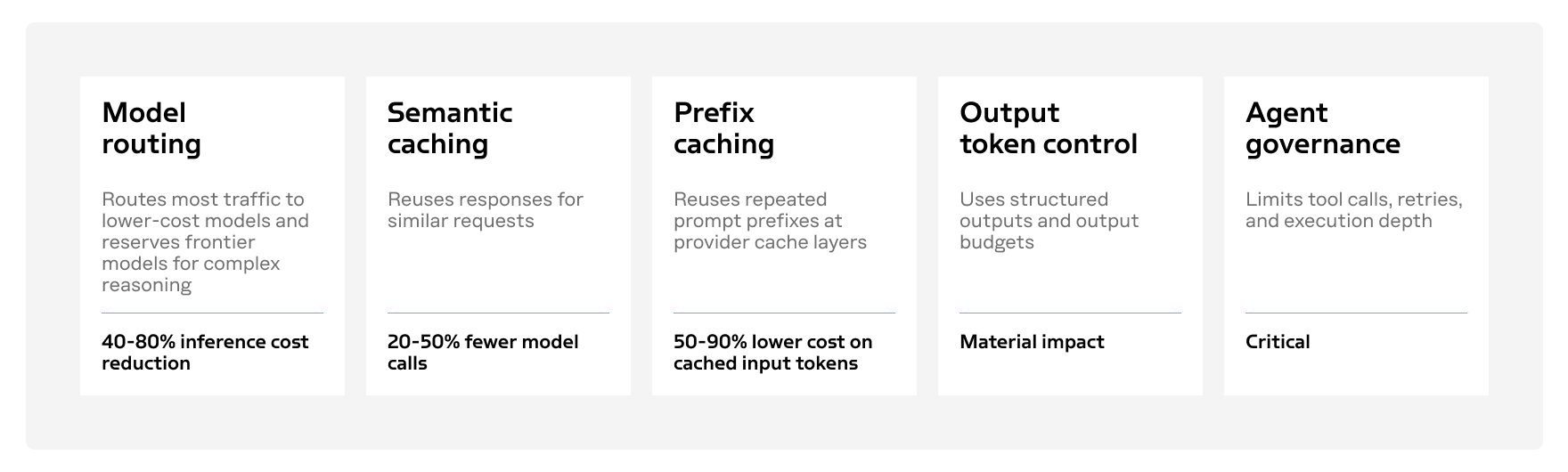
The largest TokenOps gains typically come from optimization after attribution data becomes available.
Model routing
Model routing directs routine requests to lower-cost models while reserving premium models for advanced reasoning. This approach frequently produces the largest savings opportunity.
Semantic caching
Semantic caching identifies similar user requests and returns previously generated responses. This removes inference calls for repeated patterns and significantly reduces API utilization.
Prefix caching
Major AI providers now support prompt caching. OpenAI, Anthropic, and Microsoft Azure OpenAI describe mechanisms that reuse identical prompt prefixes and reduce processing costs for repeated context. These capabilities align directly with the TokenOps practice of caching recurring system prompts.
Output token control
Output tokens frequently cost more than input tokens. The deck estimates a 3-5x difference on many models. Structured responses and output budgets help organizations control this source of spend.
Agent governance
Agent governance introduces hard limits for steps, retries, execution paths, and tool invocations. This provides predictable control over complex AI workflows.
How to roll out TokenOps: a 3-phase approach
A successful rollout starts with attribution, continues through optimization, and evolves toward architecture modernization.
| Phase | Timing | Key activities | Outputs |
| Attribute | Weeks 1-4 | Feature inventory, attribution schema, AI gateway, context tagging | AI feature registry, token ledger, dashboards, alerts |
| Optimize | Weeks 5-12 | ROI analysis, routing, caching, governance controls | Cost reduction, showback dashboards, governance controls |
| Architect | Month 4+ | SLM strategy, specialization design, fine-tuning planning | Architecture blueprint and scaling roadmap |
Timelines are indicative and depend on scope and existing infrastructure.
Phase 1: Attribute
Organizations map AI features, define attribution models, deploy a centralized AI gateway or LLM gateway, and establish a per-request token ledger. The outcome is complete visibility into consumption and ownership.
Phase 2: Optimize
Teams analyze costs, identify low-ROI workloads, implement routing and caching, establish token budgets, and validate savings opportunities.
Phase 3: Architect
Organizations identify workloads suitable for small language models (SLMs), design specialized AI architectures, and create a long-term roadmap focused on lower marginal inference costs.
Who owns TokenOps?
TokenOps works best as a shared responsibility.
The rollout model includes engineering, platform, finance, product, architecture, and MLOps stakeholders working from a common attribution and reporting framework. Typical participants include an engagement lead, MLOps engineer, platform lead, product leadership, finance stakeholders, architects, and AI engineering teams.
The core principle is simple: finance and engineering operate from the same ledger and evaluate the same consumption data.
A TokenOps assessment can deliver an AI feature registry, a per-request token ledger, per-feature cost dashboards, budget alerts, and a baseline cost report within the first attribution phase.
For organizations investing in generative AI development and large-scale AI products, TokenOps provides the operational discipline required to connect AI spending with measurable business value.
Ready to assess your TokenOps maturity? Contact us.