From farm to table is an attractive value proposition for consumers. But it’s operationally challenging for manufacturers. Transportation of temperature-sensitive shipments has become a tough business: you need a lot of patience to ensure that goods are transported in the right condition at every step of the supply chain, be it by truck, aircraft, or a medical trolley.
What is cold chain logistics?
The cold chain logistics industry is a combination of science, technology, and business processes aimed at determining the best way to transport perishable goods.
Pharmaceuticals, fresh produce, and frozen products require special conditions for transportation. Failure to provide these conditions risks spoilage, recalls, and other risks to end consumers.
Moving such products (and their components) through the global supply chain, which stretches over multiple checkpoints at different locations, is the task of many agents:
- Cold storage and cooling system providers
- Cold transport managers
- Sea and airport workers
- On-site cold processing and distribution agents
- Logistics companies in charge of delivering the entrusted goods
Back in the old days, a block of ice and a quick prayer were all that businesses had to transport perishables.
In the twenty-first century, we have more advanced cold chain technology — IoT sensors, location-based services, cloud computing, and predictive analytics, among other novelties. This host of technologies is used to provide a precise temperature-controlled environment during the entire cycle of intermodal transportation.
Still, cold chain logistics isn’t an easy sphere in which to operate. Every leg of transportation remains dependent on manual labor:
- Cold storage containers need to be plugged in and unplugged at warehouses.
- The temperature inside containers has to be checked regularly.
- On-the-ground staff need to react fast when a new shipment arrives.
- Visibility and traceability throughout the full cycle is crucial.
Inevitably, mistakes and mishandling happen. Perishable products either go to waste (meaning lost profits) or worse — get publicly recalled from the shelves (meaning damaged brand reputations and regulatory interventions).
In 2019, US Food Safety and Inspection Service recalled over 20 million pounds of food produce.
Regulators keep close tabs on how perishable products travel through the supply chain and introduce new controls. In 2017, EU regulators issued Good Distribution Practices that introduced stricter rules for transporting temperature-sensitive pharmaceutical products. The WHO also imposed non-negotiable transportation guidelines for pharmaceutical companies.
In response, the demand for cold chain logistics solutions and refrigerated warehouses shot up. But the lack of process standardization, limited visibility, and high operational costs prevent a lot of companies from scaling their cold logistics.
Why cold chain logistics is a hot issue
In 2021, the pharmaceuticals, consumer packaged goods, and agricultural industries are driving the demand for cold chain logistics solutions.
By 2026, the cold chain logistics market will hit $58.51 billion, growing at a CAGR of 17.9%.
There are good reasons for the upsurge in demand:
- Increase in temperature-sensitive biological shipments. In 2019, cold chain logistics already accounted for 26% of shipments in the pharmaceuticals market. In 2020, 27 of the 50 top-selling drugs required cold chain storage and transportation at 2 degrees to 8 degrees Celsius. With COVID-19 vaccine distribution underway in 2021, it’s safe to assume that the demand will keep rising.
- Frozen goods are a new favorite among consumers. In the US alone, retail sales of frozen goods netted $65.1 billion last year. Over 57% of consumers admitted that they started buying more frozen foods since the start of the pandemic to “prep” and stockpile.
- The online grocery market is booming. In 2020, the US accounted for almost 29% ($198 billion) of the global online grocery market. China, Japan, Canada, and Germany are the other markets projected to experience double-digit growth in the online grocery market between 2020 and 2027. The total EU market for online grocery shopping is expected to reach $110 billion by 2027.
- The dairy trade remains strong. Prices for dairy products rose by 1.7% globally in November 2019 alone. Despite ongoing trade tensions and tariff wars between major suppliers — the US, Europe, and China — export volumes keep growing. The recent US–Japan trade deal for cheese exports and the USMCA agreement further open doors for cross-border dairy shipments.
The demand for cold chain solutions is strong. But what stands in the way of execution?
Pervasive issues affecting cold chain logistics management
Despite the high demand, only a handful of logistics companies can step up to the challenge of providing temperature-controlled shipments of vaccines and other highly regulated pharmaceuticals.
In the US, 78% of cold storage warehouses are two decades old and are no longer suited for modern operational requirements.
Percentage of total US cold storage warehouses inventory built in a given decade
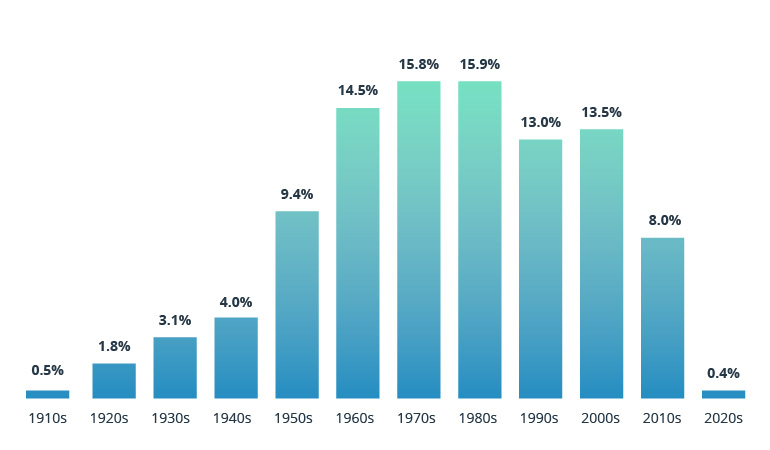
Source: JIL — Cold storage in the post-COVID economy.
At the same time, the online grocery and meal kit delivery markets alone are projected to demand an extra 100 million square feet of cold storage warehousing space over the next five years.
However, cold logistics operations aren’t just restricted by real estate. New solutions for digital cold chain monitoring, management, and optimization are in high demand too. The industry needs to overcome the following issues:
- Fleet management inefficiencies. Refrigerator units and trucks often malfunction. Ordering spare parts and maintenance can bottleneck operations. At the same time, lack of cold chain visibility into fleet movements can result in shipment delays and scenarios when imported products sit too long at ports of entry (often in subpar conditions).
- The high cost of marginal temperature errors. Transporting products requiring precise temperature and humidity conditions is an expensive endeavor. But with limited visibility and control, companies carry major losses if there’s a slight change in the transport environment. The stakes are particularly steep for high-value pharmaceutical products.
- Lack of remote control of refrigerated vehicles, cooling systems, and containers. Even if monitoring is in place, making any adjustments to transport conditions remotely and in real time is nearly impossible. Marginal errors are often left unattended until the product arrives at the next checkpoint.
- Low precision in manual handling. Even when there’s a human worker in sight to make adjustments, not everyone has the knowledge, skills, or equipment to effectively handle sensitive shipments.
- Missing controls during transit. After handing over the product, manufacturers have little to no control over how it’s going to be packaged and stored in the hold of the aircraft or vessel. Proper positioning can be crucial for certain product types. But the means to control that positioning are mostly absent.
Cold chain technology services offer a rapid response to common shipment perils
Similar to the wider transformation of the supply chain industry, cold chain logistics is undergoing digitization too.
The aforementioned inefficiencies are prompting leaders to investigate better approaches to ensure:
- Proper packaging
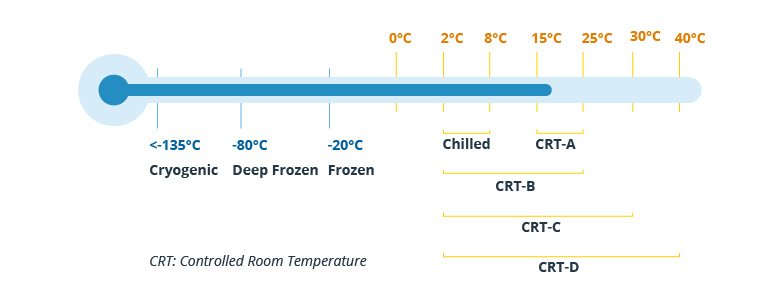
Source: DHL — The Smarter Cold ChainThe problem with traditional temperature sensors (installed in refrigerated trucks and containers) is that they are challenging to monitor remotely.IoT devices are more versatile. They can be programmed to capture a wider range of data points such as:
-
- Temperature
- Humidity
- Position
- Pressure
- Visual state of the product