AI agents can automate incident response, service requests, remediation, and other IT operations tasks. The harder part is giving them enough operational context to make safe decisions. Successful AI adoption in ITSM depends on reliable data, connected systems, appropriate autonomy levels, human oversight, and clear ways to reverse automated actions.
AI agents for ITSM are becoming a standard part of the technology conversation. Service management platforms now offer capabilities for incident analysis, ticket routing, knowledge retrieval, workflow automation, and automated remediation. IT operations platforms are adding similar capabilities across monitoring, observability, and infrastructure management.
The technical capabilities are developing quickly, and enterprise adoption is raising a different set of questions: where an agent should act independently, what information it needs before acting, and what happens when its decision has consequences beyond the immediate task.
That distinction becomes critical in production environments. An agent can perform a remediation perfectly in a controlled demonstration and still make the wrong decision when the surrounding system lacks dependency information, current telemetry, business context, or a reliable rollback path.
The agent was always the easy part.
What AI agents in ITSM do today
AI in ITSM covers several levels of automation, from systems that assist service desk employees to agents that can plan and execute multi-step operational tasks. The distinction between these levels depends on how much authority the system has and how independently it can select and execute actions.
Three broad categories help clarify the landscape:
- AI-assisted ITSM provides recommendations, summaries, classifications, or suggested actions. A human reviews the output and executes the task.
- AI-powered or AI-driven ITSM uses AI inside defined workflows. The system can trigger actions within established rules and boundaries.
- Agentic AI in ITSM can pursue an operational goal through multiple steps, select tools and actions, adapt to changing conditions, and execute tasks with limited human intervention. Depending on its level of autonomy, an AI agent can recommend an action or carry it out within defined operational boundaries.
Agentic AI therefore introduces a different operational question: what action should the system take based on the information available at that moment?
Consider an incident where an application becomes unavailable after a deployment. An AI-assisted system can summarize the incident and suggest a rollback. An AI-driven workflow can initiate a predefined rollback under specific conditions. An agentic system can investigate the incident, examine recent changes and dependencies, assess possible remediation paths, execute an approved action, and verify the result.
The risk profile changes at every level.
The term AI-native ITSM describes platforms designed around AI capabilities as a core part of their architecture. AI-powered ITSM usually refers to established service management platforms that have added AI capabilities to their existing workflows and systems. The distinction describes platform architecture rather than a fixed level of autonomy.
For organizations evaluating AI ITSM tools, the relevant question is therefore how the AI capabilities connect to workflows, operational data, integrations, governance, and decision controls.
Organizations building this foundation can also explore machine learning & AI development services for the broader AI development and implementation capabilities required across enterprise environments.
Agentic AI challenges: Why ITSM projects can stall
Agentic AI projects can stall because organizations underestimate the operational conditions required for autonomous action. Business value, data quality, system integration, risk controls, and the boundaries of agent autonomy all influence whether an implementation can progress from a proof of concept to production.
Gartner predicts that more than 40% of agentic AI projects will be canceled by the end of 2027 because of escalating costs, unclear business value, or inadequate risk controls. Gartner also estimates that only about 130 of the thousands of vendors presenting agentic AI capabilities are genuinely agentic, with many products relying on existing assistants, chatbots, or robotic process automation capabilities.
This has led to the term agent washing: presenting an existing AI assistant, chatbot, or automation capability as an agentic system without the underlying capabilities required for autonomous, multi-step decision-making. A conversational assistant that summarizes tickets and an agent that can restart infrastructure are different categories of system, even if both are marketed as AI agents.
This distinction is particularly relevant to robotic process automation services, since established RPA capabilities can be presented as agentic AI even when the underlying system follows predefined automation rules.
There is also a practical question of value. An agent is useful when its ability to reason and act improves an outcome that conventional automation cannot handle efficiently. Routine, predictable workflows can often be handled through traditional automation. More complex cases may benefit from an agent that can interpret conditions, select actions, and respond to changes.
Gartner recommends evaluating agentic AI according to the use case and expected business value, with attention to the costs and risks associated with autonomous systems.
For IT leaders considering agentic AI for ITSM, this makes AI readiness a practical part of the adoption process. The organization needs to understand which workflows are suitable for autonomous execution, which require human intervention, and what operational information is available to support those decisions.
Three questions before an AI agent acts
A practical framework for evaluating autonomous ITSM actions consists of three questions:
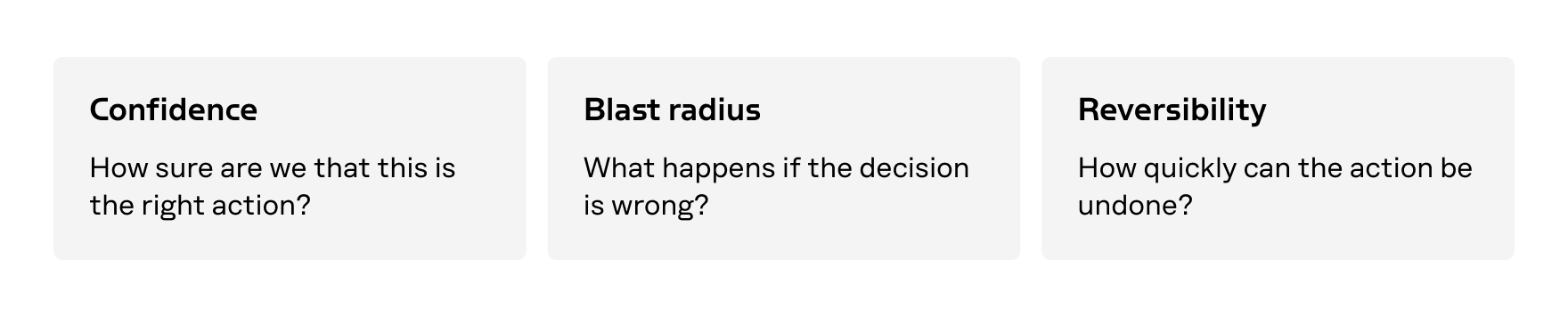
The three questions establish a simple relationship between autonomy and risk.
A low-risk action with high confidence and a tested rollback path can be automated. An action with uncertain outcomes, a large potential impact, or no reliable recovery path should require human review.
This framework also provides a useful structure for AI decision-making, particularly when teams assess the confidence, potential impact, and recovery options associated with automated actions.
Teams can use these criteria to define AI autonomy levels. Autonomy can range from human-approved recommendations to automated execution within defined boundaries. Different actions can have different authorization thresholds.
A routine service restart may require limited oversight. A configuration change affecting a critical production service can require approval before execution. The same AI agent can operate at different autonomy levels depending on the action, system, and business impact.
Get it wrong and you’ve built a very confident intern.
Why AI agents need operational context
AI for ITSM needs reliable data, but data quality alone does not provide enough information for safe operational decisions. A clean CMDB, accurate discovery, and reliable monitoring create a foundation. An agent also needs dependencies, current system state, change history, ownership, business impact, and information about how an action can be reversed.
Data quality is one of the most visible prerequisites for AI implementation, which can make it easy to overlook the operational context surrounding individual records.

These activities provide valuable foundations. An operational decision still requires context:
Is rolling back this deployment, on this system, right now, a routine correction or a Saturday-night incident?
A perfectly accurate record will not answer that question by itself.
Consider the same agent in two different environments.
In the first environment, the agent can see which services depend on the affected system. It has access to current telemetry, recent changes, service ownership, business criticality, and a tested rollback procedure. A known failure pattern appears after a deployment, and the available information supports a controlled remediation.
The agent has the context required to assess the action.
In the second environment, the agent has access to the incident ticket, several monitoring alerts, and a CMDB record describing the server. It cannot see the full dependency chain. Recent changes are incomplete. Business impact is unclear. The rollback procedure has not been tested.
The underlying agent technology remains the same.
The operational environment determines what the agent can safely do.
This is one of the central challenges in enterprise ITSM. The quality of an AI-driven decision depends on the information available at the time the decision is made. Forrester’s research on agentic service management also connects AI capabilities with AIOps and observability, highlighting the need for operational information to work across the service management environment.
For organizations preparing for AI adoption, this means that AI-ready data needs to include relationships and operational meaning alongside individual records.
Keeping humans in control of AI in ITSM
Human-in-the-loop AI for ITSM means establishing a defined point for human approval or intervention when an action reaches a predetermined level of uncertainty or potential impact. The approach allows low-risk automation to run independently and reserves human oversight for actions with greater consequences.
The goal is to calibrate autonomy to risk.
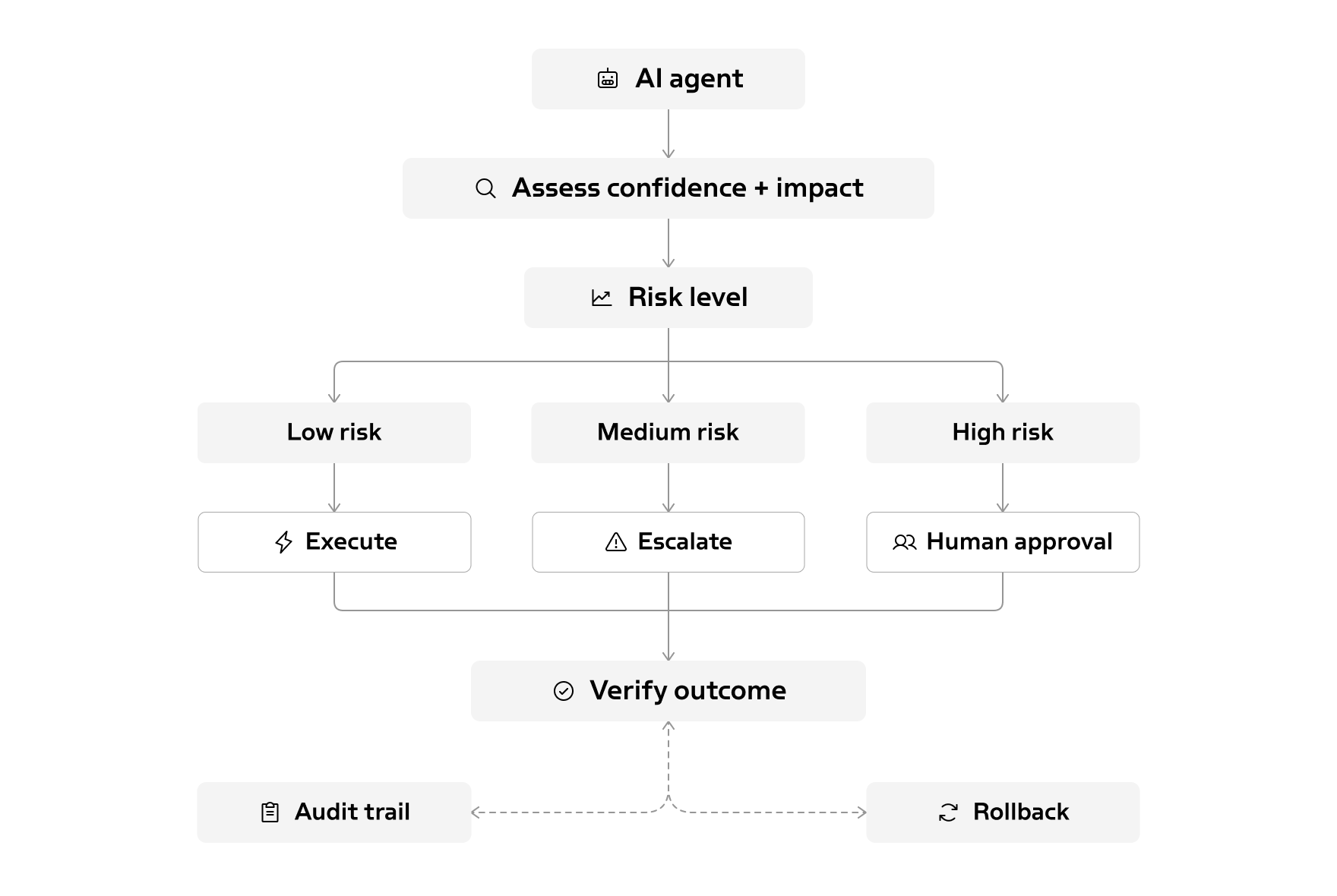
An automated restart of a non-critical service and a configuration change affecting a payment-processing platform should follow different approval rules, even when the same agent technology performs both tasks.
Human oversight can take several forms:
- approval before a high-impact action;
- escalation when confidence falls below a defined threshold;
- intervention when the observed result differs from the expected outcome;
- mandatory approval for changes affecting critical systems;
- automatic rollback when predefined failure conditions occur.
The system also needs auditability, teams should be able to see what information the agent used, what decision it made, which action it executed, and what happened afterward.
Gartner’s 2026 research on AI agent governance reinforces the need for differentiated controls. Gartner warns that applying the same governance model to agents with different autonomy levels and access scopes can lead to failures, and predicts that 40% of enterprises will demote or decommission autonomous agents by 2027 because of governance gaps.
For AI service management, human oversight belongs in the architecture from the beginning. The required level of intervention can change as teams collect evidence about system behaviour, improve operational data, and establish reliable controls.
This principle also applies to intelligent automation services, where automated workflows can be designed with defined controls, escalation paths, and human intervention points.
Human oversight can also remain part of the operating model through managed support services, particularly for environments that require structured L1–L3 support, ITIL-based processes, and continuous operational coverage.
The role of ITSM platforms in agentic operations
ITSM platforms provide workflows, service records, integrations, knowledge bases, automation capabilities, and increasingly sophisticated AI functionality. They provide an important operating layer for AI service management, but the platform itself operates within a wider environment of operational data, dependencies, controls, and infrastructure.
Platform consolidation can reduce the number of contracts, interfaces, and administrative environments an organization maintains. Bringing ITSM and ITOM capabilities under one vendor can also simplify selected integrations.
The broader operational picture still requires deliberate architecture. Service management records, monitoring information, infrastructure data, application information, and change management records need to connect in ways that support risk assessment when an agent is deciding what to do.
Platform-agnostic architecture can be useful in this environment. An organization may have ServiceNow, Jira, Freshservice, or another ITSM platform at the centre of its environment, alongside separate cloud, infrastructure, application management, and observability technologies.
For organizations using Jira and the Atlassian ecosystem, Atlassian Platform and Intellias covers platform implementation, integrations, automation, governance, and operations across the ecosystem.
The ITSM platform remains one component of the operational system an AI agent needs.
What to build underneath AI agents for ITSM
The foundation for AI agents for ITSM consists of connected operational data, decision controls, observability, integrations, and recovery mechanisms. This layer gives an agent the information and constraints required to operate at an appropriate level of autonomy.
Several capabilities are particularly important:
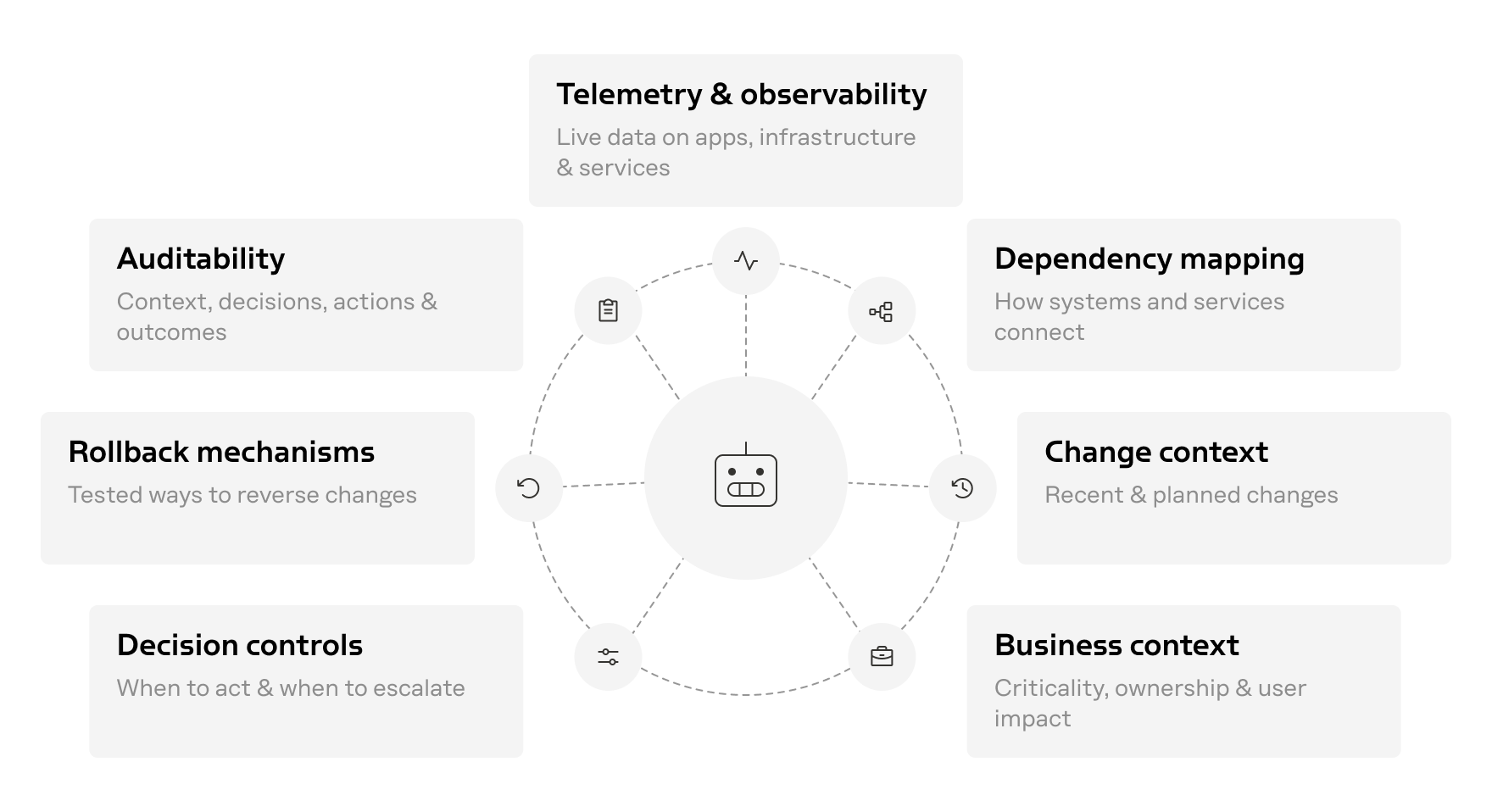
Infrastructure automation forms an important part of this foundation. So does the ability to connect information across platforms and operational domains.
Infrastructure automation service can support this foundation through infrastructure workflows, automation, monitoring, and controlled remediation.
This is where an implementation partner can contribute without replacing the organization’s existing ITSM platform. The architecture can remain platform-agnostic, with the supporting layer connecting ServiceNow, Jira, Freshservice, observability tools, cloud infrastructure, applications, and other systems.
The same principle applies across ITSM environments: ITSM AI agents should operate within a supporting architecture that reflects the organization’s existing technology landscape and operational requirements.
Building a practical path to agentic AI
AI readiness does not require every operational process to become autonomous at once.
A more controlled approach starts with use cases where the outcome is predictable, the operational context is available, and the action can be reversed. Teams can measure performance, identify failure patterns, improve the supporting data, and then consider broader autonomy.
This approach also provides a clearer basis for incident management automation. Ticket classification, information retrieval, routine service requests, and predefined remediation actions can be assessed separately from changes that affect critical infrastructure.
The same principle applies to AI-driven self-service. An AI-powered digital employee assistant can resolve routine requests and retrieve information without requiring the same autonomy level as an agent performing infrastructure remediation.
The implementation sequence should therefore follow the risk profile of the work.
Start with defined actions. Establish the information required to make them safely. Add escalation rules. Test rollback procedures. Measure the results. Then expand the agent’s authority where the evidence supports it.
The AI agent was always the easy part
Organizations will continue adding AI agents to ITSM platforms, service desks, and IT operations.
The harder task is creating an environment where AI agents have enough context to act safely, which means connecting operational data, defining autonomy levels, establishing human oversight, and making recovery possible before an agent receives production access.
Looking to introduce AI agents into your IT service management environment? Intellias can help assess your current technology landscape, identify suitable use cases, connect the required operational data, and build the automation and governance foundation for responsible AI adoption.
Talk to our experts about your ITSM and agentic AI strategy.