Most loyalty programs were built for a single storefront, and integrating them with new channels or systems is often complex and far from seamless. Some monolithic loyalty solutions are even delivered as standalone portals, further separating the program from the broader commerce experience. A headless loyalty engine for composable commerce works differently. It is an API-first rewards system that runs decoupled from the commerce frontend and backend, so points, tiers, and offers can be composed into any channel and changed independently, the same way the rest of a composable stack works.
What is a headless loyalty engine?
A headless loyalty engine separates the logic that calculates points, tiers, and rewards from the interface where a customer sees them. Instead of living inside a single ecommerce platform, that logic gets exposed through APIs, so any channel, a website, a mobile app, a point-of-sale terminal, a customer service tool, can call it and get the same answer.
Traditional loyalty software usually works the other way around. It gets bundled into the commerce platform itself or tied tightly to one storefront, so every new channel or integration means custom work on top of a system that was not built to be pulled apart. Headless loyalty software avoids that by design. The rewards logic stays the same no matter where the customer interacts with the brand.
Headless vs. composable commerce
The two terms get used together often enough that they start to blur, but they describe different things. Headless refers to decoupling the frontend from the backend, so a team can rebuild the customer-facing layer without touching the systems underneath it. Composable commerce implies the broader idea. It means building the entire commerce stack out of independent, best-of-kind services, cart, search, payments, rewards, connected through APIs instead of bundled into one vendor’s platform.
A headless loyalty engine fits into that picture as one composable capability among several. It does not have to be headless and composable at the same time, but in most modern stacks, the two go together.
The MACH pillars
MACH stands for microservices, API-first, cloud-native, and headless. It is the architectural pattern most composable commerce platforms are built around, and it defines how a loyalty engine is expected to behave inside that stack. Microservices mean the loyalty engine can be updated or scaled on its own, without redeploying the rest of the commerce platform. API-first means every function, earning points, redeeming a reward, checking a tier, is reachable by any other system without custom integration work. Cloud-native means it scales with demand instead of running on fixed infrastructure. Headless, as covered above, means the logic and the interface stay separate.
Anatomy of a headless loyalty engine
At the center of a headless loyalty engine is the flow from customer activity to a loyalty outcome. Connected commerce systems submit loyalty-relevant events, such as completed purchases, delivery updates, referrals, or other customer actions. These events are associated with a customer profile or session and evaluated against the program’s rules. For example, an external order management system can submit a delivery event that the rule engine evaluates before awarding loyalty points.
The rules engine determines how the program responds. Depending on the event and member context, it may award points, update progress toward a tier, apply a promotion, or issue a benefit. Loyalty rules may also govern qualification thresholds, point expiration, reward eligibility, and campaign-specific conditions. Salesforce’s loyalty promotion model illustrates how promotions can incorporate qualification targets, vouchers, point credits, enrollment, and status.
Approved point transactions are recorded in a loyalty ledger. Rather than storing only the current balance, the ledger preserves the credits, debits, expirations, and transfers associated with each member. This gives the program a transaction-level record of how balances change over time.
A separate reward-management component controls what members can access and how redemption works. It can define a reward’s point cost, eligibility criteria, availability, and status. Rewards may include discounts, vouchers, gift cards, digital items, physical products, partner benefits, or custom experiences. Fulfillment may happen inside the loyalty platform or be passed to an external system, depending on the reward type. Talon. One’s reward-management documentation explains how point costs, eligibility rules, usage rules, and reward statuses can be managed.
These components rely on a loyalty data model that connects each member with their point balances, tier status, benefits, rewards, partners, promotions, and transaction activity. A consistent member identifier links activity from connected channels to the correct loyalty account, while the API layer exposes the resulting balance, tier, and reward information to websites, apps, point-of-sale systems, and other touchpoints.
Building vs. buying a headless loyalty engine
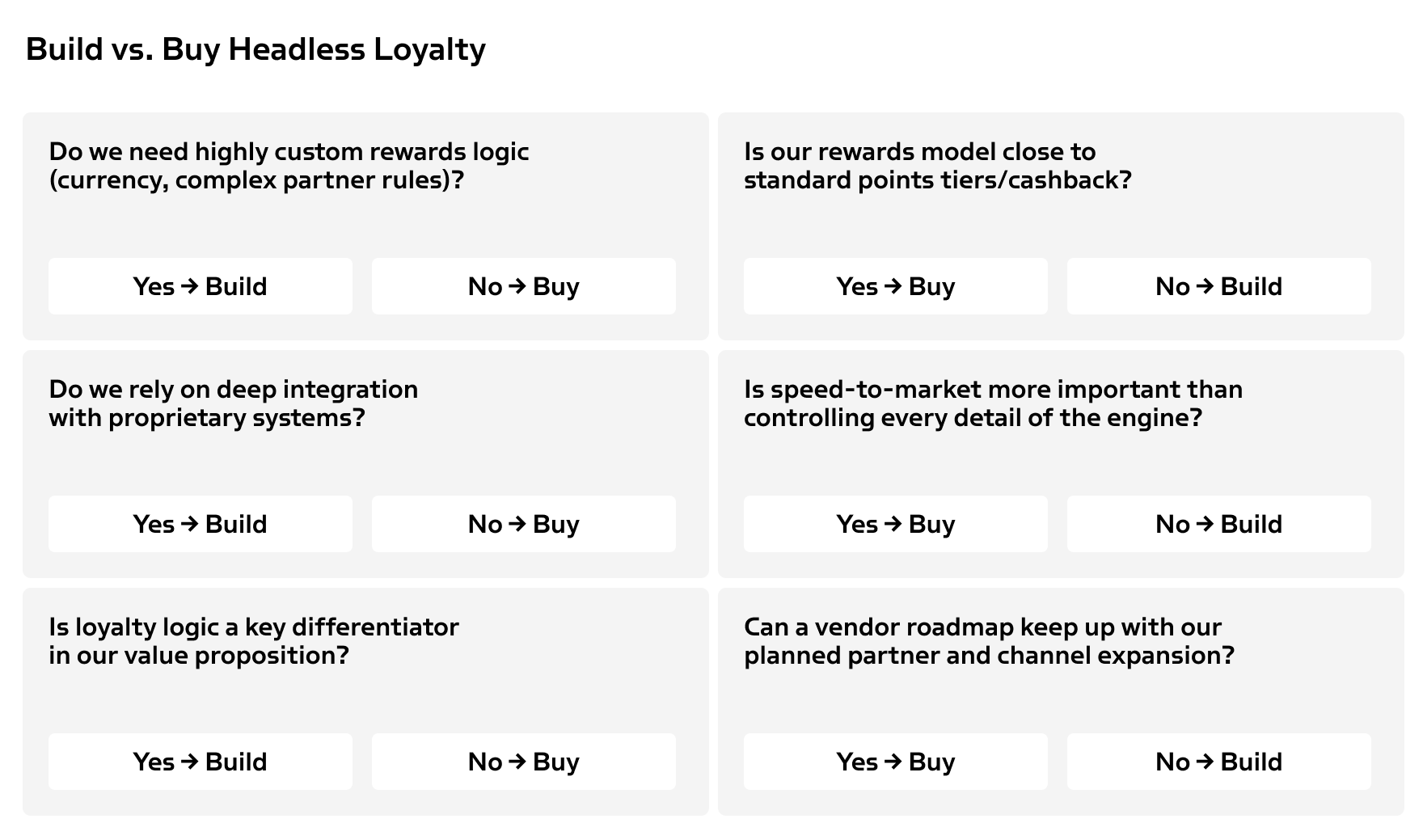
This is usually the first real decision point, and there is no single right answer for every headless loyalty program. Buying a best-of-kind loyalty platform and integrating it through APIs gets a program running faster, and it is often the better call when the core rewards logic, points, tiers, standard promotions, does not need to be highly custom. Building custom logic makes more sense when the program has requirements that off-the-shelf platforms do not handle well: complex partner networks, non-standard currency or points models, or deep integration with proprietary systems.
Organizations choosing the vendor route can evaluate a mix of broad enterprise suites and API-first platforms designed for composable architectures, including Salesforce Loyalty Management, Talon.One, Voucherify, Antavo, and Open Loyalty. These examples illustrate the range of available options, from platforms with broad loyalty management capabilities to specialized solutions focused on promotion rules, rewards, integrations, and composable commerce. The right choice depends on how closely a platform’s data model, rules engine, APIs, and integration options align with the program’s requirements.
A useful way to frame the decision: treat the loyalty engine like any other composable service. Buy the parts that are commodity, build the parts that are genuinely differentiating, and make sure both sides talk to the rest of the stack through the same API contracts. Teams that skip this framing tend to either over-invest in custom logic for problems a vendor already solved, or lock themselves into a platform that cannot handle a business rule they need six months later. Retailers going through a broader application modernization push in retail often hit this exact question when loyalty comes up as the next system to decouple.
A few questions tend to separate the two paths cleanly. Does the program need a rewards model a vendor already supports out of the box, points, tiers, cashback, or does it need something closer to a custom currency with rules a platform was not built for? Does the business plan to add partners or co-branded programs at a pace the vendor’s roadmap can keep up with? And how much of the value sits in the rewards logic versus in how well it connects to everything else already in the stack& None of these questions has a universal answer, but working through them before writing a line of integration code tends to be the difference between a build that scales and one that gets rebuilt in two years.
Integration patterns and implementation roadmap
The teams that get this right rarely start with a full rewrite. A phased approach, decoupling the loyalty engine first while leaving the rest of the commerce backend untouched, lets a team prove the architecture works before touching anything else. From there, channels get added one at a time: in-store, then mobile, then partner integrations, rather than all at once. That is true of headless ecommerce development generally; loyalty is just usually the piece teams save for last. It helps to treat the migration as a sequence of small, reversible steps rather than a single cutover: each added channel can be tested and rolled back on its own, without putting the whole program at risk if something in the integration does not behave as it did in staging.
Reference architecture
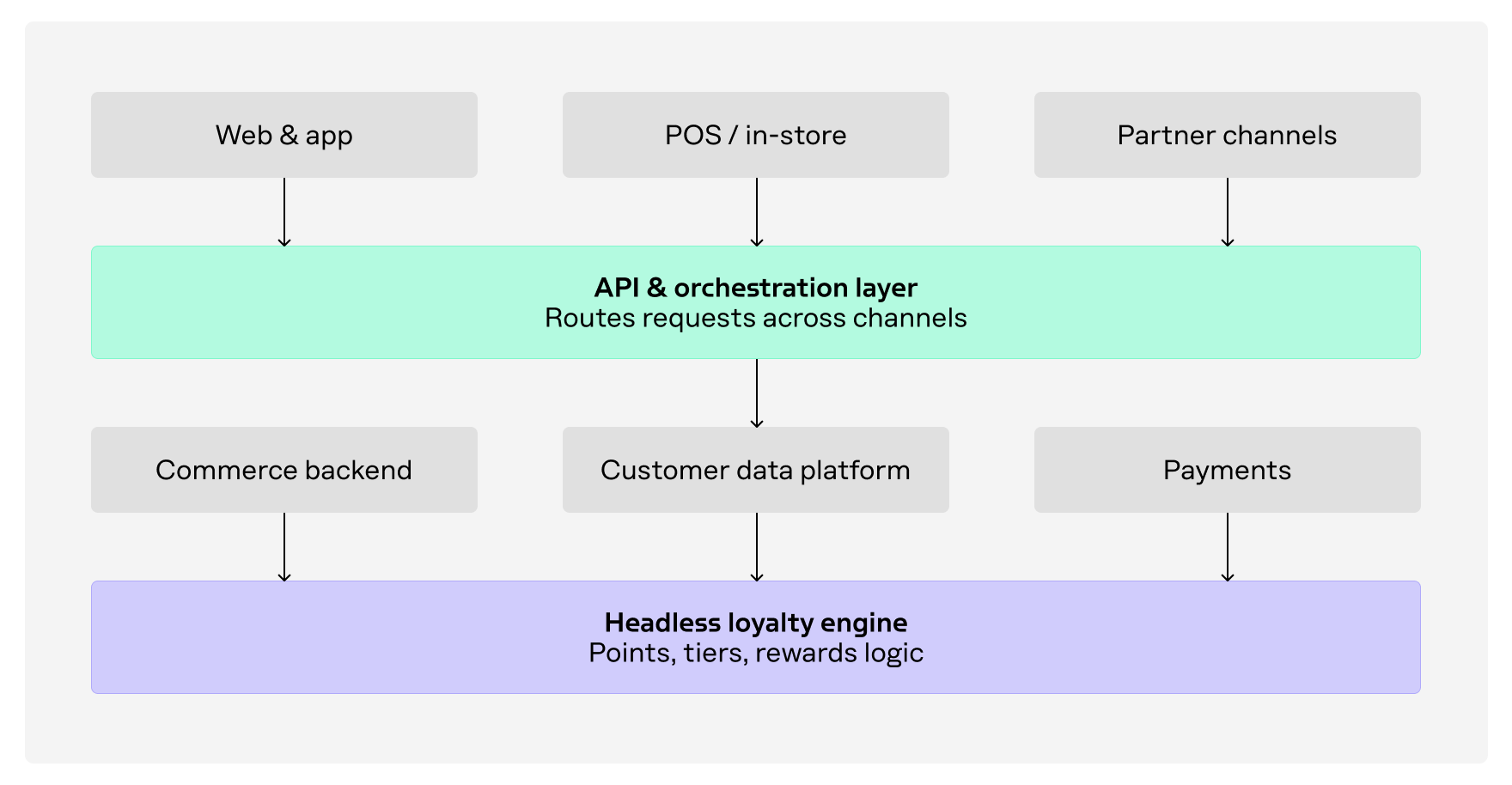
A typical setup looks like this. Customer-facing channels, web, app, POS, partner sites, sit at the top, calling into an API and orchestration layer. That layer routes requests to the loyalty engine, which runs independently and connects to the commerce backend, the customer data platform, and payments as needed. None of these systems need to know the internal logic of the others, only the API contract between them.
Common pitfalls
- Latency between the loyalty engine and the commerce backend, especially on real-time redemption at checkout.
- Data sync issues when multiple channels write to the same customer profile at once.
- Consent and PII handling across systems that were not designed to share a single customer record.
- Vendor lock-in when integration work gets built around one platform’s proprietary API instead of open standards.
Scaling the reward ecosystem
Once the architecture is in place, scaling means adding partners, channels, and personalization without repeating the original integration work. That is the payoff of decoupling the loyalty engine in the first place. New capabilities plug into the same API layer instead of triggering another platform migration. The same logic applies to any headless commerce engine meant to grow with the business.
The global loyalty market is projected to grow from roughly US$80.9 billion in 2024 to about US$155.2 billion by 2029, according to Research and Markets’ 2025 Loyalty Programs Market Intelligence and Future Growth Dynamics report. McKinsey’s 2026 Australian Consumer Loyalty Survey highlights where a lot of that growth is coming from: a shift from static customer segments to dynamic, AI‑enabled insight engines that integrate behavioral, transactional, and contextual data across channels. That kind of profile is difficult to maintain when loyalty logic lives inside a single platform, and considerably easier once it becomes the shared layer the rest of the stack calls into. As more of that growth gets driven by data pulled from every channel a customer touches, the architecture decisions made early on tend to determine how much of that growth a business can actually capture down the line.
If you are weighing what that build would take for your stack, our Ecommerce Development Services and Application Modernization Services teams can walk through the architecture and the integration work involved.
Ready to talk through your composable commerce roadmap? Contact us and we will set up time to look at your architecture.