An enterprise design system is the shared operating layer a multi-team product organization relies on: design tokens, reusable components, documented product patterns, and governance rules that define how those assets are created, changed, and used. A UI kit standardizes interface elements; an enterprise design system also standardizes the decisions and processes behind them.
The real work on a design system starts when a product organization recognizes that teams are repeatedly solving the same problems, recreating similar components, losing context, and spending delivery time aligning decisions that could already be shared.
The value of a design system appears far beyond visual consistency, in the way teams design, build, estimate, onboard, maintain, and evolve products.
When an enterprise design system isn’t worth building
An enterprise design system is most useful when product complexity, team size, or platform diversity creates enough repeated work to justify shared standards. A small MVP with a few screens and an unvalidated product hypothesis may need only a lightweight UI kit, basic styles, and a small set of design principles while decisions are still changing frequently.
That distinction is important because building a system introduces its own maintenance cost. Someone has to define components, document them, review contributions, publish updates, maintain design-to-code parity, and support teams that consume the system. Treating those activities as overhead is reasonable when the product is still changing at a fundamental level.
The need becomes clearer as a product grows. More teams introduce more interpretations of the same patterns. More platforms introduce differences in behavior and implementation. New designers and developers need to reconstruct decisions that previously lived in informal conversations. Product managers and delivery teams have to estimate work without knowing how much can be reused.
At that point, the cost is no longer the absence of a design system. It is the repeated work created by its absence.
Figma similarly frames design systems as something organizations should adopt according to their needs and maturity, with the process extending beyond components and styles into documentation, management, and ongoing use.
What is an enterprise design system?
An enterprise design system is a shared set of foundations, reusable interface components, product patterns, documentation, and governance practices that enables multiple teams to make and implement product decisions consistently. Its three practical layers are foundations, components, and product patterns supported by an ownership model.
At the foundation layer are design tokens, typography and spacing scales, color, iconography, primitives, responsive breakpoints, theming, and accessibility principles. A design token is a named representation of a design decision, such as a color, spacing value, or typography property, that can be shared across tools and platforms. The Design Tokens Community Group published its first stable specification in 2025 to support interoperable exchange of these decisions between design and development tools.
The component layer contains reusable interface elements with defined variants and states. A component library is the collection of those reusable UI components, usually accompanied by implementation guidance and documentation. At enterprise scale, that documentation needs to cover normal and exceptional states: default, hover, focus, disabled, error, loading, empty states, responsive behavior, nested components, and relevant edge cases.
This is the layer most teams associate with a design system, but it is only one part of the system.
The third layer is product patterns and governance. A product pattern describes a repeatable way of solving a product problem, including the purpose of the pattern, the decisions it supports, and the conditions under which it should be used. A product card, for example, is more than its visual component. Teams also need shared decisions about what information it prioritizes, how users compare products, which actions are available, and how the pattern behaves across the customer journey.
Governance determines how those decisions evolve. It establishes ownership, contribution processes, design review, versioning, deprecation, documentation, and the boundaries between local experimentation and system-level standards.
Established systems such as IBM Carbon, Google Material Design, Microsoft Fluent, and Shopify Polaris demonstrate different approaches to combining components, patterns, guidance, and organizational standards. Their relevance to enterprise teams is less about copying their individual components and more about recognizing that a mature system extends beyond a visual library.
Enterprise design system vs UI kit vs component library
A UI kit helps make the interface consistent; a design system helps make the decisions behind the interface consistent. A component library provides reusable implementation assets, while an enterprise design system connects those assets to foundations, product patterns, documentation, governance, and measurable adoption.
| UI kit | Component library | Enterprise design system |
|---|---|---|
| What it standardizes | Visual styles, basic elements, layouts | Reusable UI components and their implementation |
| Who owns it | Usually a designer or design team | Design and/or frontend team |
| Primary artifact | Figma assets, styles, templates | Design library plus coded components |
| What breaks without it | Visual consistency | Reuse and implementation consistency |
| Success metric | Adoption of styles and assets | Component reuse and design-to-code parity |
| Typical failure mode | Becomes a collection of visual assets | Becomes an archive of components |
This is the practical design system vs component library distinction. A component library can be technically complete and still fail to guide product decisions. A UI kit can be widely used and still leave designers and developers to resolve the same business and interaction questions independently.
The distinction also explains why simply publishing a Figma library rarely solves enterprise consistency. Teams need a reliable single source of truth, but they also need to know how that source is maintained and what authority it has.
The same principle applies to design system documentation. Documentation needs to explain not only what a component is, but when to use it, when not to use it, how it behaves, and where its implementation lives. Figma’s guidance similarly emphasizes documentation, feedback, contributions, updates, and making the system easy for its users to access.
Common design system mistakes at enterprise scale
Enterprise design system problems often appear as component inconsistency, duplicated work, or documentation gaps, but their underlying causes are usually organizational. The first case illustrates how a formally established system can still create operational friction when ownership, contribution rules, documentation standards, and Figma usage boundaries are unclear.
Context
The product already had a design system. Two designers worked across different product streams, both using and extending the shared system. A Product Owner also had access to the Figma files and could make changes directly.
The system therefore appeared to have the necessary ingredients: shared components, a design library, multiple contributors, and documentation.
Symptom
The practical experience was less consistent.
The designers documented decisions differently. There was no single standard for naming components, describing states, recording rules, or checking whether a proposed solution duplicated something that already existed. The Product Owner could also make local changes to working designs, including detaching components from the shared library.
A detached instance is a component instance that has been disconnected from its source component. Once detached, subsequent changes to the parent component no longer propagate to that instance.
That created a recurring maintenance problem. A designer could encounter a local variation without immediately knowing why it existed, whether it represented a deliberate product decision, or whether it should be returned to the shared system.
The result was that design work could begin with investigation rather than product design: identifying where a component had changed, which local overrides existed, and whether a variation represented a legitimate new requirement or accumulated design debt.
Root cause
The underlying problem was governance rather than a lack of UI assets.
The team did not have sufficiently explicit answers to several operational questions:
- Who owns the design system?
- Who can modify existing components?
- Who can propose or add new components?
- Which component states are mandatory?
- Where should design system documentation live?
- How should Product Owner feedback be provided without changing the underlying system?
- Which local variations should remain local?
- Which variations should enter the shared system?
- How should design and code remain aligned across platforms?
The experience also demonstrates why a strong delivery team can mask a weak system. Experienced designers, developers, and delivery managers can manually resolve duplication, synchronization, and communication problems for a long time. Those interventions keep the product moving, but they create invisible operational work.
Every restoration of a detached component consumes time. Every manual synchronization between streams consumes time. Every clarification about which version is current consumes time. Over time, those activities become a form of design debt: accumulated work created because decisions and standards are not maintained systematically.
What to change
The appropriate response is not another round of components. The system needs clearer ownership, a consistent documentation approach, defined rules for component changes, and a feedback process that allowes stakeholders to contribute without breaking the structure of working designs.
This is also where design review and contribution processes become important. An enterprise system needs an intake process for new patterns, criteria for deciding whether a contribution belongs in the system, and a defined path for publishing, versioning, and eventually deprecating components.
Result
The source case does not provide a quantified before-and-after result, so a numerical outcome should not be added to the published article. The operational conclusion is nevertheless clear: the team was spending delivery capacity on synchronization and restoration work that could have been prevented through governance.
Enterprise design system governance: who owns what
Enterprise design system governance defines ownership, contribution, change management, documentation, and adoption. A centralized team can provide consistency and accountability, while a federated model can bring product teams closer to the system. In both cases, responsibilities and decision rights need to be explicit.
Who owns an enterprise design system?
There are two common models.
A centralized model gives responsibility to a dedicated design system team. This team manages foundations, components, documentation, releases, and system-level quality. It can provide a clear source of authority, although it needs strong relationships with product teams to avoid becoming disconnected from real product work.
A federated model distributes contribution across product teams while maintaining shared governance and standards. This can improve adoption because teams have a direct role in shaping the system, but it requires clearer contribution and review processes.
A hybrid approach is often practical for large organizations: central ownership of foundations and governance, combined with structured contributions from product teams.
The 2022 Sparkbox Design Systems Survey found that only 44% of respondents reported having a governance model or product roadmap for their design system, while only 16% reported tracking metrics. Among systems viewed as successful, onboarding, contribution, training, and processes for determining what to add, update, or remove were much more common.
Who can change components — and who can’t?
The answer should be documented rather than inferred from organizational hierarchy.
A contributor may be able to propose a component, while only designated maintainers can publish it. Product teams may be able to create local experiments, while system-level changes require design review and implementation review. Product Owners may provide feedback without directly modifying shared components.
The objective is not to restrict contribution. It is to distinguish contribution from uncontrolled change.
How should design system changes be documented?
Design system documentation should cover the rationale and usage of a change as well as its visual and technical implementation.
For a component, that can include its purpose, variants and states, accessibility requirements, examples of correct and incorrect usage, responsive behavior, dependencies, code implementation, and relevant edge cases. A changelog should explain significant changes, while versioning and deprecation rules should make it clear how teams should migrate from older patterns.
The documentation can live across a Figma library, documentation site, code repository, Storybook, Confluence, or another enterprise design system management tool. The relationship between those sources should be clear, and teams should know where the authoritative information lives.
Which changes are local, and which enter the system?
A local variation is appropriate when a product team is testing a hypothesis or solving a genuinely isolated problem. A change should enter the shared system when the problem is recurring, the pattern has broader applicability, or multiple teams would benefit from the same decision.
That distinction should be supported by an intake process rather than informal judgment.
A mature workflow typically includes contribution criteria, design review, implementation review, accessibility checks, versioning, library publishing, changelog updates, and deprecation of obsolete patterns.
Where to start: the questions before the components
Teams looking at how to create a design system should begin by understanding the product and organizational problems they want the system to solve. A product strategy approach to identifying repeated decisions, ownership, and product priorities can provide a useful starting point before the team defines the component roadmap.
The practical questions include:
- Who is responsible for the system?
- Which repeated problems justify standardization?
- Which component states and accessibility requirements are mandatory?
- Where does current design system documentation live?
- How do designers and developers discover existing solutions?
- How are contributions reviewed?
- How are local experiments distinguished from system standards?
- How are versions released and old components deprecated?
- How is design-to-code parity maintained?
- Which metrics will show whether the system is improving delivery?
These are among the most useful design system best practices because they connect the system to the way teams actually work.
Design system ROI for enterprise companies
Design system ROI is best evaluated through delivery and product outcomes. Useful measures include component adoption, duplication, detached instances, onboarding time, UI-related defects, and feature lead time. In the second case, standardizing product patterns is associated with measurable improvements across the customer experience and delivery process.
Context
The second case involves a large e-commerce platform with multiple teams responsible for different parts of the customer journey. As the platform grows, team creates their own variants of similar solutions.
The issue is therefore broader than visual inconsistency. Teams lack a shared model for implementing recurring business and product decisions.
Symptom
Similar problems are being solved in different ways. Product cards, filtering experiences, promotional elements, and checkout-related patterns could vary between areas of the platform.
The design system have to mature from a collection of UI components into a pattern library that describe how recurring product problems should be addressed.
A product pattern answers questions such as what a pattern is intended to achieve, where it belongs in the customer journey, which decisions are standardized, and where teams have room to adapt it.
Root cause
The underlying issue is a lack of shared product logic.
Components could provide the visual and technical building blocks, but teams still need to make decisions about how those components should work together. Standardizing those decisions reduce the number of situations in which each team has to develop its own interpretation.
What to change
The system begins to function as shared product knowledge for business stakeholders, designers, and developers. The emphasis moves from selecting individual components to standardizing repeatable product patterns.
This is where the Intellias approach to product engineering becomes relevant to design system work: design-to-code parity is not simply a technical concern. It determines whether the decisions documented in the design system survive into implementation.
For organizations working across web, mobile, desktop, or multiple brands, the same principle applies to platform consistency. Application modernization initiatives can involve multiple application surfaces and technology stacks, making shared foundations and explicit platform rules particularly important.
Result
The team recorded a 25% improvement in shopping experience, a 15% speedup in feature delivery, and an estimated 8–13% reduction in implementation ambiguity.
These figures are useful because they connect the design system to outcomes beyond visual consistency. Better product-pattern alignment can reduce variation in the customer journey. Reusable solutions can shorten feature lead time. Shared decisions can reduce clarification and rework between product, design, and development.
Reported impact:
25%
better shopping experience
15%
faster feature delivery
8–13%
estimated reduction in implementation ambiguity
Metrics that show whether the system is working
A practical set of design system metrics should combine adoption, quality, efficiency, and organizational impact.
| Metric | What it indicates | Useful signal |
|---|---|---|
| Component adoption | Whether teams actually use the shared system | Percentage of relevant work using approved components |
| Detached instances | Where teams are overriding or bypassing the system | Number and trend of detached instances |
| Duplicate components | Whether teams are recreating existing solutions | Number of duplicates created or retired |
| Designer onboarding | How effectively the system transfers product knowledge | Time until a new designer works independently |
| UI-related bug volume | Whether shared standards reduce inconsistency | Number and type of recurring UI defects |
| Time to ship a typical feature | Whether reuse affects delivery velocity | Feature lead time before and after adoption |
The same principle applies to measuring design system ROI more broadly: select metrics that connect system activity to a business or delivery outcome.
External evidence supports this approach. Figma identifies usage, adoption, documentation, feedback, and impact measurement as central to realizing design system benefits. Sparkbox’s 2022 survey likewise found adoption, design-code parity, technical and creative debt, governance, and staffing among the major challenges reported by design system teams.
A large component count is therefore a weak success metric. A smaller system that teams trust, understand, and reuse can provide more value than a larger library that requires constant clarification.
Does AI replace an enterprise design system?
AI does not remove the need for an enterprise design system; it makes the quality of the system more consequential. AI-generated UI, prompt-to-component workflows, Figma AI, LLM-assisted documentation, and automated consistency checking all depend on usable product context. Structured tokens, components, patterns, and metadata provide that context.
AI can quickly generate interface variations, identify similar components, assist with documentation, detect potential duplication, and help teams explore alternatives. Those capabilities are most useful when the organization already has clear standards for what constitutes an approved component or pattern.
Without those standards, faster generation can increase inconsistency rather than reduce it. AI can produce another variant, but the organization still needs to determine whether that variant represents a useful product decision or another piece of design debt.
This makes the design system an important source of context for AI. Machine-readable design tokens, structured component metadata, documented usage rules, and consistent product patterns can give AI tools a better representation of the organization’s existing decisions. The W3C Design Tokens Community Group’s stable 2025 specification is one example of the industry moving toward more interoperable, machine-readable design decisions across tools.
AI can speed up production. A design system has to provide direction.
The enterprise design system maturity model
Design system maturity can be understood as a progression from shared visual assets to a governed operating layer that can provide reliable context to AI.
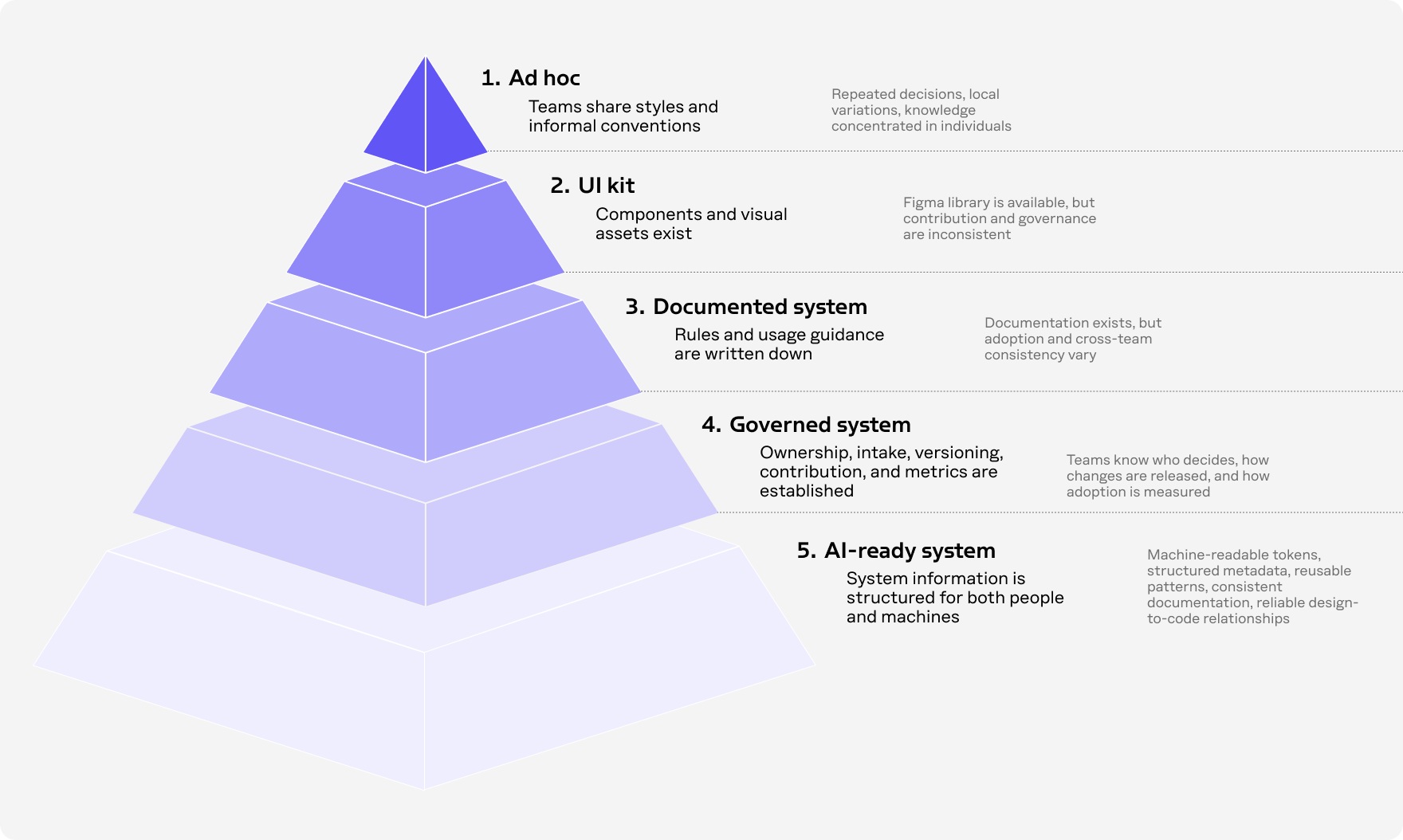
The first client case corresponds approximately to Level 2: the organization had shared components, but unclear governance and change boundaries reduced the system’s practical value.
The second case is closer to Level 4: the system was being used to standardize product patterns and support repeatable decisions across teams, with measurable effects on delivery and customer experience.
The fifth level does not mean that AI manages the design system independently. It means that the system is structured well enough for AI tools to use organizational standards as context rather than generating isolated solutions.
Interested in how to build a design system from scratch? Talk to Intellias about a design system audit and governance engagement.