The demo ends. The AI drafted a clean clinical note, routed a patient to an appointment, and flagged an abnormal reading. On screen, the entire encounter looks perfectly smooth.
Then someone asks the question the demo never answered: What happens when the clinician disagrees with the AI?
That is where the buying decision begins. AI now touches everything from patient intake and live visits to documentation, image analysis, and monitoring. The feature list tells only part of the story. Clinicians need useful outputs. Healthcare leaders need workflows that hold up. Procurement and engineering need to know what can be integrated, supported, and governed long after the demo.
The best telehealth AI choice depends on the clinical workflow you’re improving, the systems it must connect to, and the evidence supporting its use.
- Buy a virtual-care platform when visit delivery, EHR integration, and operational consistency are the main requirements.
- Embed specialist AI when documentation or intake is the gap in an otherwise workable telehealth product
- Evaluate diagnostic AI separately for intended use, regulatory status, clinical performance, and escalation.
- Pilot with real clinicians and measure corrected notes, workflow time, patient experience, and safety exceptions
How is AI used in telehealth? It can collect a patient’s history, suggest routing, draft clinical notes, assess specific images or signals, and prioritize monitoring alerts. Those are distinct jobs, with distinct risks. Some products cover several; others do one well. The surrounding clinical workflow determines how much value reaches the care team.
How AI in telemedicine fits into the care cycle: layers and risks
One visit may involve several AI systems with little in common beyond the label. A strong scribe tells you nothing about triage safety. Authorization for a particular imaging device does not validate the entire virtual-care platform. Separate the jobs before comparing the products.
| Layer | Typical function | What buyers must verify |
| Before the visit | Conversational intake, symptom collection, scheduling and routing | Escalation rules, exclusions, language performance, where the intake record lands |
| During the visit | Captioning, translation, image or device-data analysis | Intended use, accuracy in the target setting, clinician visibility, fallback process |
| After or during the visit | Ambient transcription and draft clinical notes | Note quality, attribution, EHR workflow, consent, correction and signing |
| Between visits | Remote patient monitoring and alert prioritization | False alerts, missed events, ownership of the work queue, response times |
Each layer has its own failure modes, evidence requirements, and often its own budget owner. That distinction also matters when designing broader AI healthcare solutions.
Top telehealth AI solutions at a glance
The following market map includes full virtual-care platforms and specialist AI tools for enterprise teams who are choosing between replacing the platform and improving one part of it. They are not interchangeable, and the entries here are not endorsements, nor performance ranks.
| Option | What you are buying | AI capabilities | Best fit for | Due-diligence priority |
|---|---|---|---|---|
| Teladoc Health Solo | Enterprise virtual-care platform | SoloScribe ambient documentation; SoloVitals contactless vitals | Hospital virtual care and nursing workflows | Verify SoloScribe availability and SoloVitals preview status |
| Amwell Converge | Enterprise virtual-care platform | EHR-embedded visits; captioning and translation; NLP triage and routing | Health systems prioritizing EHR-centered visits with multilingual populations | Demonstrate exact EHR and AI integration scope |
| Doximity Dialer + Scribe | Clinician-facing telehealth and documentation tools | Free ambient scribe inside telehealth calls | Individual US clinicians and smaller groups | Confirm eligibility, recording handling, and organization-level controls |
| Zoom Workplace for Clinicians | Healthcare-oriented communications environment | AI-based clinical notes integrated with the EHR | Organizations already standardized on Zoom | Confirm clinical AI release status and EHR write-back |
| Doxy.me | Browser-based telehealth | Built-in AI scribing and transcription | Practices prioritizing simple patient access | Verify eligibility, rollout status, and documentation workflow |
| Microsoft Dragon Copilot | Clinical documentation/assistant layer | Ambient notes, orders, and summaries inside Epic and other EHRs | Organizations enhancing existing clinical workflows | Test telehealth capture and EHR workflow in the licensed configuration |
| Abridge, Suki, Nabla, Freed, Heidi | Specialist ambient documentation tools | Visit-to-note, coding suggestions; telehealth-ready | Organizations adding AI notes without replacing video visits | Compare specialty note accuracy, integration, and total cost |
| K Health / Counsel Health | AI-supported care-access models | AI intake chat leading to a clinician visit | Teams studying structured intake and clinician handoff | Verify what is purchasable or embeddable versus part of their own service |
| Talkspace / Headspace | Virtual behavioral health services support | AI notes and risk indicators for clinicians; AI companion between sessions | AI-assisted therapy workflows | Separate clinician support from consumer AI companion functions |
| TytoCare / Skin Analytics | Remote-exam and image-analysis technologies | FDA De Novo eardrum-bulging AI; autonomous skin-cancer AI (DERM, CE-marked, EU/UK only) | Selected visual AI diagnostic or referral pathways | Confirm jurisdiction, device authorization, and intended use |
AI-powered telehealth platforms and tools: overviews and key considerations
1. Teladoc Health Solo: virtual care with added AI
Teladoc Solo is built for virtual care across hospital departments, with AI now entering the picture. In October 0226, Teladoc introduced SoloScribe for automated clinical notes and SoloVitals for camera-based vital sign measurements. SoloScribe is generally available, while SoloVitals is still in private preview, with broader availability expected in December 2026.
Before buying, test how notes reach the EHR, how corrections work, and what happens when camera measurements fail.
Best for: Hospitals evaluating a coordinated virtual-care platform, including virtual nursing, observation, and other smart hospital solutions.
2. Amwell Converge: integration matters more than the AI catalog
Amwell Converge focuses on fitting virtual care into existing clinical systems. Its Google Cloud collaboration describes AI capabilities such as translation, captioning, and patient routing, though buyers should verify what’s included in their configuration.
The real test happens during a visit. Can clinicians move from patient records to documentation and follow-up without jumping between screens or reentering information?
A polished integration diagram means little if the daily workflow remains clunky.
Best for: Larger health systems prioritizing EHR integration, consistent workflows, and healthcare interoperability.
3. Doximity Dialer + Scribe: AI documentation built into clinician communication
Doximity brings AI documentation directly into patient calls. With Scribe in Dialer, clinicians can conduct supported phone or video visits, generate draft notes, and edit them afterward.
Its appeal lies in fewer tools to juggle. But check how notes reach the EHR, since copying them manually may still be necessary.
Privacy deserves attention, too. Doximity describes deleting audio after transcription and retaining notes and transcripts for up to 29 days. Confirm the applicable terms.
Best for: Eligible US clinicians adding AI documentation without replacing their telehealth setup.
4. Zoom Workplace for Clinicians: familiar video tools with clinical AI capabilities
For healthcare teams already using Zoom, adding clinical AI may be a natural next step. In 2026, Zoom announced integration with Epic Haiku and Hyperspace, bringing AI-assisted documentation into supported workflows.
The question is how smoothly it works in practice. Can clinicians capture an encounter, review the draft, and sign off within their existing Zoom and Epic setup?
Check licensing, supported workflows, and how information syncs before assuming the integration is ready to use.
Best for: Healthcare organizations already using Zoom, especially those with Epic.
5. Doxy.me: simple virtual visits with AI documentation
Doxy.me keeps virtual visits simple: patients join through a browser, without downloading an app. Its built-in Scribe adds AI-generated clinical notes, including SOAP, DAP, PIE, and intake formats.
There’s one limitation worth knowing: Scribe is in early access for paid US users. Notes can be downloaded or copied into an EHR, which may leave some manual work.
Check eligibility and whether that extra step fits your practice before replacing an existing documentation tool.
Best for: Smaller practices seeking straightforward telehealth with optional AI documentation.
6. Microsoft Dragon Copilot: AI layer on top of the visit platform
Microsoft Dragon Copilot isn’t a telehealth platform. It’s an AI assistant that captures clinical conversations and drafts notes for review. Depending on the setup, it can also prepare referral letters, encounter summaries, and after-visit instructions.
The question is how well it works alongside your current systems. Test remote audio capture, EHR integration, and challenging encounters with interruptions or multiple speakers.
The payoff should extend beyond a single video visit: less documentation work across virtual and in-person care.
Best for: Health systems looking to ease clinical documentation workloads.
7. Abridge, Suki, Nabla, Freed, and Heidi: specialist AI scribes
Sometimes the best telehealth AI upgrade is simply less paperwork. Abridge, Suki, Nabla, Freed, and Heidi focus on clinical documentation without requiring a new virtual-care platform. Their integration options, deployment requirements, and documentation workflows differ, though.
Their differences become clear when you test them. Run the same remote visits through each tool and compare accuracy, speaker identification, editing time, and EHR transfer. A polished draft is useful. A polished draft that still takes considerable effort to move into the patient chart is clearly less so.
Best for: Practices and health systems looking to reduce documentation work while keeping clinicians in control.
8. K Health and Counsel Health: AI at the front door of care
AI can help patients reach appropriate care before a traditional appointment begins. K Health offers AI-supported access to care, while Counsel Health combines medical AI with physician-supervised messaging.
These aren’t interchangeable software products, so the buying questions differ. Are you considering a care service, a partnership, or technology to integrate into your patient experience? Most importantly, examine the handoff: when does AI stop gathering information and a clinician step in?
Best for: Health systems, payers, and digital-health teams exploring AI-assisted intake and care navigation.
9. Talkspace and Headspace: clear boundaries of AI in mental healthcare
AI in mental healthcare serves different purposes, from helping therapists with paperwork to supporting patients between sessions.
Talkspace offers Smart Notes and Smart Insights for documentation and preparation, AI-assisted risk indicators, and a patient-facing guide called Tee. Headspace’s Ebb offers conversational support and self-reflection.
Those roles require different safeguards. Clinical notes need therapist review; patient-facing companions need clear limits around advice, privacy, and crises, and they clearly don’t replace professional care.
Best for: Behavioral-health organizations exploring AI documentation, risk monitoring, or support alongside licensed care.
10. TytoCare and Skin Analytics: AI that adds clinical evidence to remote care
These tools take remote care beyond video calls, helping clinicians assess specific medical findings.
In March 2026, the FDA granted De Novo classification to TytoCare’s eardrum-bulging detection software for patients six months and older. Results support, rather than replace, clinical assessment.
Skin Analytics’ DERM supports skin cancer assessment in defined pathways, with Class III CE certification and reported NHS use. CE certification doesn’t equal FDA authorization.
Best for: Providers expanding remote examinations or dermatology services where clinical validation and medical device software requirements matter.
AI tools for telehealth visit documentation: where the time goes after the call
The video visit ends. The clinician still has a note to finish, a chart to update, and perhaps a referral to prepare. For many providers, this is the first place AI can make a measurable difference.
AI documentation tools take two main forms: capabilities built into virtual-care platforms and specialist scribes used alongside existing clinical systems. Both aim to reduce manual charting. What separates them is how they capture a conversation, structure the note, and get it into the medical record.
Ambient AI for telehealth platforms: how a video call becomes a clinical note
Ambient AI captures the conversation and generates a structured draft for clinician review. Separate patient and clinician audio channels can improve speaker attribution, though overlapping speech, poor connections, and interruptions still create challenges. The harder part is getting the draft into the right chart without creating another manual step.
Native documentation tools may fit more naturally into the visit itself. Specialist scribes may suit organizations that need consistent documentation across virtual and in-person care. Either way, the evaluation should follow the note from the first spoken word to the signed chart. Test missing audio, overlapping speakers, medication corrections, and interrupted visits.
AI scribes for telehealth visits: what recent research shows
Clinical research offers a useful counterweight to vendor-reported time savings. In a 2025 randomized trial at UCLA Health, researchers evaluated two commercial ambient scribes across 238 physicians and approximately 72,000 encounters. Physicians assigned to Nabla showed a statistically significant reduction of roughly 10% in documentation time compared with usual care. Results differed between the products evaluated.
The finding does not establish Nabla’s superiority over other scribes outside the trial. It shows why similar features don’t guarantee similar clinical results.
A 2025 JAMA Network Open study reported that measured clinician burnout declined from 51.9% to 38.8% among clinicians after an ambient scribe was introduced. Its pre-post design limits causal conclusions, but the result gives healthcare leaders another outcome worth measuring.
A clinical pilot should assess:
- Note accuracy: Missing findings, invented details, speaker attribution, and clinically significant corrections.
- Clinician effort: Review time, time to sign, and documentation completed after hours.
- Workflow reliability: Failed captures, EHR transfer errors, and recovery time.
- Patient experience: Consent, comfort with recording, and disruption to the consultation.
- Total cost: Licensing, integration, training, support, and the value of time saved.
A faster first draft is encouraging. The stronger result is a clinical record that requires less effort to complete without losing accuracy.
Best AI note taker for telehealth and medical calls
General meeting assistants like Otter and Fireflies can transcribe conversations, but clinical documentation demands more: accurate medical terminology, appropriate note structure, and reliable handling of uncertain or missing information. A SOAP or DAP note must accurately reflect the encounter on top of producing a convincing summary.
The best AI note taker for telehealth should also fit the EHR workflow, protect patient data, and leave clinicians in control of the final record.
HIPAA-ready AI chat for telehealth intake and triage
AI chat can collect symptoms, medical history, and appointment details before a virtual visit. When an AI symptom checker for telemedicine providers begins assessing urgency or directing patients to care, clinical safety becomes a bigger consideration.
For healthcare buyers, the key question is whether the system can recognize uncertain or concerning cases and pass them to a clinician with the original patient responses intact.
What makes AI chat HIPAA-ready for telehealth intake
For teams comparing the top HIPAA-ready AI chat for telehealth intake, a compliance badge is not enough. Three areas need separate assessment.
| Area | What to verify |
|---|---|
| Privacy and security | A business associate agreement (BAA) where required, access controls, encryption, audit logs, data retention, and permitted uses |
| Clinical safety | Validation for the intended use, escalation of urgent or uncertain cases, and clear separation of patient responses from AI interpretations |
| Procurement and operational fit | Performance across relevant patient populations and languages, clinician access to intake records, and integration with care workflows |
As HHS guidance explains, a BAA does not replace risk analysis or other applicable HIPAA obligations. Clinical safety requires separate evaluation.
Beyond video visits: telehealth AI agents, visual assessment, mental health, and remote monitoring
AI in telehealth is increasingly useful where a video call alone falls short: examining patients remotely, supporting behavioral health, and tracking conditions between appointments.
In dermatology, AI can assess images of suspicious skin lesions and help prioritize referrals. Skin Analytics’ DERM, for example, supports skin cancer assessment within established clinical pathways. For ENT examinations, TytoCare uses AI to analyze otoscope recordings for signs of eardrum bulging. Both depend on clinically usable images and clear next steps when findings are uncertain.
Contactless monitoring offers another approach. Teladoc’s SoloVitals estimates heart and respiratory rates through a device camera, although it remains in private preview as of October 2026.
In behavioral health, AI can assist clinicians with documentation and session preparation or provide conversational wellness support. These uses require different safeguards, especially when patients show signs of distress.
Remote patient monitoring extends care beyond appointments. iRhythm’s Zio, for instance, uses AI-assisted ECG analysis to identify arrhythmias for specialist-reviewed reports.
The core challenge across all these setups stays the same: getting accurate information into the hands of the right clinician, and making sure nothing falls through the cracks.
How AI-enabled telehealth platforms will mature in 2026–2028
From the Intellias perspective, the next phase of AI-enabled telehealth will depend on what happens after AI generates a note, recommendation, or clinical signal, and whether organizations can connect that usage to operational and clinical outcomes of AI in telemedicine.
The products reviewed here suggest six design priorities for the coming years, shaped by clinical evidence, regulation, and organizational readiness.
1. From separate AI tools to embedded clinical workflows
AI documentation is moving into clinical encounters, making accurate patient identification, EHR access, permissions, and data exchange more important.
What it means for builders: Make sure AI-generated notes reach the correct patient chart. Respect clinician permissions, prevent duplicate records, and handle failed integrations. Even an accurate note has little value if it ends up in the wrong chart or never reaches the EHR.
2. From draft notes to supervised actions
AI already helps with clinical documentation and administrative tasks. The next step could be preparing referrals, follow-up messages, and prior-authorization documents for clinician approval.
What it means for builders: Distinguish drafting an action from executing it. Define who can approve each action, preserve supporting information, and record who authorized it. A suggested referral and a submitted referral carry different risks.
3. From single-purpose inputs to multimodal encounters
A transcript, an otoscope recording, and a camera-based measurement provide different kinds of clinical evidence. Each has its own source, timestamp, quality, and limitations.
What it means for builders: Track where each input comes from and distinguish patient-reported symptoms from measurements and AI-generated assessments. Clinicians need to know what supports each finding and how reliable that evidence is.
4. From scheduled calls to selective asynchronous care
AI-supported intake and remote assessments could allow clinicians to review more cases outside live appointments. The challenge is deciding which cases can wait, for how long, and when a patient needs a live consultation.
What it means for builders: Define which cases qualify for asynchronous review, how quickly clinicians must respond, when to escalate, and who handles each case. Patient safety should guide routing decisions, not targets for reducing appointments.
5. From documentation to compliance built into software
Clinical documentation, mental-health support, and diagnostic AI face different regulatory requirements.
What it means for builders: Build access controls, consent management, audit trails, data retention, incident tracking, and AI model-change controls into the software. For regulated AI-enabled medical devices, development plans should also consider the FDA’s guidance.
6. From adoption figures to evidence of clinical value
Documentation shows why adoption alone is a weak measure of success. The UCLA trial proved that results vary even between products developed for the same task.
What it means for builders: Measure note corrections, time to sign, after-hours charting, failed EHR transfers, patient acceptance, and safety issues. Compare results across specialties and workflows to see where AI delivers measurable improvements.
Build, buy, or embed: choosing your telehealth AI stack
After comparing the top telehealth AI solutions, buyers face another decision: how much of the technology should they purchase as a complete platform, add to existing software, or develop themselves? The answer depends on the care model and the systems already in place.
For providers replacing fragmented systems, a supported platform may be the simplest path. For digital-health companies that already own the patient experience, adding a specialist AI can improve an existing telehealth service and preserve existing investments. Custom development makes more sense when the clinical workflow or underlying data model is central to the product’s value.
A modular stack still needs coherent operation. Connecting a video platform, AI scribe, EHR, intake service, and monitoring tool introduces multiple vendors, data transfers, and possible points of failure.
| Approach | When it makes sense | Relevant examples | What to evaluate |
|---|---|---|---|
| Buy a virtual-care platform | You need a reliable way to deliver virtual visits and manage clinical workflows | Teladoc Solo, Amwell Converge, Zoom Workplace for Clinicians, Doxy.me | EHR integration, patient access, administration, support, and available AI features |
| Add specialist AI | Your telehealth platform works, but documentation or another specific task needs improvement | Dragon Copilot, Abridge, Suki, Nabla, Freed, Heidi; Doximity Scribe where its communication workflow fits | Clinical accuracy, EHR integration, data handling, licensing, and costs |
| Build or integrate a specialized workflow | Your care model requires custom intake, monitoring, or clinical assessment | K Health and Counsel Health as care-access examples; TytoCare and Skin Analytics as specialized technology examples | Integration options, clinical validation, regulatory requirements, and ongoing maintenance |
For organizations building or extending their own platforms, AI telemedicine software development starts with clinical and operational requirements. They help determine which parts of the technology to buy, integrate, or own so that telehealth and AI become a useful part of care.
Five steps to a sound buying decision
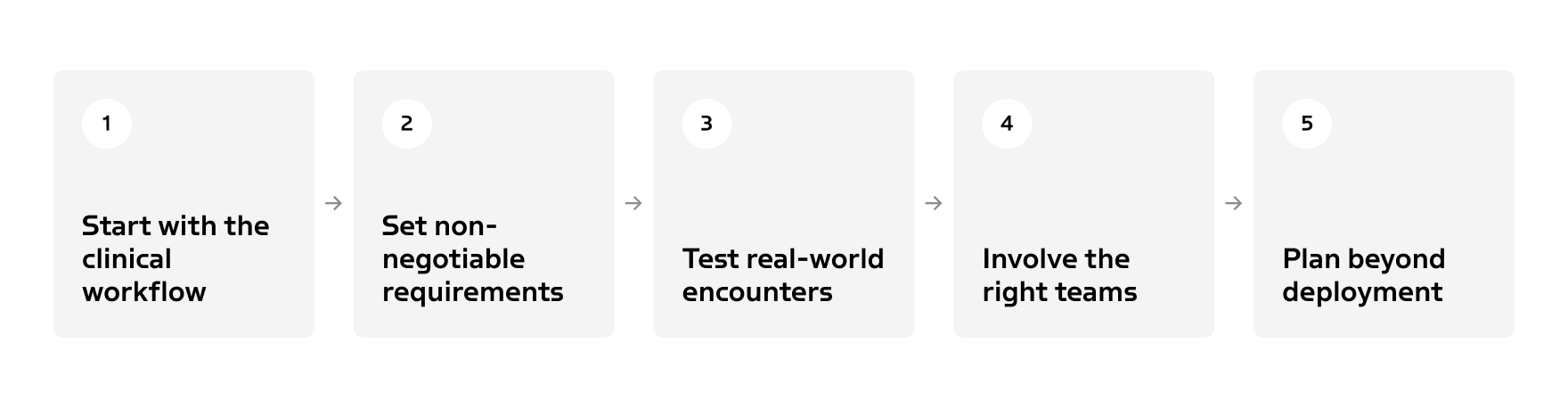
- Start with the clinical workflow. Map what happens from patient intake to final documentation and follow-up. Identify the specific step AI should improve.
- Set non-negotiable requirements. Establish standards for data protection, regulatory compliance, EHR compatibility, and reliability.
- Test real-world encounters. Include complex histories, interruptions, poor audio, and specialty-specific cases. Measure the entire workflow.
- Involve the right teams. Bring clinical, engineering, security, and procurement stakeholders into the decision early.
- Plan beyond deployment. Cover support, incident response, updates, data portability, product or model updates, and exit options.