Show case
Physical Performance Analyzer
E2E Testing Framework is an Intellias’ AI-enabled solution that automates end-to-end automotive infotainment testing of in-vehicle voice assistance systems and digital cockpits, from requirements to nightly regression on head units in the lab.
With every release, digital cockpit teams have more voice, navigation, and media functions to retest. The most important scenarios span several systems: a driver’s request has to produce the right answer, screen, and action in the vehicle. Component tests can pass while that journey fails, and scripted automation breaks when voice replies vary in wording. As a result, these checks often stay manual, and regression slows down releases. Where infotainment testing automation is in place, device faults show up as failed tests, and results rarely carry enough evidence to tell a product defect from lab noise, so engineers recheck runs by hand.
The automotive infotainment testing framework automates these journeys end to end. AI agents turn requirements and manual test cases into tests, or testers describe scenarios in plain language. Every night, the framework speaks to the head unit, grades the answer, screen, action, and voice quality separately, and stores the evidence behind each verdict. Reports are ready before engineers start their day.

Each new cockpit function adds scenarios to retest across builds. Manual regression expands until it starts to delay releases.

Speech, UI, and navigation are usually tested separately. A user journey can fail even when every component passes its own tests.

A voice assistant can phrase a correct answer in different ways. Scripted checks that expect exact wording fail on valid responses and need regular maintenance.

Audio latency and the behavior of physical ECUs are difficult to reproduce in simulators. Some defects surface only on the head unit itself.
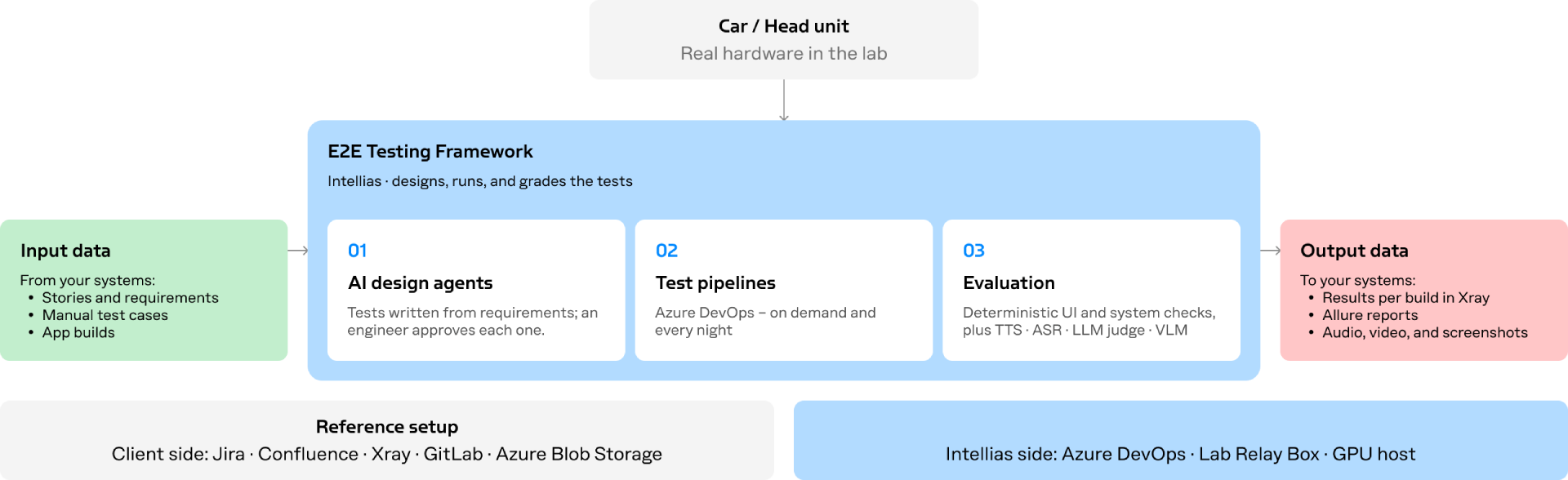
Tests can start in two ways. AI agents read user stories, acceptance criteria, and existing manual test cases from Jira, derive test cases, and write the runnable scenario. Each generated test passes a hardware-free review gate, and an engineer approves it before merge. The in-vehicle infotainment testing framework can also explore the head-unit interface on its own and discover key controls and screens. Alternatively, a testing engineer can write the scenario in plain language, and the framework turns it into a voice prompt and a set of checks
During a run, text-to-speech (TTS) delivers the wake word and command to trigger the head unit’s own voice assistant, and automatic speech recognition (ASR) transcribes the reply. Each infotainment automation testing run then receives four verdicts. An LLM judge scores the answer against the intent of the request. Screen and action verdicts rely on deterministic checks of the UI hierarchy and system state through UI Automator 2, for example, that a route was created. Where no deterministic check can reach the screen, a vision-language model (VLM) reads it. Voice quality is graded as a separate verdict.
Every test run saves audio, video, screenshots, and full run data, so each verdict can be reviewed later.
Engineers stay in control of what reaches the nightly suite. A new test joins it only after it passes consistently on a debug device. Before each nightly run, a preflight step brings up the head unit through the lab relay box and resets it to a clean state. An unresponsive device is reported as an infrastructure issue and kept out of test results. Infrastructure retries are tracked separately, and the test design owner triages the remaining failures into test defects and product defects.

Validate the full driver journey – Check the spoken answer, the screen, and the resulting system action in one automated scenario.

Make test creation accessible – Let testers describe scenarios in plain language or generate them from existing requirements and manual test cases.

Deliver verdicts teams can verify – Keep infrastructure faults out of defect reports and store the evidence behind every result.

Run regression every night – Prepare results before the working day begins.

Four verdicts per run – Answer, screen, action, and voice quality are graded separately, so a report shows which part of the journey failed.

Autonomous UI exploration – The framework navigates the head-unit interface on its own and discovers key controls and screens.

Full evidence capture – Every run stores audio, video, screenshots, full run data, and an Allure report.

Requirement traceability – Acceptance criteria flow in from Jira, and test cases and results flow out to XRAY, so each test stays linked to the requirement it covers.

Lab Relay Box and preflight checks – Each nightly run starts with device bring-up and a clean state, and device faults are reported separately from test results.

Separate development and regression flows – New tests go through their own pipeline, and the framework is designed to run development and nightly regression on separate device pools.

Modular skills – New capabilities are added as skills, so the framework can extend to other vehicle domains, mobile apps, and web interfaces.

A test team needs to verify that the voice assistant handles a navigation request correctly: the voice assistant answers, the screen shows the destination, and the head unit sets the correct route.
An AI agent derives the test from the Jira user story and acceptance criteria, or a tester writes it in plain language. After a hardware-free review gate, an engineer approves it.
The test runs on a debug device until it passes consistently, then joins the nightly suite.
The head unit is brought up through the lab relay box and reset to a clean state.
TTS speaks the wake word and a navigation request to the head unit.
ASR transcribes the reply, and the LLM judge scores it against the intent of the request.
UI Automator 2 confirms that the correct route is set, and a VLM checks the navigation screen where needed.
The evidence bundle and Allure report are uploaded, results are published as an XRAY test execution for the build, and confirmed product defects are logged in Jira.
Each verdict is reported separately. A correct spoken answer without a route shows up as a failed action verdict, so the report points to the part of the journey that broke.
The team receives a verified result for the complete voice-to-route journey with every nightly build, together with the evidence needed to review any failure.
The automotive infotainment system testing framework connects requirements, lab hardware, and defect tracking in one automated flow. At design time, AI agents turn requirements into tests in the framework repository, with a hardware-free review gate in Azure DevOps. At run time, a nightly Azure DevOps pipeline picks up the latest application build from GitLab, and a thin test harness drives the head unit through the lab relay box. A dedicated GPU host runs TTS, ASR, the LLM judge, and the VLM, so no models run on the CI agent. Evidence and Allure reports are stored in Azure Blob Storage, and results are published to XRAY.