AI improves retail customer loyalty by predicting churn and personalizing offers and rewards for each customer. It also automates loyalty operations, improves customer service, detects program fraud, and connects POS, e-commerce, and CRM data into a single customer view.
For retailers, the value of AI in customer loyalty programs results from making retention more responsive to customer behavior. Instead of relying on predefined campaigns or universal reward rules, retailers can use customer loyalty AI to identify changing purchase patterns, decide which intervention is relevant, and deliver it through the channel where the customer is most likely to engage.
This article explains where artificial intelligence can add measurable value, the technology retailers need to enable it and how the approach differs across the retail industry hub, from consumer to B2B.
How AI can improve retail customer loyalty: six capabilities
The core capabilities of AI in customer loyalty programs include:
- churn prediction and next-best-action retention
- hyper-personalized offers and rewards
- dynamic loyalty tiers and reward economics
- conversational AI and AI-assisted customer service
- loyalty fraud detection and program integrity
- customer lifetime value modelling and budget allocation
Together, these capabilities show how generative AI in retail can improve cost efficiency, customer engagement, and customer lifetime value when they are connected to reliable data and measurable business rules.
Churn prediction and next-best-action retention
Customer retention AI can identify behavioral signals associated with declining engagement. A churn model considers purchase frequency, recency, order value, product categories, browsing activity, reward redemption, customer service interactions, and changes in engagement. The model then assigns a churn propensity using a propensity model and helps determine the most appropriate intervention.
The next-best action could be a replenishment reminder, a relevant product recommendation, an incentive, or no action at all. The last option is important because unnecessary communications can create additional friction and reduce the perceived value of the loyalty relationship.
Retailers should therefore evaluate churn prediction against business outcomes, including incremental purchases, recovered customers, margin, and customer lifetime value rather than model accuracy alone.
Hyper-personalized offers and rewards
AI personalization retail strategies use behavioral and contextual data to determine which products, benefits and messages are most relevant to a customer.
The mechanism ranges from recommendation engines and propensity models to real-time decisioning. A customer who regularly purchases a particular category might receive a replenishment recommendation, another customer with high browsing activity but declining conversion might receive a different intervention.
The objective is to make loyalty benefits useful in the context of the customer’s relationship with the retailer. Discounting is one possible action, which is not used as a default mechanism.
Dynamic, adaptive loyalty tiers and reward economics
AI can also help retailers determine how loyalty tiers should evolve.
A static tier structure may assign benefits according to historical spend alone. A more adaptive approach can incorporate purchase frequency, category breadth, predicted lifetime value, engagement, margin contribution, and desired behaviors.
This allows retailers to design differentiated incentives around specific commercial objectives. For example, a retailer could use a model to identify customers with strong potential to expand into another category and offer a benefit that encourages that behavior.
The same approach can support dynamic reward budgeting: instead of assigning identical incentives to every customer segment, retailers can estimate the expected incremental value of different actions and allocate loyalty investment accordingly.
Conversational AI and AI-assisted service
Conversational AI is one of the clearest applications of AI in retail customer experience, helping customers find products, understand loyalty benefits, check order status, locate inventory, resolve common issues, and receive personalized recommendations. When connected to loyalty and commerce systems, these interactions can also become part of the customer profile.
Architecture plays here a major role, as a conversational interface that cannot access current customer, product, inventory, or order information is limited to generic assistance. A connected assistant can work with real-time business context and support more relevant interactions.
This also creates an opportunity to connect service and loyalty data. Repeated service issues, unresolved returns, or delivery problems can influence retention models and customer treatment.
Loyalty fraud detection and program integrity
Fraud detection models can look for anomalies that would be difficult to identify through static rules, including unusual redemption frequency, account behavior inconsistent with historical activity, coordinated transactions, or patterns associated with account takeover.
Deloitte’s 2026 retail outlook identifies fraud detection among the leading areas of current AI adoption in retail.
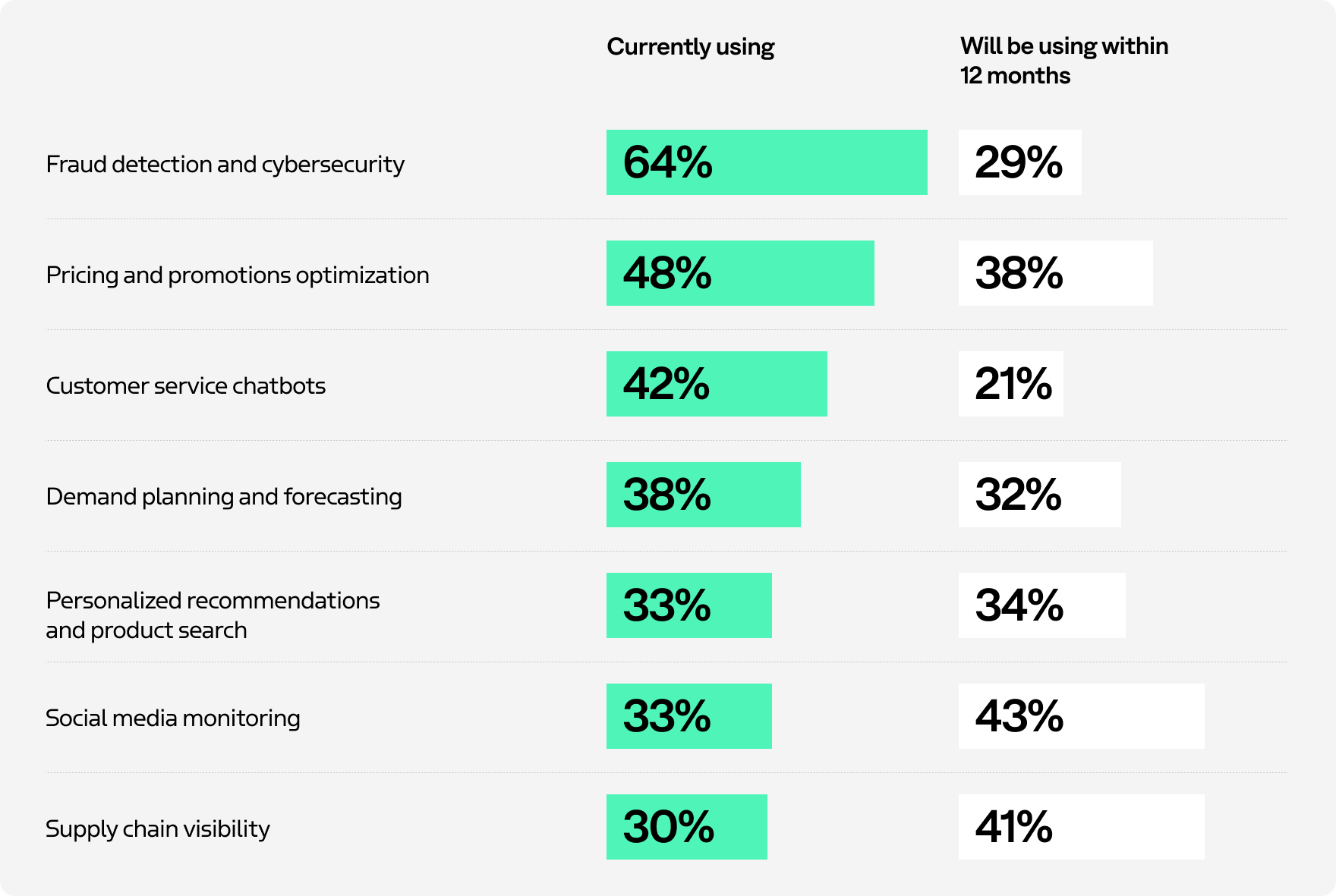
The objective is to protect program economics without creating unnecessary friction for legitimate customers. This requires combining automated detection with appropriate thresholds, human review where necessary, and clear governance.
Customer lifetime value modelling and budget allocation
Customer lifetime value gives retailers a way to estimate the future economic contribution of different customer groups. AI can improve these estimates by incorporating a wider range of behavioral signals and updating predictions as new interactions occur.
This way decisions about retention spending, promotional budgets, loyalty benefits, and customer acquisition are more supported by data. A retailer may find that a customer with relatively modest current spending has strong future potential based on purchase frequency, category expansion, and engagement. Another customer may generate high revenue but respond very little to additional incentives.
The resulting models help loyalty teams allocate resources according to expected value and not to rely on historical sales or broad customer segments. Machine learning & AI development services provide the modelling and engineering capabilities needed to put predictive customer analytics into production.
What AI loyalty programs look like in practice
Consider a grocery retailer with a large loyalty base. Its AI system can combine transaction history, product affinity, purchase frequency, and replenishment cycles to identify customers approaching their expected next purchase. The loyalty platform can then trigger a relevant recommendation or benefit skipping a generic promotion to the entire segment.
In fashion and specialty retail, AI can combine browsing behavior, previous purchases, category preferences, and loyalty status to determine which products or benefits are most relevant. Adobe reported that traffic from AI sources to US retail sites grew 393% YoY during the first quarter of 2026, while AI-referred visitors generated stronger conversion and revenue-per-visit metrics than non-AI visitors.
For trade and wholesale businesses, the mechanics are different. Purchase frequency, account potential, reorder patterns, project activity, rebates, and tiered pricing can all become signals in a B2B loyalty program.
Intellias has applied similar principles to retail technology delivery, drawing on its eCommerce development services. A dynamic e-commerce mobile app, built for City Plumbing, generated more than 500 daily active users, over 150 orders per day, and achieved 70% customer-data capture rate.
The data and technology foundation behind AI loyalty
AI customer loyalty depends on the quality and accessibility of the underlying data.
Unifying first-party data
A retailer should be able to connect POS transactions, e-commerce clickstream data, loyalty activity, CRM records, customer service events, product information, and relevant inventory signals. To make that connection possible, a retail data warehouse creates the customer context required for personalization and predictive models.
Customer loyalty analytics in retail depends on a unified view of transaction, browsing, and service data. Loyalty programs can also become an important source of consented first-party and zero-party data. Antavo’s 2026 research describes loyalty data as an important input for organizations building AI readiness.
Real-time event streaming and decisioning
Many loyalty decisions are time-sensitive. A customer’s interaction with a product, order, promotion, or service channel can change the appropriate next action. Event streaming architecture can move these signals into decisioning systems without waiting for a periodic batch process.
Kafka or similar event-streaming infrastructure can support this layer, while APIs and GraphQL can connect customer-facing applications with commerce and loyalty services.
Integration with ERP, CRM, PIM, OMS, and POS
An AI loyalty platform should fit into the existing technology landscape of a retailer.
ERP systems provide commercial and account information. CRM systems provide relationship context. PIM platforms provide product information. OMS and POS systems provide order and transaction data. E-commerce platforms expose digital behavior and commerce events.
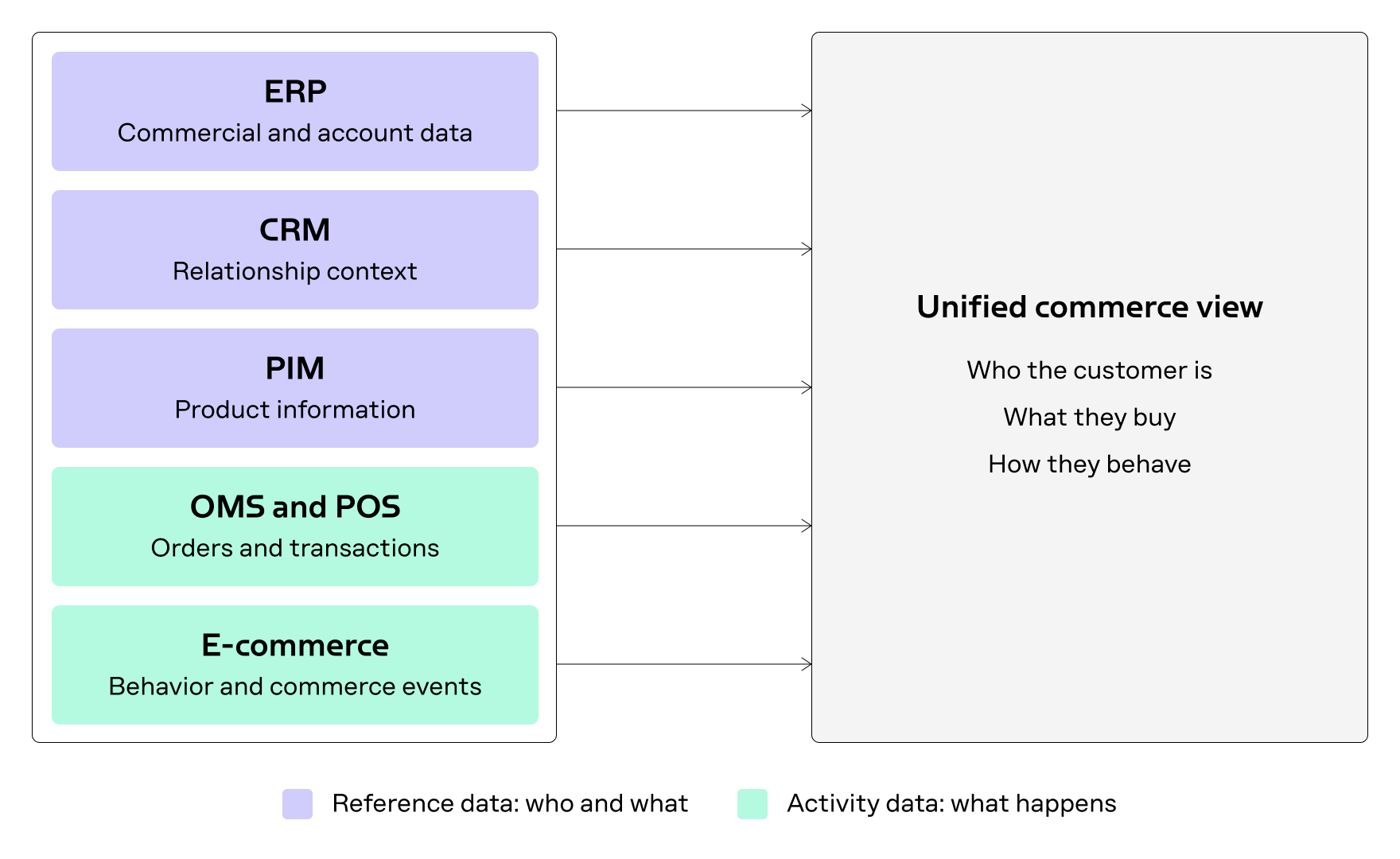
Intellias’ retail engineering work illustrates this integration-oriented approach. The City Plumbing implementation used GraphQL, PostgreSQL, Algolia, Flutter, and local mobile storage to connect product discovery, inventory, ordering, and customer engagement.
For retailers planning an AI loyalty initiative, this makes data architecture an early design consideration rather than a later implementation detail.
Privacy, consent, and PII governance
Personalization requires responsible data use, thus retailers need clear rules for consent, identity resolution, PII access, retention, model inputs, and downstream activation. PCI requirements also become relevant when loyalty and commerce workflows intersect with payment information.
A technically sophisticated loyalty program can still underperform if customers do not trust how their data is used. Governance therefore needs to be designed alongside the data and AI architecture.
AI loyalty in B2B retail: wholesale, trade, and distributor networks
B2B loyalty deserves its own treatment because the relationship goes further than individual purchases.
For a distributor, customer loyalty involves recurring orders, account management, negotiated pricing, rebates, project-based incentives, credit terms, product availability, sales-representative interactions, and service quality. The relevant loyalty behavior is often embedded in a customer’s workflow.
An AI-enabled B2B loyalty program can predict reorder timing, identify cross-category opportunities, recommend incentives, flag accounts showing declining activity, and adapt rewards according to account value or strategic objectives.
Mobile access is particularly relevant for trade buyers. A contractor or trade professional may need to check stock, pricing, account information, or place an order while working on-site. A loyalty experience that is integrated into this workflow can create more frequent and useful customer interactions than a standalone rewards portal.
For retailers exploring this model can connect loyalty mechanics with mobile commerce, ERP, CRM, POS, and e-commerce capabilities.
Intellias has also built a B2B API for external customers, giving trade partners direct, secure access to product, pricing, and order data.
What’s next: agentic loyalty
Deloitte’s 2026 research found that 68% of surveyed retail executives expect to deploy agentic AI for key operational and enterprise activities within 12 to 24 months. The same research found that 81% believe generative AI will weaken brand loyalty by 2027 because AI-mediated shopping may place greater emphasis on value and fit than brand recognition.
Accenture’s 2026 research points to the same structural shift from another perspective: 74% of surveyed consumers across 16 countries said they would trust personal AI shopping agents more than their best friend to make a purchase on their behalf.
For loyalty teams, this means loyalty data increasingly needs to be useful not only to human customers but also to software systems making purchasing recommendations. Product availability, pricing, member benefits, reward eligibility, delivery information, and other value signals need to be structured and accessible enough for AI-mediated commerce.
Retailers should therefore consider agent-readiness alongside traditional loyalty optimization. A loyalty program that cannot expose its benefits and customer context to emerging AI-driven commerce workflows may become less influential as shopping interfaces evolve.
How to get started with AI customer loyalty
A practical AI loyalty roadmap can be structured around three stages.
First 30 days: audit the data and loyalty journey. Map customer identifiers, POS and e-commerce events, loyalty rules, CRM data, reward mechanics, integrations, consent, and the points where customers disengage.
By 60 days: select one high-value use case. Churn prediction and next-best-offer decisioning are practical starting points because both can be measured against purchase behavior and retention outcomes.
By 90 days: test one segment and industrialize what works. Establish a control group, measure incremental revenue and retention, validate the model and business rules, then integrate the capability into the loyalty platform and customer-facing channels.
The goal is to build an AI loyalty capability that can be measured, governed, and expanded rather than introducing AI as a disconnected feature.
If you’re looking to turn that approach into a scalable loyalty solution, explore Intellias’ development of a B2B loyalty app for retailers.