Agentic checkout refers to the transaction execution layer of an agentic commerce system. It’s the technology that allows an AI agent to place an order on behalf of a customer directly in ChatGPT, Gemini, Claude, or another AI system. The result is a zero-click shopping experience in which the customer makes a purchase without being redirected to a merchant’s website or mobile app.
To better understand the role of agentic checkout, let’s look at how agentic commerce works. In agentic commerce, an AI agent starts with understanding customer intent, or what the customer is actually trying to accomplish.
Example of customer intent: Buy a birthday gift for my 6-year-old nephew who likes race cars and make sure it arrives by Friday. Last year, he got a few LEGO sets, a soccer ball, and a remote-controlled car. The RC car was his favorite. Budget is $50, not including shipping.
With agentic commerce, an agent can decide what to search for, search for products and compare offers across merchants, place an item in the cart, provide shipping and payment details to the merchant, and actually make the purchase — taking the customer straight from intent to order. While doing so, the agent can compare pricing and shipping across merchants and consider reviews of both merchants and manufacturers. After an order is placed, it can even field inquiries like “Where’s my order?”
While customers must approve all purchases made by an AI agent (either through pre-approval or approval at checkout), they no longer need to spend hours researching choices and making purchasing decisions.
Let’s consider another specific example.
Say that you’ll be going on holiday to Greece in one week.
Your intent as a travel consumer: Buy new, wheeled, carry-on luggage for my trip to Greece that meets my airline’s baggage requirements, has good reviews regarding durability, and costs no more than $200. Prefer blue or gray, but color isn’t critical.
In the past, you might:
- Research the airline’s requirements for carry-on luggage
- Search for carry-on recommendations and the best carry-on luggage for frequent travelers
- Browse carry-on luggage on your favorite online stores, filtering by size, price, and color
- Decide which luggage to buy that meets all of your requirements
- Figure out which stores have it in stock in the color you want
- Compare prices and delivery options across stores (making sure the luggage will arrive well before your trip so you have time to pack)
- Once you have chosen a store: Add the luggage to the cart, then go through the checkout flow, providing shipping and payment details
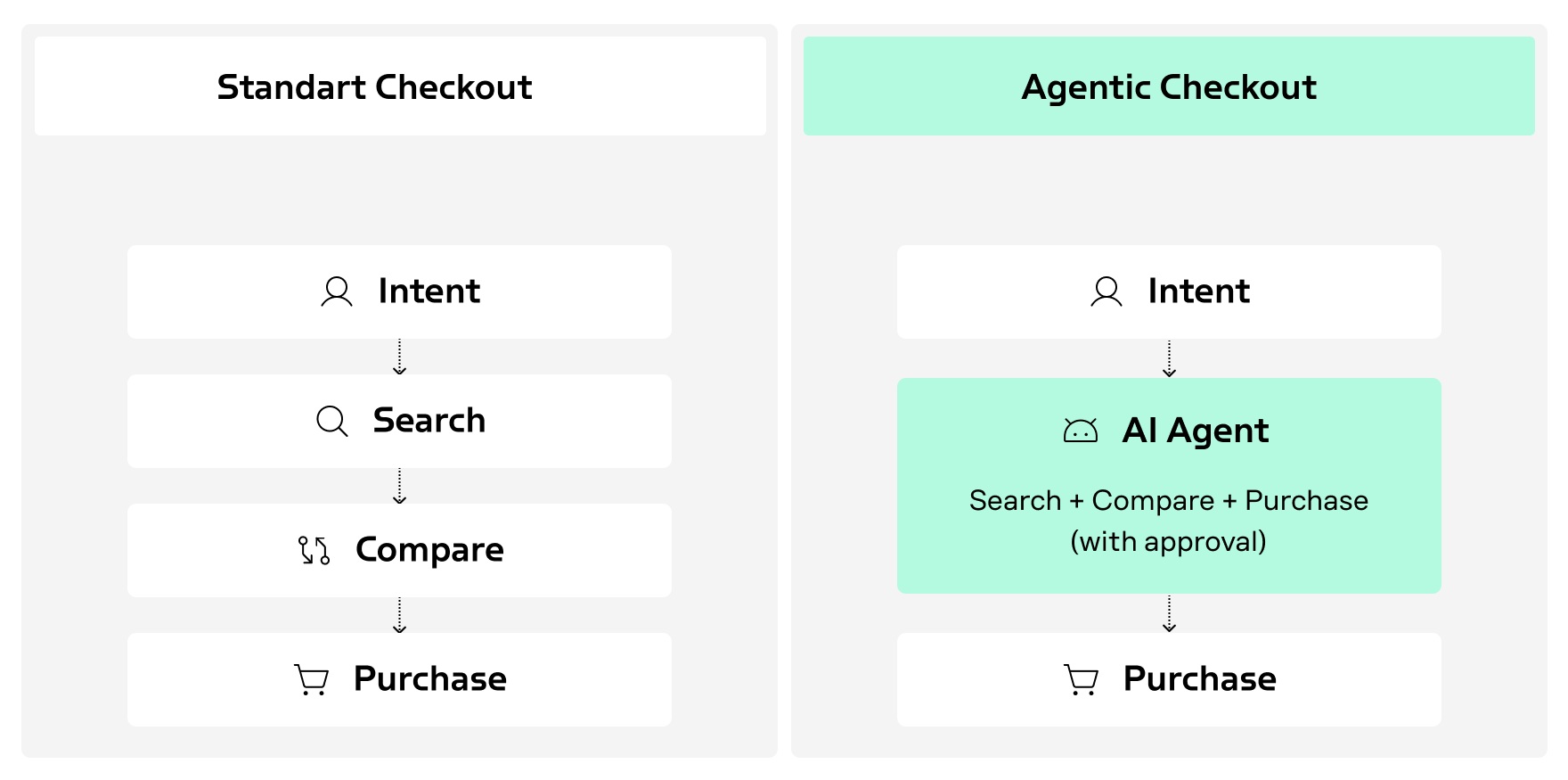
Agentic commerce promises to handle these steps for you, while agentic checkout allows an AI agent to place your order directly with a merchant. This can be done using a protocol, such as Agentic Commerce Protocol (ACP) or Universal Commerce Protocol (UCP), or through agentic browser automation.
Agentic checkout technology removes friction in the traditional online checkout experience:
| Traditional online checkout experience | Agentic checkout online shopping experience | |
| Customer control | Full control and full responsibility for all steps of the checkout process | Customer approves the order before AI submits for payment |
| Steps (for customer) | 1) Add items to cart
2) Log in or choose guest checkout 3) Enter promotion codes, use loyalty points, or apply other discounts or incentives 4) Enter/confirm shipping information 5) Enter/confirm payment information 6) Review order details 7) Place order |
1) Approve order created by AI agent
AI agent completes all other steps autonomously. |
| Data | As a first-time buyer or when using guest checkout, the customer needs to manually enter:
|
An AI agent already has access to this information and can enter it automatically. The agent could even choose a credit card to maximize points earned. |
| Conversion risks |
|
|
How to implement agentic checkout technology: What’s under the hood
As of 2026, there are two main approaches to implementing agentic checkout:
- Universal Commerce Protocol (UCP) or Agentic Commerce Protocol (ACP), alongside a payment rail (like Stripe or WorldPay)
- Browser automations for eCommerce sites that do not support agentic commerce protocols
Let’s consider both options.
Protocol-based agentic checkout
Agentic Commerce Protocol (created and maintained by OpenAI and Stripe) and Universal Commerce Protocol (created by Google and Shopify) are both open standards that allow an AI tool (such as ChatGPT or Gemini) to interact with a retailer’s online store. The idea is to make such interactions possible without the need for custom store-specific integrations.
Although these technologies may seem like direct equivalents, they largely meet different needs and have different aims.
Comparison of ACP and UCP according to several key criteria:
| Agentic Commerce Protocol (ACP) | Universal Commerce Protocol (UCP) | |
| Key members | OpenAI, Stripe, Meta | Google, Shopify, Etsy, Target, Wayfair, Amazon, Meta, Microsoft, Salesforce, Stripe, Walmart |
| License | Open source, Apache 2.0 | Open source, Apache 2.0 |
| Scope | Product discovery | Full journey: discovery, negotiation, checkout, orders, post-purchase |
| Discovery | Merchant catalog feed, ingested by the platform | Merchant publishes a public “capabilities” file that agents fetch directly |
| Payment | Support for checkout and payments removed in March 2026 | Modular “handlers” — any processor or wallet can plug in |
Agentic Commerce Protocol (ACP)
Agentic Commerce Protocol was the technology behind OpenAI’s Instant Checkout feature, which was available for a short time to ChatGPT users.
Instant Checkout worked like this:
- A user would discover a product they wanted to buy within ChatGPT (or, in theory, another AI surface).
- The user would choose to buy the product and select a saved payment method.
- An AI agent in ChatGPT would use ACP to send secure shared payment tokens directly to the merchant. In this flow, payment tokens are never exposed to the AI agent, and the merchant remains responsible for fulfillment, fraud checks, and the customer relationship (just as they would be with a traditional ecommerce checkout experience).
OpenAI stopped offering Instant Checkout in March 2026, and the company is now pursuing product discovery within ChatGPT alongside merchants’ own ChatGPT apps. In the same month, Shopify released a new ACP-powered agentic storefront feature for Shopify merchants that focuses on product discovery on AI surfaces but does not offer agentic checkout functionality.
Not many merchants are actively using ACP as of late 2026, and those that do are in the US market. But ACP is young, Shopify has a strong market presence, and — notably — Stripe’s yet-to-be-released Agentic Commerce Suite is built on ACP and will serve merchants in the United States and Canada. You can join the waitlist today; Stripe promises to review submissions on a rolling basis.
Universal Commerce Protocol (UCP)
Universal Commerce Protocol is maintained by Google and backed by over 20 companies including Shopify, Amazon, and Microsoft. Unlike ACP, UCP covers the entire shopping journey, including discovery, checkout, ordering, and post-purchase.
UCP relies on merchant-hosted JSON manifest files and allows any AI agent to read these files with a plain HTTP request. It takes the pattern of separating responsibilities into layers from TCP/IP and applies it to eCommerce. Merchants and agents can introduce new capabilities independently, making UCP a highly flexible open standard. Ilya Grigorik, a Distinguished Engineer at Shopify, characterizes this as an “open bazaar of capabilities, no committees required.”
Merchants declare and define what capabilities they support, including their own bespoke functionality. Agents discover these capabilities, negotiate what they can handle, and proceed to complete transactions. UCP defines the discovery and negotiation mechanisms between agent and merchant, as well as the core capabilities that make commerce programmable for agents and humans alike.
Significantly, UCP is payment provider agnostic by default (by contrast, the ACP-powered Instant Checkout was tied to Stripe). Through the Embedded Checkout Protocol (ECP), UCP can even embed a retailer’s own checkout interface into an AI chat window. This gives retailers control over their brand voice within AI platforms in a way that ACP can’t.
In 2026, Google released a new checkout feature in the Gemini app and Google AI Mode that is built on UCP. When a user sees an eligible product listing on these platforms, they can tap “Buy” to start the UCP-powered purchase process. In this way, Google’s AI Mode becomes the storefront, with UCP being the technology behind the “Buy” button.
Full agentic commerce experience with MCP, A2A, and AP2
For a full agentic commerce experience, UCP can be combined with Model Context Protocol (MCP), Agent2Agent (A2A) protocol, and Agent Payments Protocol (AP2).
The stack looks like this:
Communication layer
MCP (Model Context Protocol)
- Allows an AI agent to read a merchant’s catalog and call a merchant’s functions
- Standardizes connections between AI models and external data sources
A2A (Agent2Agent)
- Allows agents to hand off tasks to each other: shopping agent to merchant agent or shopping agent to logistics agent, for instance
- Gives agents a common language to talk to each other
Commerce layer
UCP (Universal Commerce Protocol)
- Enables agentic checkout
Authorization layer
AP2 (Agent Payments Protocol)
- Responsible for authorization, authenticity, and accountability (i.e., proving that a human asked the agent to make the purchase):
- Verifies that a user authorized an agent to make a particular purchase
- Proves to the merchant that a request reflects the user’s true intent
- Determines who is accountable for fraudulent or incorrect transactions
According to the Cloud Security Alliance, AP2 does all of this by “reimagining payments as ‘contractual conversations’, where VCs [Verifiable Credentials] serve as signed contracts.” For a detailed explanation of secure use of AP2, check out the full article by CSA.
Agentic checkout through browser automation
The alternative to protocol-based agentic checkout is browser automation. Instead of calling an API, an agent controls a webpage through an actual web browser. The agent places an order exactly as a human would: by looking at the UI, filling out fields, and clicking buttons.
Because the agent accesses the same website and checkout flow as human customers, the merchant (in theory) does not need to integrate or add support for new technologies on their end. This makes browser automation the most universal agentic checkout solution in 2026. But it comes at the expense of speed, reliability, and security:
- Reading UI elements, filling out fields, and clicking buttons is time-consuming.
- Though AI tools can “think” and figure out how a website works, UI/UX choices (such as use of CAPTCHA) could interfere with agentic checkout functionality.
- Browser automation is less secure than protocols such as UCP or ACP.
Despite its limitations, browser automation makes sense in 2026 as a way to bring agentic checkout support to online retailers that are not at the forefront of implementing agentic commerce functionalities.
Agentic checkout landscape in 2026
| Platform | Who it’s for | Biggest benefits |
|---|---|---|
| Google “Buy for Me” & AI Mode shopping (Gemini) |
|
|
| Stripe Agentic Commerce |
|
|
| Shopify Agentic Storefront |
|
Single integration connects to multiple AI surfaces; uses ACP (for ChatGPT) and UCP (for all other AI surfaces) |
| Microsoft Copilot Checkout |
|
|
| Walmart’s Sparky AI Assistant |
|
|
| Amazon Buy for Me |
|
|
The agentic checkout landscape is changing rapidly. As an example, consider this evolution of Instant Checkout over a span of months:
OpenAI announced an Instant Checkout feature in September 2025, but CNBC reports that the company “struggled to onboard merchants, show accurate data about products and introduce multi-item carts or connect loyalty memberships.” They pivoted to a new checkout experience, with a focus on product discovery, in March 2026.
Through the rest of 2026 and moving into 2027, we can expect retailers and agentic commerce providers to continue experimenting with what’s technologically possible and determining what sort of shopping experience consumers actually want within their AI chat platforms.
Benefits of agentic checkout technology for retailers
Benefits of agentic checkout for retailers include:
- Visibility on new AI surfaces. Get your products in front of a rapidly growing audience (already numbering millions of users) on ChatGPT, Gemini, Copilot, and other AI surfaces.
- Merchant control. Unlike marketplaces, agentic checkout allows retailers to remain the merchant of record, keeping pricing and fulfillment in-house.
- Unified catalog management. Syndicate once via Shopify Agentic Storefronts or another tool (via ACP and/or UCP) to all AI surfaces, without needing per-platform integrations.
- Reduced friction. Agents handle product comparison, cart building, and checkout.
How to implement agentic checkout for businesses: A roadmap for retailers
Step 1. Audit catalog and feed readiness for agentic commerce
To prepare for agentic checkout, retailers should audit their catalogs to make sure that product data is enriched, complete, and accurate (including real-time inventory availability data). This includes ensuring that every SKU has structured fields (name, description, price, inventory, variants, product attributes, media) in a machine-readable format (JSON/XML feed or API endpoint). In addition, you should ensure a single source of pricing truth and set up automatic price updates so that all sales channels (your website, AI feeds, marketplaces) show the same price at any given time and support real-time stock level updates.
Step 2. Choose your protocol(s)
You’ll need to choose the technical protocols that connect your online store to AI shopping agents. As of the second half of 2026, UCP should be your starting point for implementing agentic checkout. For greater product visibility, you might also consider implementing ACP to improve product discovery (within ChatGPT in particular).
Step 3. Implement payment tokenization
The idea behind payment tokenization is that an AI agent never has access to card details. A network-issued token stands in place of sensitive card data. This minimizes PCI compliance requirements for merchants, as they do not handle raw payment card data.
Payment tokenization works like this:
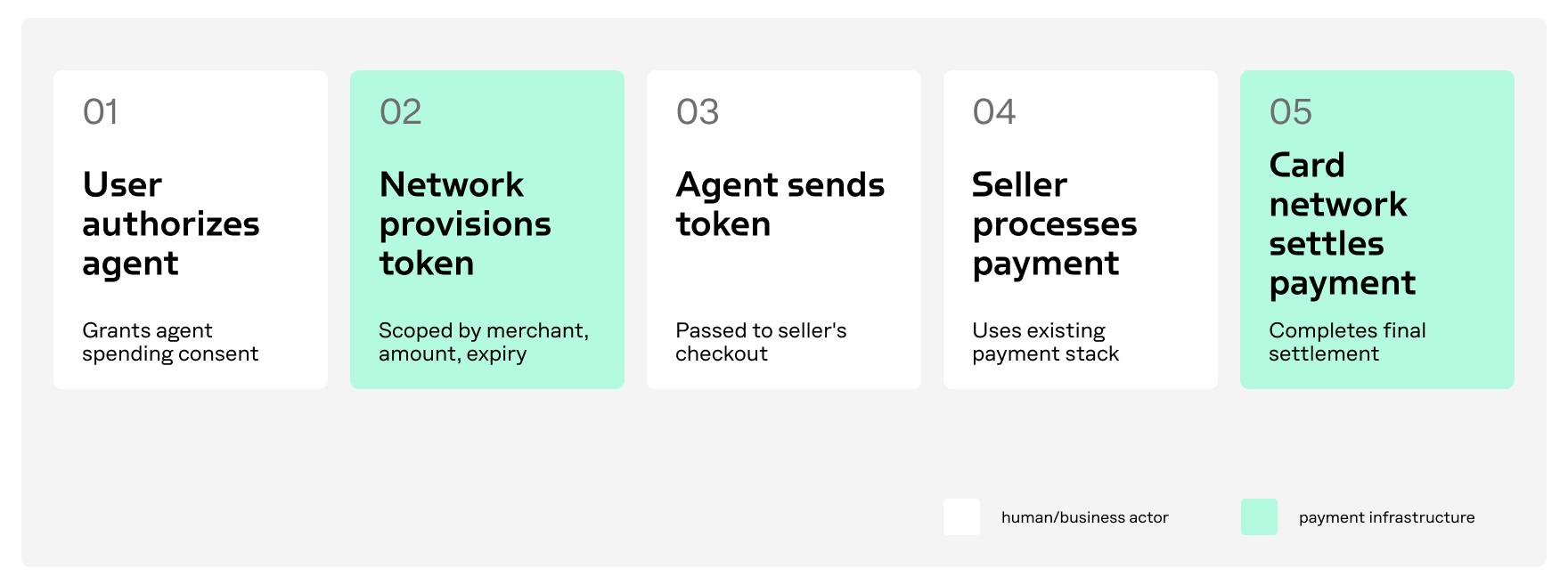
To accept credit cards from AI agents, merchants can make use of:
| Protocol | What it does |
| Visa Trusted Agent Protocol (TAP) | Verifies identity of AI shopping agents |
| Mastercard Agent Pay | Allows a verified AI agent to securely execute a transaction |
| Secure Payment Token (SPT) by Stripe | Gives an AI agent one-time permission to complete a particular purchase |
Step 4. Opt in / expose catalog to agents
To expose your catalog to AI agents using UCP (Google AI Mode / Gemini, Copilot):
- Host a JSON manifest at /.well-known/ucp on your primary domain. This file declares supported services (checkout, cart, catalog), API endpoints, and payment handlers.
- Implement three REST endpoints:
- Session creation (POST /sessions)
- Session updates (PATCH /sessions/{id})
- Checkout completion (POST /checkout)
- For Google AI surfaces: Connect to Google Merchant Center with clean, schema-marked product feeds (pricing, inventory, variants). Enable native or embedded checkout.
Note: Shopify merchants in the U.S. are likely already enrolled in Agentic Storefronts (auto-enabled as of March 2026), which is powered by ACP.
Step 5. Put up guardrails
Businesses can implement agentic checkout safely by putting guardrails in place to prevent fraud, avoid unnecessary returns, control the brand, and maintain price integrity.
Prevent fraud
Separating legitimate from unauthorized agent activity is increasingly difficult. Know Your Agent, or KYA (modeled on KYC, “Know Your Customer,” from banking), is the response. There are various ways that merchants can implement it, including:
- AP2 Mandates
- Visa TAP
- Mastercard Agentic Tokens
- SPT identity headers
Fraud can also be minimized by setting strict token scoping (amount caps, expiry, single-use) and by deploying ML-based behavioral drift detection trained on agent patterns.
Avoid unnecessary returns
- Synchronize policies across all surfaces (traditional as well as AI) for a 360-degree view of end customer behavior, and flag automated cancellation/refund patterns.
Control the brand
- Continuously reconcile catalog attributes across feeds.
Maintain price integrity
- Use price-binding tokens and validate all agent requests against published rates on the server side.
Step 6. Measure and iterate
Now it’s time to measure the results of agentic checkout and iterate accordingly.
Metrics to consider:
- Agent-oriented conversion rate
- Time to purchase from AI query
- Average order value (compare traditional checkout to agentic checkout)
- Chargeback and fraud rates for agent-created orders
- Return rates by channel
Based on your findings, you can iterate by:
- A/B testing product feed attributes in an attempt to improve product visibility
- Adjusting purchase limits and expiry times for agent authorizations to avoid fraud
- Retraining fraud models on agent-specific data
- Investing in Generative Engine Optimization (GEO)
Risks of agentic checkout
Agentic checkout introduces risks for retailers, including the risk of disintermediation (i.e., cutting out the retailer entirely). With agentic checkout functionality that works directly within a chat-based LLM, it becomes much easier for brands to sell directly to end customers, without the need for wholesale distributors and retail partners. Given this, it is imperative for merchants to demonstrate their value within the agentic commerce ecosystem.
Another risk to merchants is loss of retailer loyalty. AI agents doing price and product comparisons across online stores are far less likely than human customers to make their final purchasing decision based on emotion or loyalty to a particular retailer. As a result, merchants may see fewer committed customers.
Additionally, retailers may lose cross-selling and upselling opportunities. Customers will no longer be navigating catalog and checkout flows that merchants carefully craft on their own websites. Meanwhile, AI commerce tools make it easy to complete single-item checkouts and to spread checkouts across multiple merchants.
Also significant is retailers’ loss of control over valuable customer data. Over time, companies such as OpenAI and Anthropic may gain the same data advantage that Amazon has relative to competitors — that is, access to troves of third-party merchant data that they can use (for instance) to decide what to produce and/or sell.
There are also risks that move into the realm of compliance, including limits on data processing and the scope of customer consent for agent purchases under laws and regulations such as the GDPR.
Finally, agentic checkout solutions face various fraud risks:
- Unauthorized agent transactions (forged customer mandates)
- SPT token abuse (reuse, velocity clustering at spending limits)
- Identity spoofing (malicious actors impersonating legitimate shopping agents)
- Automated policy exploitation (programmatic returns or cancellations that exploit loopholes)
- Chargeback disputes, where consumers deny authorizing agent actions
Since AI agents do not demonstrate human behavioral patterns, detecting fraud becomes more difficult, requiring ML-based drift detection, KYA verification, and immutable proof of consent.
How Intellias helps businesses implement agentic checkout and other retail AI solutions
Intellias has extensive experience engineering retail AI solutions — and the expertise you need to succeed in this new era of agentic commerce. As your AI commerce engineering partner, we can help you build retail AI agents, conversational AI platforms for both customers and retail associates, and personalized shopping experiences powered by generative AI.
Message our agentic AI specialists to see how agentic checkout can get your products in front of a larger audience and grow your sales.