Page
AI-Enabled Predictive Analytics for Supply Chain Intelligence
Freight brokers make high-volume carrier decisions under constant pressure to secure capacity, keep loads moving, and meet legal and safety obligations. Intellias has designed an AI freight broker platform PoC that transforms fragmented, often manual carrier selection into a connected risk management workflow, helping freight brokers mitigate liability exposure through consistent checks and documented due diligence. It brings together regulatory safety data, business and identity verification, explainable risk scoring, policy controls, and decision records inside a compliance layer that can connect with the broker’s existing transportation management system (TMS).

On May 14, 2026, the US Supreme Court held in Montgomery v. Caribe Transport II, LLC that a state-law negligent-hiring claim involving the selection of a motor carrier is not preempted by the Federal Aviation Administration Authorization Act because it falls within the Act’s motor-vehicle safety exception. To put it simple, people can sue a company under state law for carelessly hiring an unsafe trucking carrier, and Federal transportation law does not block such claims because they concern motor-vehicle safety. The decision does not establish that a broker was negligent, but it allows this type of safety-related claim to proceed under state law.
For freight brokers and third-party logistics providers (3PLs), the operational implication is clear: a license, insurance record, and safety-rating check may no longer be enough to demonstrate a consistent carrier-selection process. Organizations need a repeatable way to assess available risk information, manage exceptions, and trace the decision logic after a shipment has moved.


Safety status, operating authority, insurance, business identity, performance history, and fraud indicators often sit in separate systems. Dispatchers must assemble the picture manually, which slows the decision and makes the depth of each review difficult to standardize.

A carrier file may show that documents existed, but not which information was available at assignment, who made the decision, whether a policy flag appeared, or why an exception was approved. Without a timestamped audit trail, the organization may struggle to demonstrate how its process worked for a specific load.

A carrier approved during onboarding may remain trusted even when its authority, insurance, safety indicators, or operating behavior changes. Problems may become visible only during the next manual review or after an adverse event.

Carrier selection happens in a capacity-driven environment. If a warning can be dismissed without a reason or approval, the real process may drift away from the written policy. Managers then have limited visibility into exception patterns across agents and offices.

A legitimate carrier record does not automatically prove that the truck and driver arriving at pickup belong to the approved carrier. Mismatched identities, equipment, or registration details can expose the load to unauthorized subcontracting, identity misuse, and cargo theft.
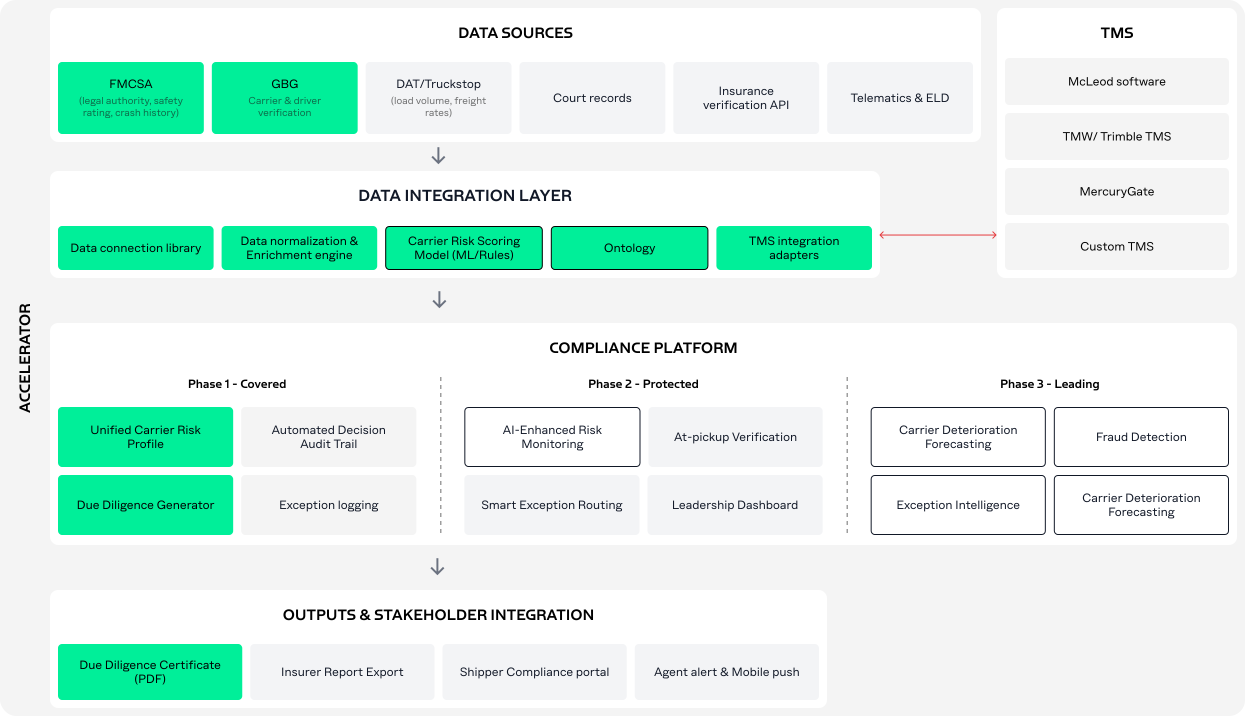
Intellias is developing a carrier-intelligence and compliance layer that can extend the existing TMS workflow. The concept is designed to connect external data, normalize carrier information, apply configurable rules and data-driven scoring, and convert the results into a unified risk profile at the moment of assignment. As the solution evolves, it is intended to support decision recording, exception routing for approval, and due diligence documentation for legal, insurance, or shipper review.
The initial PoC validates the core flow following these steps: a dispatcher enters a carrier DOT number; the system retrieves authority and safety information, verifies the business entity, calculates an explainable risk score, and produces an exportable record of the checks performed. The complete solution roadmap extends this foundation into continuous monitoring, pickup verification, predictive risk intelligence, and AI-assisted policy decisions.
Solution goals

Capture the available risk profile, decision, exception, justification, and approval in a timestamped record.

Combine regulatory, insurance, identity, performance, and behavioral signals in a form dispatchers can understand and act on.

Monitor carrier risk between assignments and surface deterioration or suspicious behavior before it becomes a formal incident.

Embed risk checks, policy controls, and outputs into established TMS and brokerage workflows instead of requiring a platform replacement.
Whether you aim to build a new solution from scratch or, more commonly, modernize an existing system, the development process can be structured into core phases. Each phase delivers distinct business value and introduces additional tools to improve how the organization manages risk, compliance, and carrier-selection workflows.

The lag between gathering information and processing it on the provider’s side, with further updates to in-vehicle navigation systems, may take days or even weeks, which is becoming critical for navigation and AD/ADAS map data.

Road attributes that directly affect safety, including scheduled road works, temporary speed limits, real-time road hazard detection, emergency closures, and sudden infrastructure failures, are often missing from maps. They stay missing until the next scheduled update.

Recent changes in map data are scattered across news outlets, municipal feeds, and social channels. There is no built-in way to check how reliable this information is before it becomes part of the map.

Stronger due diligence evidence – A timestamped record makes the selection process easier to reconstruct for internal reviews, insurers, shippers, and legal teams. It supports defensibility without guaranteeing a legal outcome.

Faster, more consistent carrier review – A unified risk profile reduces fragmented checks and gives dispatchers a repeatable decision framework at the point of assignment.

Proactive risk detection – Continuous monitoring and predictive signals help teams review deteriorating carriers before the next onboarding cycle or formal rating change.

Scalable compliance oversight – Automated exception routing and dashboards help a smaller compliance function monitor activity across many agents and offices.

Better fraud and pickup controls – Business and driver verification, combined with behavior analysis, helps teams investigate identity mismatches and suspicious carrier activity earlier.

TMS-aligned adoption– Integration adapters allow the compliance layer to work with established transportation workflows, reducing the need for disruptive platform replacement.

Greater stakeholder transparency – Exportable records and reporting give insurers and shippers clearer evidence of how carrier-selection policy is applied.

A dispatcher needs to assign a carrier to a time-sensitive load. The carrier has capacity, but the broker must verify that it meets policy and preserve evidence of the decision.
The dispatcher enters the carrier’s USDOT number in the broker’s existing workflow.
The platform retrieves available FMCSA information, including operating authority, safety rating, inspection and out-of-service summaries, and crash information.
A third-party verification service confirms the carrier’s business identity. Optional identity and fraud-screening services can verify driver documents.
The integration layer resolves the data into a consistent carrier profile and links related entities through a common ontology.
A configurable model applies policy rules and data-driven weights, producing an explainable score with the factors behind it.
If the carrier meets policy, the assignment proceeds. If a threshold is breached, the workflow requires a reason and, where configured, supervisor approval.
The platform records the decision and generates a due diligence certificate summarizing the data checked, score, exceptions, and approvals.
The score does not replace accountable human judgment. It makes the evidence visible, applies the organization’s policy consistently, and records how the final decision was reached.
The broker receives a unified carrier risk assessment and a documented decision record before the load moves. The output supports consistent operations and later review without claiming that risk has been eliminated.
The freight broker AI solution follows a modular data-to-decision architecture that can begin with a focused PoC and expand as additional data and controls become available.