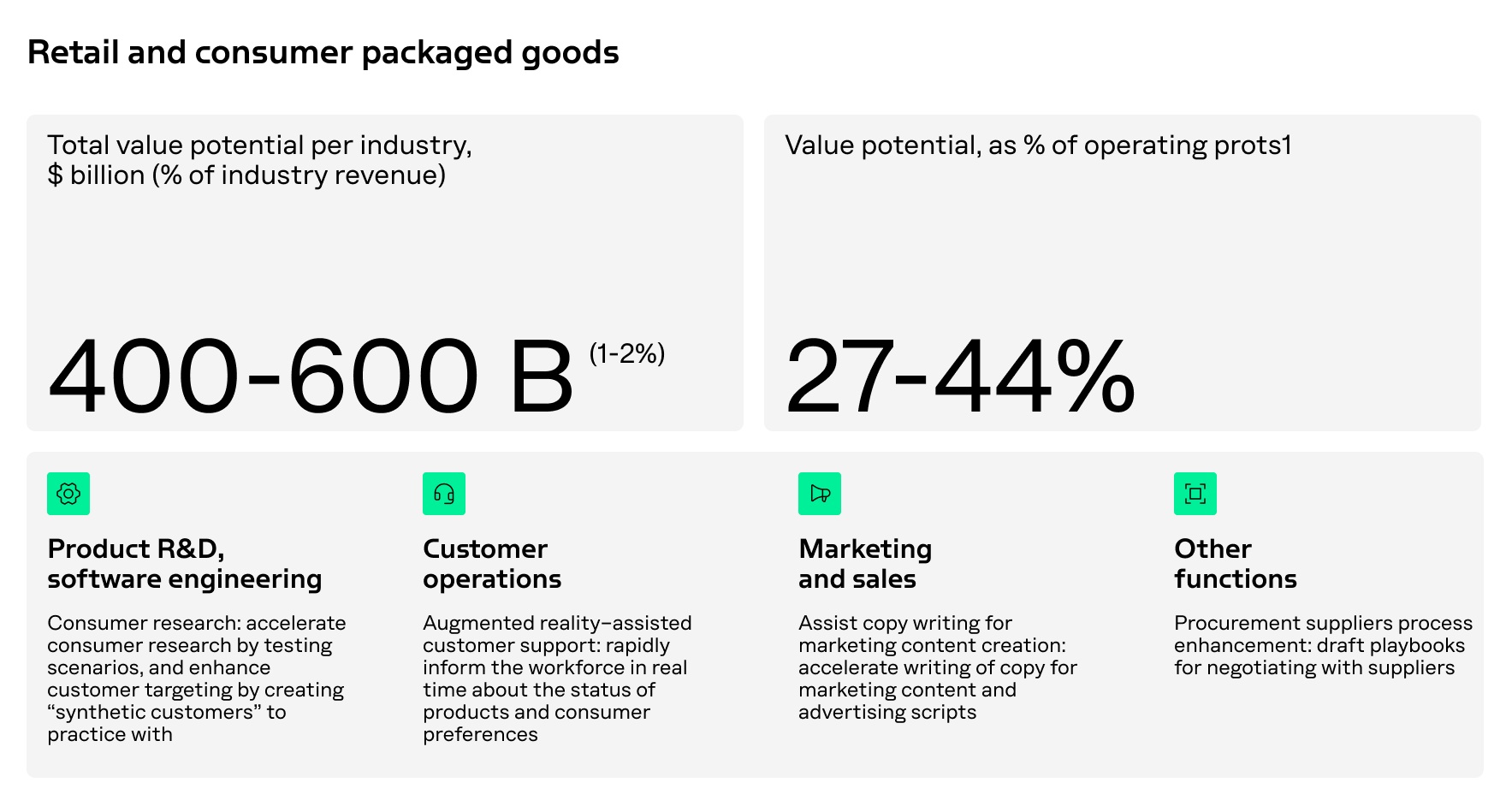
An AI-ready retail data engine is a governed data foundation that brings POS, eCommerce, loyalty, and supply-chain data together into one clean, machine-actionable format. This is a must-have basis for retailers and enterprises to run generative AI reliably at scale. Capitalizing on AI benefits has real business outcomes for organizations: McKinsey estimates generative AI could unlock $240 billion to $390 billion in economic value for retail and consumer packaged goods.
Generative AI could deliver significant value in the retail industry:
Source: McKinsey
Yet most retailers aren’t capturing that value. The Project Management Institute puts the enterprise AI project failure rate at 70% to 80%, and Gartner predicts that during 2026, more than 60% of enterprise AI implementations will be abandoned altogether.
One of the reasons why the AI initiatives stall could be low-quality, fragmented data that organizations still use. Today, only about 12% of organizations keep their data clean enough for production deployment. And if you are not one of them and you feed raw, uncurated data into a large language model (LLM), the result will most likely be unsatisfactory: hallucinations, inaccurate product recommendations, pricing errors, and compliance risks.
Retailers are learning the hard way that AI readiness takes more than good intentions or a powerful model. It takes data integration, modern governance, and a unified architecture that can orchestrate real-time data flows across physical stores, digital channels, and fulfillment networks. That’s why the AI-ready data engine is becoming a must-have, not a nice-to-have, for retailers who are serious about generative AI.
How to make retail data AI-ready: gathering data across core domains
Where do you begin if your organization wants to build an AI-ready data engine? First of all, you need to look at all the sources of data and break down the operational silos. Every customer touchpoint and every piece of supply chain data could potentially contribute to a 360-degree view of the business. Let’s focus on five critical data-driven domains that any retail company has:
- Point of sale (POS) transactions. Whenever your customers make a purchase, they leave a trail of checkout streams, associate interaction logs, basket sizes, and local return rates. If you aggregate this information across numerous stores, you will see which locations move products fastest, where associate interactions influence a sale, and which items keep coming back through returns.
- eCommerce clickstream. Online, every click leaves a similar trail: digital search logs, abandoned cart behaviors, product detail page (PDP) dwell times, and real-time session intent. This data shows you which items are shoppers most interested in or which ones did they consider but walked away from.
- Loyalty and CRM systems. Loyalty and CRM systems add the layer customers hand over on purpose: omnichannel purchase history, demographic preferences, support ticket histories, and zero-party consent preferences. This is the most trustworthy data for retailers, since customers share it directly and expect something useful in return.
- Supply chain and inventory. Behind the scenes, organizations store data from supply chain and inventory: real-time warehouse availability, stock-in-transit updates, vendor fulfillment timelines, and smart shelf sensors. This data closes the gap between what a system believes is on the shelf and what’s actually there.
- Merchandising and pricing. Merchandising and pricing data governs how all of that inventory gets sold: promotional schedules, dynamic competitor price feeds, SKU margin rules, and localized assortment plans. Prices in retail no longer hold still — Amazon alone changes its prices roughly 2.5 million times a day — and this domain is what lets a retailer’s pricing move just as fast, without losing margin or misreading local demand.
Connect these five domains, and algorithms can do real work: generate predictive demand forecasts, build hyper-personalized shopping experiences, adjust prices automatically, and optimize inventory allocation.
From raw retail data to AI-ready foundation
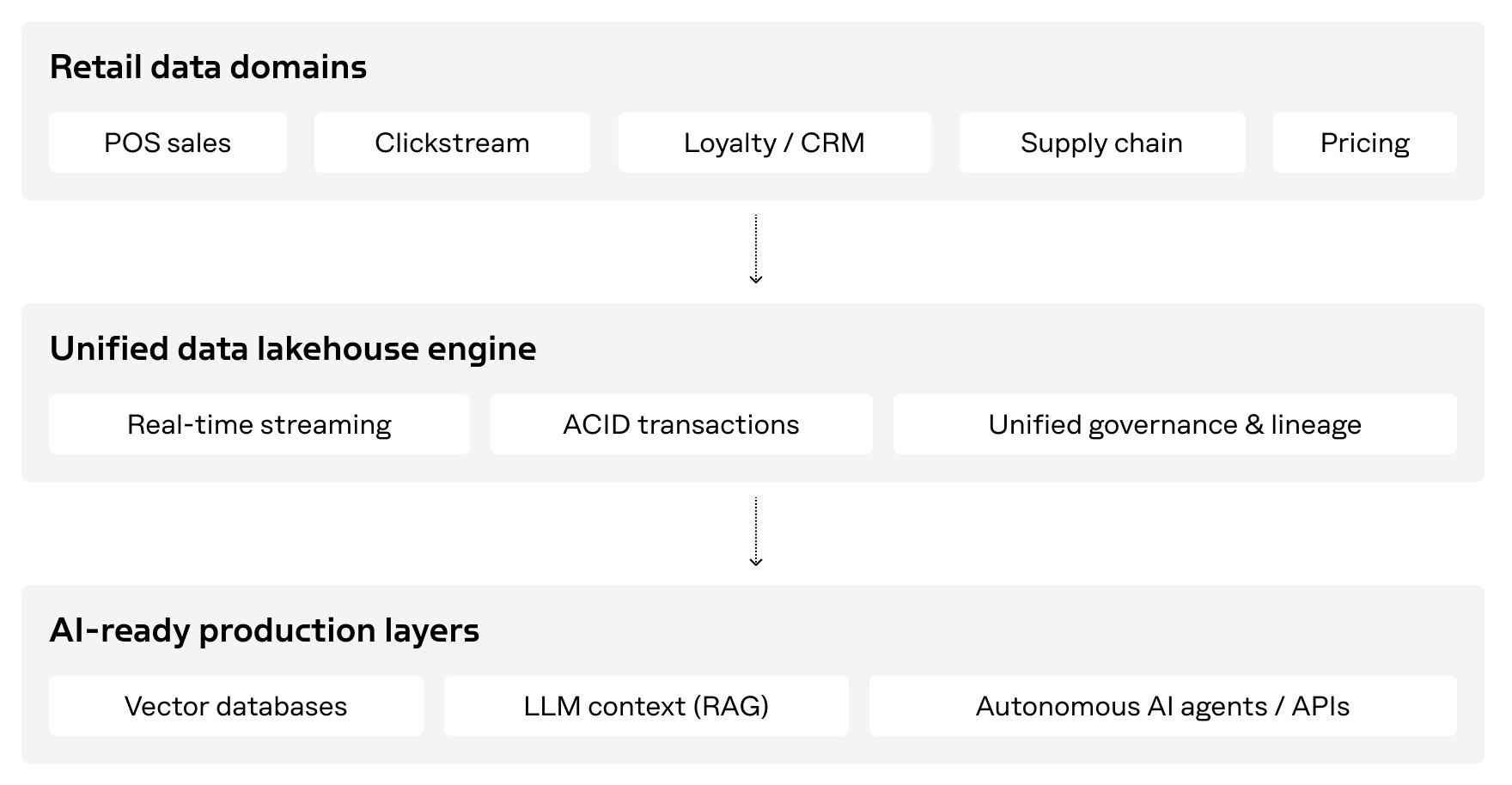
However, it is important to remember that these are high-volume, fast-moving sources, and legacy data solutions weren’t built to unify them. That’s why more retailers are shifting from a traditional data lake to a modern data lakehouse architecture instead. A data lakehouse consolidates structured, unstructured, and semi-structured streams into one governable repository. That consolidation is what removes the duplication and latency that slow legacy systems down. And it’s what gives generative AI the context it needs to answer complex queries and adjust store workflows in real time.
Core pillars of an AI-ready data foundation
Once you’ve defined and unified your data sources, you need a data infrastructure that follows a four-pillar framework crucial for building an AI-ready data foundation. Each of the pillars solves a different aspect in which data can undermine AI effectiveness: how it’s structured, how clean it is, how fresh it is, and how well it’s protected.
To ensure generative models operate accurately, an AI-ready data foundation rests on four core pillars:
- Machine actionability and multi-modal structure. Conventional databases store data in rigid, structured tables. Generative AI usually needs more than that. It thrives on semi-structured and unstructured data, like customer reviews, support transcripts, product images, catalog attributes, and even store associate voice memos. Converting these different formats into machine-actionable assets helps LLMs extract real contextual meaning from all of it.
- Data quality, completeness, and identity resolution. Once the data is structured, it has to be accurate. That means eliminating duplicate customer profiles, building a single customer view, and resolving phantom inventory records. If you train your AI models on clean data, they are more likely to deliver accurate recommendations, with zero hallucinated product specs.
- Real-time freshness and low latency. Clean data also needs to stay current. A modern data architecture keeps online clickstreams and physical store shelves in sync, using edge computing and streaming event hubs like Apache Kafka to process data on-site, in real time. This closes the gap between physical stock and digital availability and makes sure that AI systems do not sell items that are already out of stock.
- Governance and zero-trust security. None of this holds up without strong governance. Retailers need embedded compliance and zero-trust data access: identity-based access control, automated data masking, and dynamic micro-segmentation. This keeps sensitive customer information and proprietary trade secrets from leaking into public model training sets.
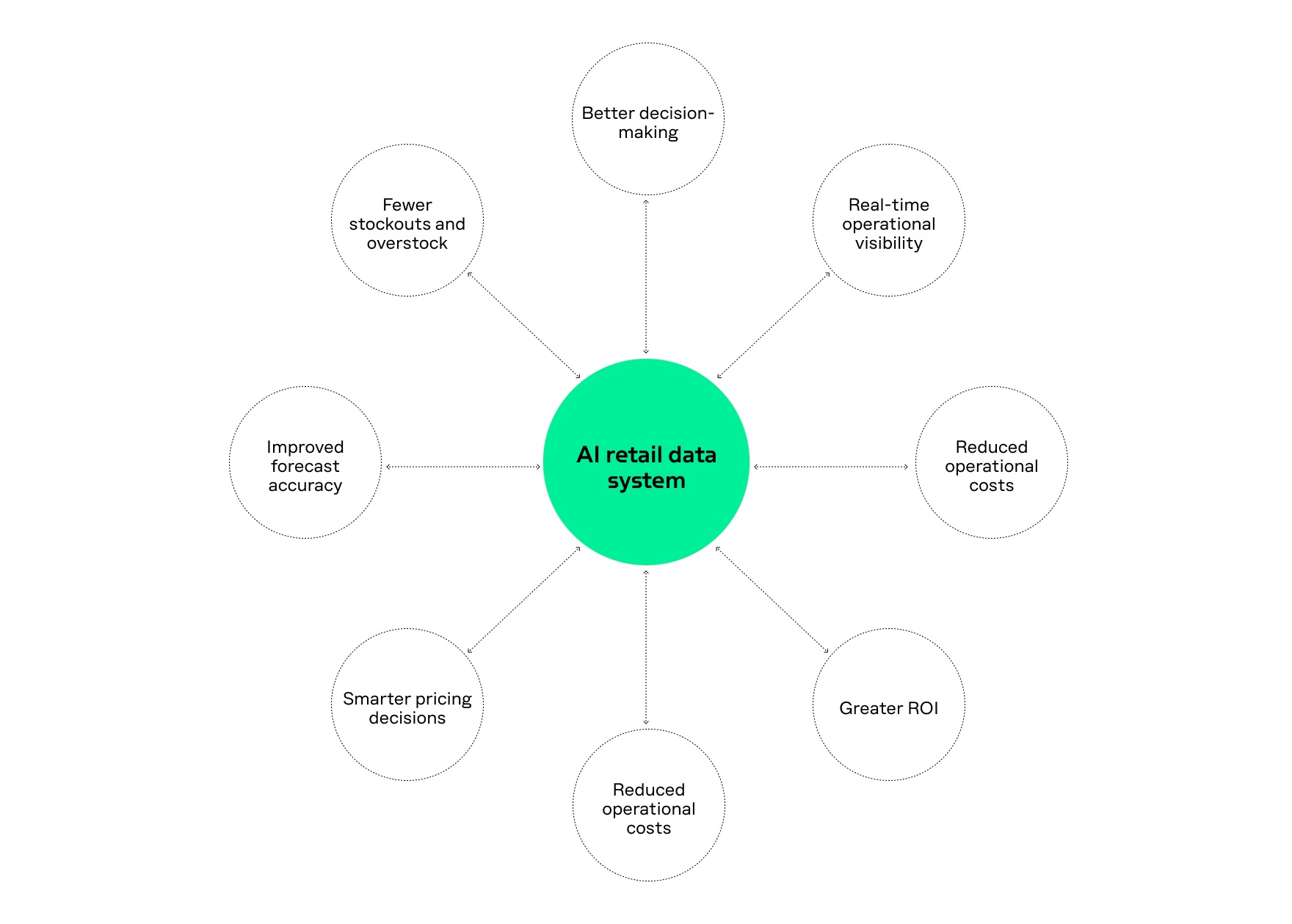
Benefits of AI-powered retail systems
Source: Age Digital
How to build AI-ready retail data pipelines
When working on a data strategy, retailers need a pipeline that turns raw information into an AI-ready data foundation. That pipeline runs in three steps, each one building on the last.
Step 1: Ingestion and schema validation. High-throughput streaming engines collect batch and real-time data from store IoT devices, e-commerce platforms, and ERP systems. Automated schema validation checks every incoming record against enterprise rules and quarantines anything corrupted or misformatted, before it has a chance to skew a model downstream.
Step 2: Vectorization and metadata sync. Once the data is clean, unstructured content — product descriptions, customer reviews, visual assets — gets converted into high-dimensional vector embeddings and indexed alongside relational data. This is what lets generative systems run semantic searches, matching something like “breathable summer outfits for beach weddings” to the right SKUs, instead of relying on rigid keyword matching.
Step 3: Governed access and RAG. That vectorized layer sits behind strict access controls. Retrieval-augmented generation (RAG) patterns query this governed layer to feed LLMs real-time business context at runtime. That’s what keeps a model from hallucinating a price that no longer exists or a return policy that’s already changed.
Governance belongs inside the pipeline code itself, built into every stage from day one. Retailers process millions of credit card transactions and customer profiles every day, so the pipeline needs to automatically enforce PCI-DSS payment security standards, mask personally identifiable information (PII), respect region-specific data residency laws, and honor consumer consent preferences. The stakes are real: the average retail data breach now costs $4.88 million. Automated governance is both a legal safeguard and an operational necessity.
Here’s what a process of creating an effective and compliant AI-ready retail data engine looks like in practice. Intellias partnered with AWS and GBG, a global identity and location technology provider, to engineer a unified data platform that replaced GBG legacy silos with a single customer analytics engine. The team consolidated more than 80 disparate products into one governed pipeline, built to support advanced AI features at scale. That foundation now securely tracks more than 614 million identity journeys, proving that retailers can transform their data into a reliable backbone for real-time analytics.
The next horizon: agent-ready data for autonomous commerce
Retail AI is moving past chat-based assistants, and the data behind it needs to be agent-ready, not just AI-ready. Gartner predicts that by the end of 2026, 40% of enterprise applications will include task-specific AI agents, up from less than 5% in 2025. Autonomous agents will be able to reorder safety stock when inventory drops, negotiate a purchase order with a supplier’s API, adjust a local promotional price based on the weather forecast, or handle a return from start to finish, all without a human approving each step. That kind of autonomy leaves no room for error and changes our perception of AI-ready data. The data would need to have transactional-level precision, since an agent can’t tolerate a discrepancy in SKU counts, shipping costs, or tax calculations the way a human can. It would require clean, machine-readable metadata, so that agents on different enterprise platforms interpret product attributes the same way every time. And it would need real-time API integrations: secure, low-latency connections that let an agent query a live database and execute an action instantly. When these requirements are met, AI agents will be able to avoid costly operational errors and turn automation from pilot projects into a real return on investment.
Strategic next steps and governance checklist
Everything in this article points to the same conclusion: generative AI and autonomous agents can transform retail’s customer experience and supply chain, but only as far as the data practices and infrastructure underneath them allow. Start your organization’s AI transformation with four actionable steps:
- Audit the retail data domains. Map the existing silos across POS, e-commerce, CRM, supply chain, and pricing to find the latency gaps and inventory drift hiding in them. You can’t fix what you haven’t located.
- Automate schema and PII checks. Once the gaps are visible, upgrade the pipelines feeding into them to validate incoming data formats and strip or mask sensitive consumer information before it ever reaches a model.
- Move to a unified lakehouse architecture. With clean, governed data flowing in, unify structured information with unstructured assets like images and text, so the business can support semantic search and RAG workflows.
- Prepare for agentic workflows. Only then does it make sense to standardize metadata and build the secure, API-driven access layers that let future AI agents query live inventory and execute actions safely.
Moving from fragmented legacy systems to production-ready AI requires a clear data strategy. Intellias delivers AI-ready data solutions for retail, helping enterprise retailers build AI-ready data foundations— from data management and unified architectures to real-time integration and robust governance—ensuring your AI solutions deliver measurable business value.
Contact us to assemble your own AI-powered knowledge management and data engine for your enterprise.