Portugal keeps appearing on nearshoring shortlists for reasons that hold up under scrutiny: EU legal framework, Western European time zones, a growing ICT workforce, and macro stability that most competing markets can’t match on paper. But shortlists and signed contracts are different things, and the gap between them usually comes down to questions about the promotional material skips.
This gap becomes especially visible in nearshore software outsourcing in Portugal, where delivery models, pricing structures, and team composition vary more in practice than most high-level comparisons suggest.
How competitive is the talent market, really? What does a mid-level engineer actually cost when you include employer contributions and inflation? Where does the infrastructure story break down?
This guide pulls from European Commission country data, Eurostat, ANACOM, and INE Portugal’s 2025 enterprise technology survey to answer those questions directly — so you can evaluate IT nearshore Portugal as an option with numbers.
The Portuguese IT landscape
Macro snapshot
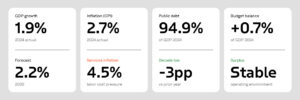
Portugal posted GDP growth of 1.9% in 2024, with the European Commission forecasting 1.8% in 2025 and 2.2% in 2026. The country recorded a budget surplus of 0.7% of GDP in 2024 while public debt fell roughly 3 percentage points to 94.9% of GDP, the lowest level in over a decade. For technology buyers evaluating country risk, these figures indicate a stable operating environment rather than the boom-and-bust exposure seen in some competing nearshore markets.
Inflation fell to 2.7% in 2024 and is forecast to decline further to 2.0% in 2026. However, services inflation remained higher at 4.5% in 2024, indicating continued labor cost pressure. For IT service providers, this could translate into higher contract renewal costs and should be considered when setting up multi-year pricing.
Digital economy and AI activity
Enterprise digitalization continues to expand across Portugal. According to National Institute for Statistics in 2025, 98.8% of Portuguese enterprises had internet access for business purposes, and 38.7% purchased cloud computing services — up 1.2 percentage points compared with 2023. E-commerce sales reached approximately EUR 83.9 billion in 2024, accounting for 20.6% of total enterprise turnover and growing 9.8% year on year. Together, these indicators point to increasing demand for software development, cloud platforms, and digital infrastructure.
AI adoption among enterprises with 10 or more employees reached 11.5% in 2025, up 2.9 percentage points in one year. Among AI-active companies, 59.4% used written-language analysis, 50.9% used image, video, or audio generation, and 45.6% used text, speech, or code generation capabilities. These trends are driving demand for generative AI, machine learning, and data engineering skills across both domestic enterprises and international clients operating in Portugal.
Source: European Commission
Why companies choose Portugal for IT nearshoring
Location and time zone advantage
Portugal operates on Western European Time (WET), one hour behind most of continental Europe and aligned with the United Kingdom. This creates a five-hour time difference with the US East Coast, allowing several hours of overlap during the working day for meetings, code reviews, and operational coordination. Lisbon and Porto also offer direct flight connections to major business hubs, including London, Frankfurt, Amsterdam, and New York, supporting regular travel for client meetings, team visits, and executive reviews.
For engineering leaders comparing delivery locations, nearshore IT Portugal consistently appears in shortlists where EU compliance, time-zone alignment, and talent quality matter as much as cost.
English proficiency and cultural alignment
English-language capability among Portuguese technology professionals is strong and reflects decades of engagement with international software companies, EU research institutions, and multinational delivery centers. Near-zero cultural negotiation overhead is an operational advantage when managing distributed engineering teams. Portuguese engineers are accustomed to working within Agile and Scrum frameworks and collaborating across European and American time zones.
Talent pipeline and workforce stability
European Commission reports that employment rose by 1.2% in 2024, with the labor force expanding by 1.1% — partly sustained by net migration inflows. Youth unemployment among those aged 15–24 stood at 21.6% in 2024, which signals an accessible pipeline of entry-level and junior engineering candidates for teams willing to invest in structured onboarding. Portugal’s universities graduate a consistent flow of computer science and engineering candidates, and the government’s Digital Decade roadmap — comprising 157 measures backed by EUR 2.15 billion in committed funding — is explicitly designed to expand digital skills.
Special visa programs for international engineers
Portugal operates several inbound talent mechanisms relevant to nearshoring and hybrid delivery:
- Tech Visa — a residence permit for technology professionals and founders sponsored by certified entities
- D8 Digital Nomad Visa — for remote workers earning above a minimum income threshold from foreign employers
- EU Blue Card — for highly qualified non-EU professionals under harmonized EU rules
These pathways support client teams that want to relocate individual contributors to Portugal or hire internationally into a local delivery center, without the setup delays of pure greenfield entity establishment.
Access to the EU single market
Operating a delivery center in Portugal provides access to EU procurement frameworks, EU research funding, and seamless cross-border data flows with 26 other member states. Portugal allocates 21% of its Recovery and Resilience Plan — equivalent to EUR 4.5 billion — to digital transformation, with a further EUR 2.4 billion cohesion funding dedicated to the same objective. Public investment at this scale generates domestic demand for software engineering, cloud migration, and data services, which in turn deepens the talent pool available to private-sector nearshoring clients.
Portugal’s digital infrastructure
Portugal ranks in the upper tier of EU member states for fixed and mobile connectivity — a key factor for teams considering nearshore in Portugal as a long-term delivery model. It supports low-latency remote engineering work, video-based collaboration, and distributed DevOps operations.
Fixed connectivity
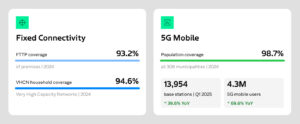
Fibre-to-the-Premises (FTTP) coverage reached 93.18% of premises in 2024, with Very High Capacity Network (VHCN) coverage for households at 94.59%. The vast majority of residential and commercial premises — whether in a delivery center or a home office — can access symmetrical gigabit-capable connections. For distributed dedicated development team configurations, this holds as much weight as office-based infrastructure.
5G deployment and adoption
In the European Commission Digital Decade, it is stated that 5G population coverage reached 98.72% in 2024. As of Q1 2025, Portugal had 13,954 installed 5G base stations — up 39.6% versus Q1 2024 and up 6.6% versus the prior quarter — with coverage extending to all 308 municipalities in the country. At the sub-municipal level, 74.1% of all parishes had at least one 5G base station, with 61.9% of stations deployed in urban areas and 24.1% in rural areas, per ANACOM.
Mobile adoption has followed the infrastructure buildout: 4.3 million users accessed mobile internet via 5G in Q1 2025, a 69.6% year-on-year increase, reaching 40.8 subscriptions per 100 inhabitants. The 5G network was actively carrying 22.4% of total mobile data traffic, with an average of 7.8 GB of monthly data per user.
For engineering leaders selecting delivery locations, these figures mean that mobile-first hybrid work patterns, remote code deployments, and real-time monitoring are practically viable across most of Portugal.
Source: ANACOM and European Commission data.
Talent supply and the engineering labour market
Supply and cost floor
ICT specialists accounted for 4.9% of total employment in Portugal in 2024, a comparable share to several established nearshore competitors in Central and Eastern Europe. Women represent 19.2% of ICT specialists, with men at 80.8% — a gap that progressive hiring programs are beginning to address, with implications for clients targeting DEI-aligned supply chains.
Portugal’s statutory monthly minimum wage in 2025 was €870, paid 14 times per year. Employer social security contributions are set at 23.75% of gross salary, with employees contributing a further 11%. Buyers modelling fully-loaded labor cost for support, QA, and junior engineering roles should use these figures as the floor; mid-to-senior software engineers command salaries substantially above the statutory minimum.
Talent competition and retention
The most important honest signal in the Portuguese labor market: 86% of Portuguese firms cited skilled-staff shortages as an obstacle to investment in 2024, compared to a 77% EU-27 average. Portugal is not a low-competition talent market. The demand for engineers in cloud, AI, and data disciplines is intense across domestic corporates, EU-funded public-sector projects, and multinational delivery centers simultaneously.
Retention planning, competitive compensation, and structured career development are required for nearshoring engagements that rely on maintaining stable teams over multiple years. In Portugal, 51.1% of employed persons had internet access for business purposes in 2025, reflecting a workforce already working in digital environments. This shapes expectations around tooling, remote work flexibility, and collaboration standards.
Enterprise AI adoption: Portugal as an AI-active market
The 11.5% AI adoption rate among Portuguese enterprises in 2025, up 2.9 percentage points year on year, indicates steady but still early-stage adoption. Among companies using AI, deployment is concentrated in operational use cases rather than experimentation.
| AI application area | Share of AI-using enterprises |
|---|---|
| Written-language analysis | 59.4% |
| Image/video/audio generation | 50.9% |
| Text/speech/code generation | 45.6% |
| Administrative/business-process automation | 40.8% |
| Marketing or sales | 36.9% |
Source: INE Portugal — IUTICE 2025
Portuguese enterprises are applying AI mainly for productivity and process automation. In parallel, 45.0% of enterprises conducted data analytics in 2025, up 6.4 percentage points from 2023, and 18.1% outsourced analytics functions externally. This indicates an established market for AI engineering, data platforms, and ML operations skills.
For nearshoring buyers assessing delivery capability, Portugal already provides engineers working on AI systems for domestic and multinational clients, alongside analytics and data infrastructure projects.
Risks and trade-offs to plan for
No nearshore location is risk-free, and the EU Commission’s data on Portugal presents a clear-eyed view of the constraints alongside the opportunities.
Talent competition is the primary operational risk. With 86% of firms citing skills shortages above the EU average, and services inflation running at 4.5% in 2024, salary expectations for experienced engineers in cloud, DevSecOps, AI, and data engineering are rising faster than headline CPI. Multi-year contracts should include indexed rate adjustment clauses, and hiring strategies should cover both senior lateral hires and structured junior-to-mid pipelines.
Regulatory and operational friction remains real. In the same European Commission investment survey, 83% of Portuguese firms cited business regulation as a barrier, 81% cited high energy costs, and over 88% cited economic uncertainty. These firm-level perceptions point to bureaucratic friction in permitting, entity setup, and compliance, which can extend delivery center establishment timelines and should be accounted for in planning.
Reform execution pace warrants monitoring. Portugal had fulfilled 33% of milestones under its Recovery and Resilience Plan at the Commission’s 2025 assessment cut-off. The government’s commitment to digital infrastructure investment is substantial on paper — EUR 4.5 billion in the RRP alone — but delivery velocity affects buyers whose scaling plans depend on talent program outcomes and public-sector technology investment generating adjacent skills supply.
Mitigation strategies: Site selection beyond central Lisbon reduces salary pressure and facilities cost. A multi-city delivery model (Porto as the primary engineering hub, Lisbon as a hybrid workspace) spreads risk while retaining access to both talent markets. Partnering with an established nearshoring provider rather than establishing a captive entity removes the regulatory navigation burden and compresses time-to-productivity.
Why nearshore with Intellias in Portugal
Intellias in Portugal operates a global delivery center in Porto and a flexible hybrid workspace in Lisbon, with more than 100 engineers on the ground delivering complex, data-driven software projects across automotive, financial services, retail, and telecom. The Porto office, established in 2022, provides 60 fully equipped workplaces with certified TISAX Level 3 infrastructure, meeting the security and compliance standards required by clients in regulated industries.
In 2024, Intellias was recognized as the best engineering team in Portugal by Teamlyzer — a recognition based on industry peer assessment. The company maintains active partnerships with Porto Tech Hub, Invest Porto, and Teamlyzer to support local hiring, community engagement, and talent pipeline development.
Engagement models
Intellias provides IT outsourcing services from Portugal across multiple engagement models, depending on client delivery needs and maturity:
- Dedicated development teams: Built and managed by Intellias in Portugal and integrated into the client’s delivery processes and reporting structures.
- Staff augmentation: Individual engineers or small teams embedded into existing client squads on a time-and-materials basis.
- IT staffing: Long-term placement of engineers sourced through Intellias’ local talent network.
- End-to-end software delivery: Full lifecycle coverage, including requirements, architecture, development, QA, and deployment.
The Intellias team brings capabilities in generative AI, machine learning, and data analytics, supporting both product development and data platform modernization. Engineers work in distributed delivery environments across European and US client organizations, with experience in both implementation and delivery governance.
Moving from shortlist to signed contract means answering the questions this guide raises: who handles entity setup, how do you retain senior engineers in a competitive market, and what does a realistic delivery timeline look like? Intellias can answer those from direct experience. Talk to our Portugal team.