What makes a business defensible when sophisticated technology becomes accessible to almost everyone? This question framed the CPO Track London discussion on whether AI is strengthening or eroding business moats. It drew on perspectives across technology services, media, financial technology, and data analytics, moving from competitive strategy to customer experience, engineering, talent, and organizational design.
A central observation was that AI may be exposing advantages that were never especially durable. Capabilities once protected by costly development, complex interfaces, or difficult data processing are becoming easier to reproduce. At the same time, AI can reinforce advantages rooted in specialized knowledge, trusted distribution, distinctive data, deeply embedded workflows, and customer relationships.
There was no single prediction. Views differed on how quickly agentic interfaces will displace applications, how widely engineering productivity gains are materializing, and whether specialized domain knowledge or transferable product judgment should dominate hiring. This uncertainty is itself useful: competitive advantage is increasingly something companies need to assess and renew continuously.
AI as a stress test for competitive advantage
Traditional sources of competitive advantage, such as switching costs, network effects, scarce resources, and strong customer relationships, still matter. The change is in how quickly certain technical barriers can be lowered. A product that took years to build may no longer be difficult for a well-equipped competitor to replicate.
This creates a distinction between technology complexity and business defensibility. A sophisticated interface, an impressive feature set, or a large archive of information may contribute to customer value without constituting a lasting moat. The sharper question is what customers would continue to value if competing products offered comparable technology.
Possible answers include proprietary insights that materially improve decisions, integrations into mission-critical processes, direct access to customers, expertise that is difficult to acquire, and an organization’s ability to execute consistently. AI makes it more urgent to distinguish these structural advantages from temporary barriers.
From discovery to customer outcomes
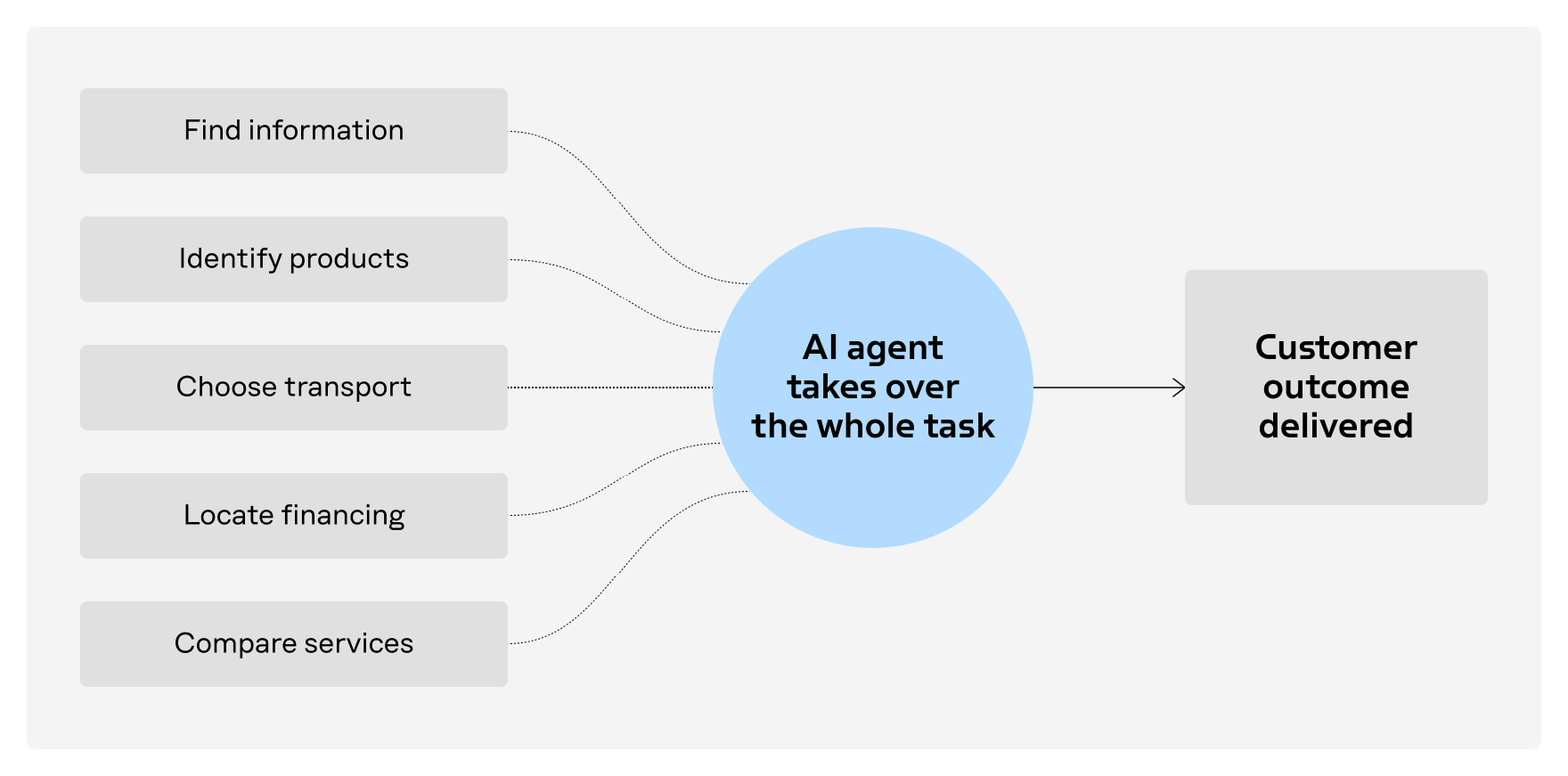
Much of the internet economy has been organized around discovery: finding information, identifying products, choosing transport, locating financing, or comparing services. AI agents may increasingly take responsibility for the broader task instead of simply showing the user where to go next.
The implications are significant. A financial platform might shift from recommending financing toward helping a business manage cash flow and decide when to expand. A travel service might move from search and comparison toward end-to-end planning and execution. An assistant may handle school communications, reminders, forms, and calendar coordination without the user opening each original application.
Companies may therefore need to reconsider the customer job they truly serve. The battleground could move from optimizing discovery and navigation to taking responsibility for a larger share of the desired outcome. This also makes distribution uncertain: if customers interact primarily with an agent, products that depend on visits to an app, or partner platform risk losing visibility.
Will applications disappear?
The future relationship between general-purpose agents and individual applications remains unresolved. Functional interactions may increasingly be delegated to assistants, reducing the need to open tools merely to retrieve a fact, enter data, or complete an administrative step.
Yet many applications offer more than utility. Communities, shared experiences, specialized interfaces, creator or expert relationships, and a sense of identity can give users reasons to engage directly. Fitness, entertainment, and news products illustrate how social participation and trusted perspectives can complement intelligent features.
The likely strategic challenge is to support agents and interoperable services while retaining the distinctive experiences that bring customers back. Data portability and agent access raise further questions about monetization, platform dependence, and who controls the customer relationship. There is also a risk that the most powerful agents concentrate distribution in a small number of ecosystems.
Data, institutional knowledge, and workflow intelligence
Possessing data does not automatically create a moat. Competitive value depends on whether information is differentiated, relevant, reliable, and useful in improving outcomes. Historical notes, for example, can contain subjective biases, while objective performance data may prove much more powerful for decision-making.
Enterprise workflows add another layer of complexity. Much of the knowledge required to complete work is not captured in formal process documents. It lives in the accumulated judgment of employees, informal exceptions, conversations, and institutional experience. Building effective AI systems therefore requires discovering how decisions are actually made and translating that understanding into usable instructions and processes.
Evaluation is equally important. AI-generated results may sound plausible while being wrong, incomplete, or inconsistent. Domain experts must help define successful outcomes, assess quality, and identify failure modes. The combination of distinctive knowledge, high-value workflows, and rigorous evaluation can differentiate applications even when the underlying foundation models are shared.
Technology services: From capacity to outcomes
AI is changing expectations of technology consulting and digital engineering providers. Historically, many engagements solved a capacity challenge: customers needed more engineers or more teams to build products and deliver transformations at speed.
As AI-enabled engineering expands what teams can accomplish, buyers increasingly focus on business value rather than the quantity of delivery capacity. They want to understand the problem being addressed, the outcome that will be achieved, how quickly value can be demonstrated, and how the engagement will be priced and governed.
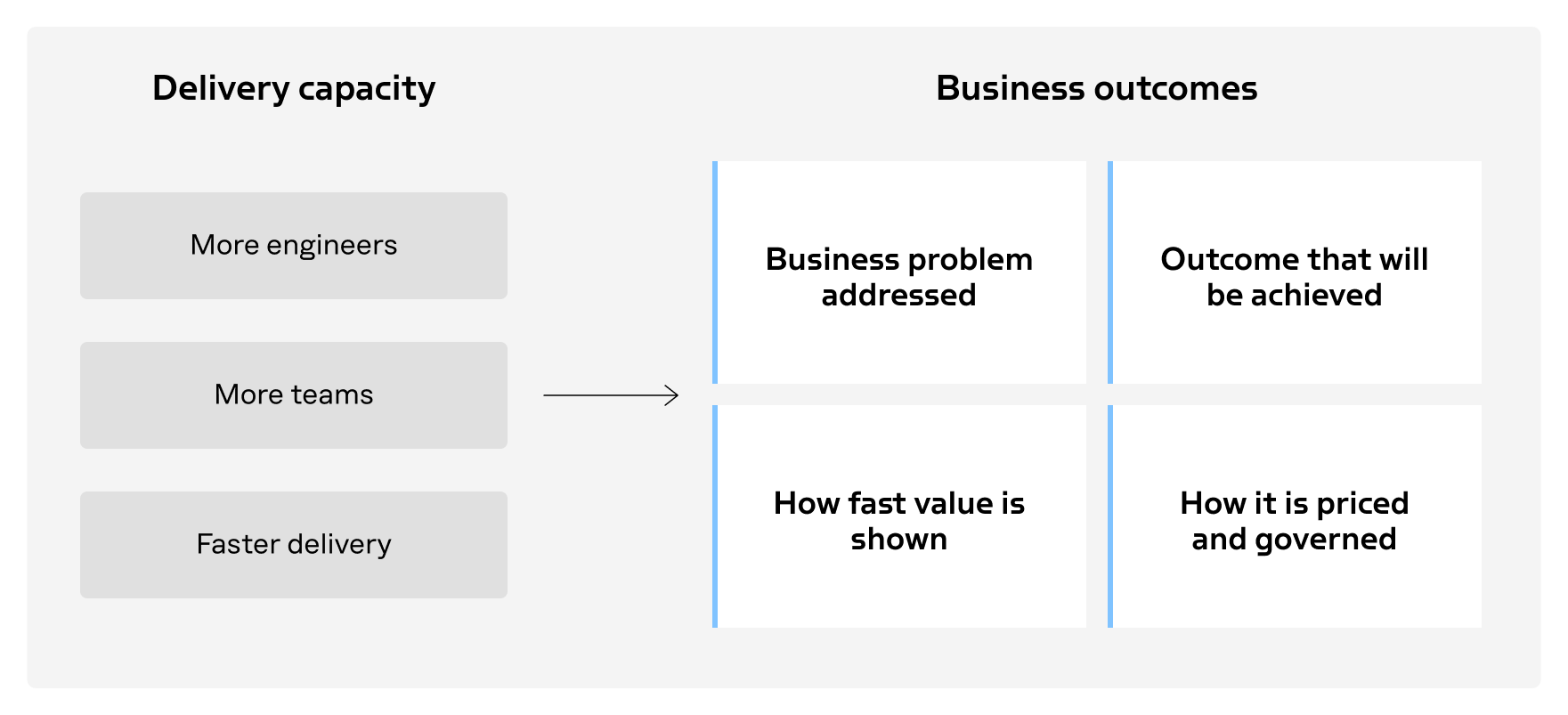
This creates an opportunity for shorter value-realization cycles, clearer milestones, and more outcome-oriented commercial structures, including within long-running programs. It also challenges services firms to make deliberate choices about the industries and problems in which they can differentiate. Broad technical capability alone is a less compelling proposition than specialized knowledge, repeatable solutions, and proven ability to connect engineering work to customer results.
Outcome-linked contracting is not straightforward: accountability must reflect what a provider can control, what depends on the customer, and how results are measured. Nevertheless, the direction of travel is toward greater clarity about measurable business impact.
Engineering, product management, and uneven productivity gains
AI-powered development tools can accelerate prototyping, coding, and testing, changing the balance of responsibilities inside product teams. Some AI-native squads are able to work with fewer people and move much faster. Product leaders in such settings spend less time negotiating what engineers can build and more time defining purpose, specifying edge cases and evaluating whether the product delivers value.
These gains are not universal. Legacy systems, architecture, organizational processes, governance, and engineering maturity can limit improvements. Striking examples of productivity are not evidence that entire industries have achieved comparable gains.
Faster feature delivery also shifts bottlenecks downstream. Commercial teams may struggle to explain an expanding set of capabilities, while customers need time to adopt changes. The value of a release depends on meaningful use, not simply how quickly it ships. The central product-management skills of prioritization, customer insight, and commercial judgment become more important as technical implementation becomes easier.
From individual AI efficiency to organizational performance
There is a gap between employees becoming faster and organizations becoming more effective. Individual team members may create highly productive personal systems with AI coding assistants, prompts, and contextual tools, yet their practices remain fragmented and difficult to scale.
Shared standards, review processes, knowledge management, and clear accountability remain necessary. Teams must balance the velocity of AI-assisted work with quality assurance and collaboration. Product and engineering groups can also adopt AI at different speeds, leading to friction about ownership, sequencing, and what constitutes completion.
In smaller squads, institutional knowledge and decision quality carry greater weight. The next stage of AI maturity concerns shared operating models and coordinated results, not just individual tool adoption. The relevant measure is improvement across the value chain from problem definition to customer impact.
Talent, judgment, culture, and belonging
Technology change places a premium on curiosity, adaptability, critical thinking, and the ability to operate amid uncertainty. Domain knowledge helps teams evaluate AI output, yet expertise alone does not guarantee strong product judgment. The ability to structure ambiguous problems, prioritize customer needs, and translate solutions into commercial value remains essential.
Motivation and retention matter as well. Meaningful work, the ability to ship useful solutions and freedom from unnecessary bureaucracy may matter as much as technical novelty. A sense of community and belonging was a recurring bridge between customer loyalty and employee engagement.
Communities help customers build relationships around products and shared identities. Within organizations, belonging and shared purpose can sustain collaboration through strategic uncertainty. Culture is thus relevant to execution and retention, as well as employee experience.
Partnerships and ecosystems as reinforcing capabilities
No company can be expected to build every required capability on its own. Strategic partnerships, integrations, and acquisitions can help combine distribution, differentiated data, domain-specific intelligence, regulatory capabilities, and customer access in ways that strengthen a broader value proposition.
The relationship itself is not automatically defensible. Its value depends on what becomes possible through the combination: better outcomes, deeper workflow integration, distinctive capabilities, or more durable customer engagement. An ecosystem approach is especially relevant when individual technologies are evolving rapidly and the strongest solution may involve complementary providers.
Partnerships can therefore be part of a living competitive strategy, provided they deepen customer value rather than merely expand a list of affiliated technologies.
A practical six-to-nine-month view of the moat
An actionable horizon is to assess how a company’s competitive advantage could evolve over the next six to nine months. Rather than treating a moat as a fixed attribute, leaders can examine whether their position is becoming stronger or easier to replicate.
Useful lenses include the criticality of the customer problem; depth of embedding within workflows; uniqueness and usefulness of data; dependence on intermediaries for distribution; difficulty of replication; willingness to pay; organizational execution; and the contribution of partnerships or complementary capabilities.
These factors matter to customers and investors alike. If AI makes a product easier to replicate, pricing power and expected growth may weaken. Conversely, if better intelligence reinforces distribution, data and customer engagement in a self-improving cycle, defensibility may improve. Competitive advantage must be continuously tested rather than presumed.
Closing reflections
AI can erode and reinforce competitive advantage at the same time. It makes software and intelligence easier to access, while increasing the significance of distinctive knowledge, deeply embedded workflows, direct relationships, judgment, and execution.
It also creates a new set of management challenges. Faster development is not synonymous with faster customer adoption. Personal AI proficiency is not the same as organizational productivity. Access to more data is not necessarily equivalent to better decisions. And broad availability of foundation models does not erase the role of industry-specific context.
The enduring question is less whether AI will strengthen or erode every business moat and more whether organizations understand what their advantage is built on, recognize which parts are changing, and can adapt their strategies accordingly.
The lively exchange across industries, followed by extensive audience questions, underscored the value of an executive community willing to compare experiences, test assumptions, and explore these uncertainties together.
Want to test how AI is changing your product’s competitive position? Contact Intellias.