Ask a digital marketing manager at a hospital group, a medtech company, or a pharma brand team what AI in healthcare marketing means today, and most will describe a faster version of what they already do: a chatbot answering scheduling questions, a tool drafting social copy, an algorithm reallocating ad spend, or other forms of conversational AI in healthcare. That answer was accurate two years ago. It is no longer complete. A newer category of software, agentic AI, plans a task, pulls live data from the systems marketing already runs on, takes action, and checks its own work before a person signs off. McKinsey describes the broader move as a shift from campaigns to continuous growth, a direction many see as the future of marketing automation. Healthcare has particular reasons to pay attention, because here the same workflow that drafts a campaign must also respect consent registries, approved claims, and at least three regulators’ worth of rules.
The shift: from campaigns to continuous, AI-driven marketing
For three decades, marketing ran on a campaign clock: plan a quarter, brief an agency, launch, wait for results, repeat. McKinsey’s growth, marketing, and sales practice now argues that marketing has become a real-time growth engine that integrates insights, content, commerce, and performance in a continuous loop. Yet fewer than 10 percent of organizations have successfully scaled AI across marketing, even though the technology could unlock up to $90 billion in improved marketing returns in the US alone. Where organizations do redesign marketing to run on AI in real time, McKinsey reports two-to-three-times productivity gains, 10 to 30 percent savings, and 4 to 7 percent growth in revenue and conversion value.
Healthcare sits at the back of that adoption curve for a specific reason, and it is not lack of ambition. In most industries the constraint on marketing velocity is budget. In healthcare it is review capacity. A promotional asset for a prescription product passes through medical, legal, and regulatory (MLR) review before it ships, and every localization for a new market can restart the cycle. Teams producing hundreds of assets a year spend more calendar time waiting for review than creating. Add fragmented organizations, where global brand teams, regional commercial units, and field staff each work from a different slice of the same knowledge base, and the result is predictable: healthcare marketing generates some of the richest data of any industry and converts it more slowly than almost anyone else.
That combination is where agentic AI pays for itself, and where it causes real damage when governance is an afterthought.
What is agentic AI in healthcare marketing?
Agentic AI in healthcare marketing is a system of software agents that research, draft, check, and act across marketing tasks: competitive analysis, campaign planning, content localization, MLR pre-screening, and field-team enablement, all under human review (not to be confused with human authorship at every step). Unlike a chatbot or a copy generator, an agent decides which internal system to query, completes a multi-step task, and hands off a finished, source-linked draft rather than a single output. In a regulated industry, that matters for one reason above all: the agent’s actions run inside enterprise systems with an audit trail, not in a public tool with none.
Agentic AI vs. generative AI vs. AI agents
In our experience at Intellias, teams often use the same language for generative AI marketing tools, AI agents, and agentic AI systems, even though they solve very different problems. Here is how they differ in practice for a marketing team:
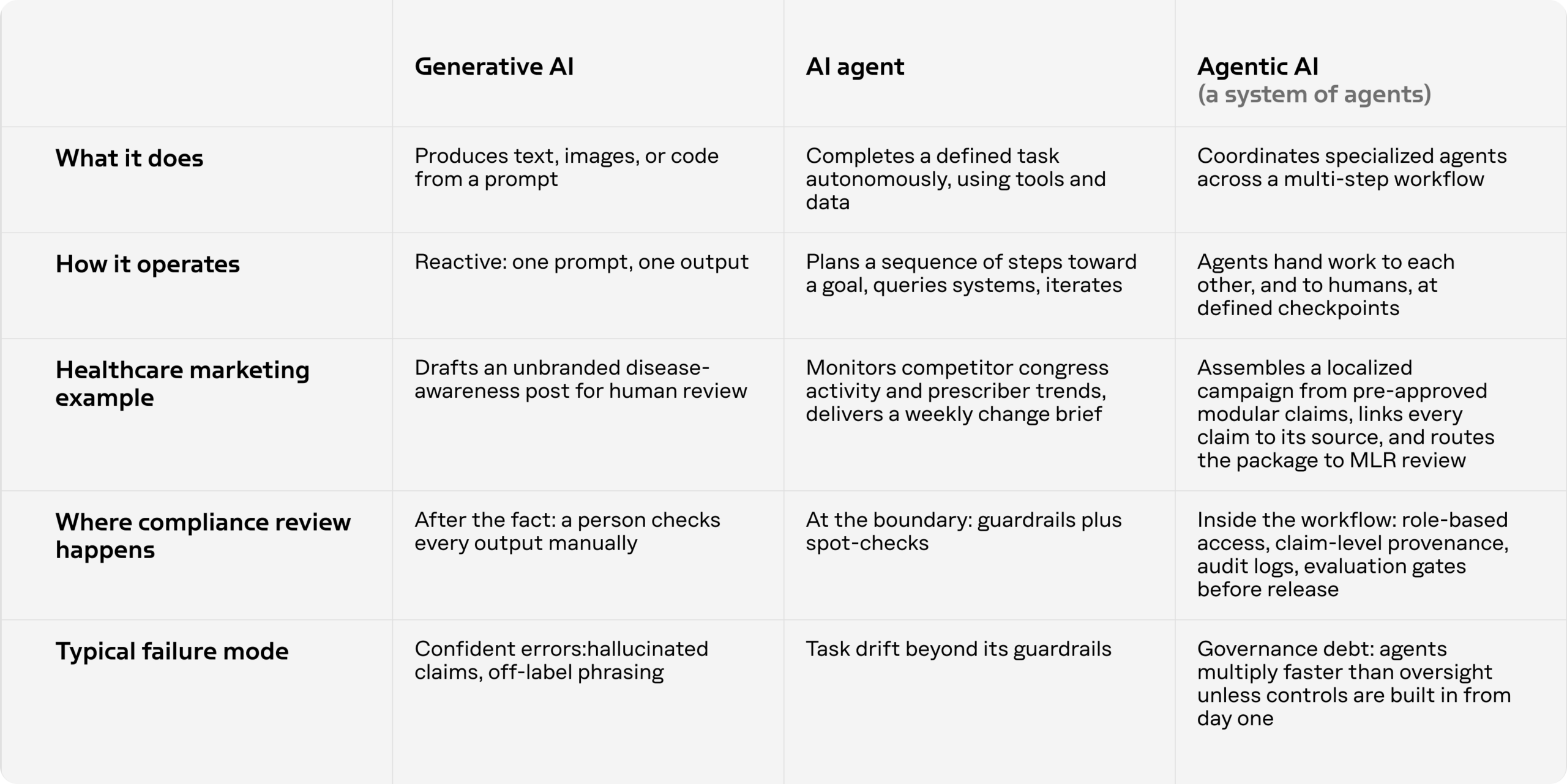
Agentic AI has the potential to resolve what McKinsey calls the “gen AI paradox”: the technology can be found everywhere except on the bottom line. McKinsey estimates agentic AI will come to power as much as two-thirds of current marketing activities, from automated content generation to synthetic audience testing and audience-based media planning.
AI in healthcare marketing: real tasks across the marketing lifecycle
The theory is easier to accept than the specifics, so here is what agentic systems actually do at each stage of the lifecycle, together with the rule that constrains each task. The second part matters: in healthcare, a use case described without its compliance boundary is not a use case. It is a liability.
Competitive and market intelligence
Instead of a specialist manually exporting data from three disconnected systems, an agent pulls competitor activity, pricing signals, prescriber trends, and congress abstracts into a single brief and flags what changed since the last update. Purpose-built industry platforms now deliver unified pharma insights in near real time, assessing market readiness across dozens of countries for pre-launch planning. Because the inputs are public or licensed data rather than patient information, this is also the lowest-risk place to start: teams learn to supervise agents before any regulated data is involved.
Campaign planning and modular content
An agent generates a structured campaign brief from a stated objective and target audience, pulling brand guidelines and prior performance data automatically instead of starting from a blank template. The bigger prize is modular content. Rather than writing each asset from scratch, an agent assembles variants from pre-approved claim blocks and visual components, so every sentence in the draft already carries an approval history. MLR reviewers then verify provenance instead of re-reviewing prose. That is the mechanism that lets review cycles compress from weeks toward days: the standard stays, the re-reading disappears.
Personalization inside consent boundaries
For US providers, HIPAA’s marketing rule is blunt: using protected health information for marketing generally requires written patient authorization. In the EU, GDPR treats health data as special-category data under Article 9, and the de-identification shortcuts US teams rely on do not transfer. Personalization agents therefore work on what remains legitimately usable: consented, de-identified, or zero-party data that patients provide directly through symptom checkers and preference centers. Agents turn that data into micro-segments and adjust content and timing without anyone manually rebuilding audience lists for every send. The pattern is identical on both continents: the agent must be able to show a lawful basis for every data point it touches, which makes personalization a data architecture question before it is an AI question.
Field and HCP enablement
Sales representatives and medical science liaisons preparing for a physician visit have historically spent hours assembling account history, recent publications, prescribing context, and formulary status. An analyzer agent prepares that pre-visit briefing automatically, pulling from CRM, medical information, and market data systems. The same architecture powers next-best-action suggestions, congress follow-up sequences, and rep-triggered approved emails: the daily plumbing of omnichannel HCP engagement. One caution that teams routinely miss: HCPs are natural persons, and their data falls under GDPR in Europe. Consent and preference management for physicians is not optional infrastructure.
Content localization and MLR pre-screening
A creator agent produces brand-guided visuals and copy variants for each market, while a separate checking agent verifies claims against approved labeling and regional regulatory requirements before anything reaches a human reviewer. In pharma, this workflow also inherits pharmacovigilance duties: a side-effect mention in a comment thread or a survey response must reach the pharmacovigilance team quickly. Expedited reporting clocks for serious adverse events run in days, and regulators generally treat awareness by anyone acting for the company as the starting point. How automated detection interacts with that clock is not yet settled practice, which cuts both ways: agents can screen for safety signals at a scale humans cannot match, but the routing rules must be explicit, tested, audited, and agreed with the pharmacovigilance team itself.
Media optimization without third-party crutches
Advertising platforms are building agents that autonomously evaluate performance, adjust bids and budgets, and pair creative with audiences. Healthcare marketers are adapting the pattern with tighter guardrails and a harder targeting problem: third-party cookies are in terminal decline and effectively unusable for health audiences, so the channels that still work reliably are authenticated ones, from endemic HCP platforms and portals to consent-based first-party lists. The regional split matters here more than anywhere else. In the US, FDA promotional standards apply to every ad regardless of who, or what, drafted it. In the EU, direct-to-consumer advertising of prescription medicines is prohibited outright, so media agents optimize HCP channels and unbranded disease-awareness campaigns instead.
This is AI automation in healthcare marketing in its practical form: a set of narrow, auditable AI agents in healthcare wired into the systems marketing teams already use.
Using AI in healthcare marketing: trends for 2026
Healthcare marketing in 2026 is showing three clear trends, many of which are already among the most important trends in pharma marketing. First, teams are moving from isolated AI features to agentic workflows across content, media, and compliance. Second, the digital health industry is pushing past experimentation, expecting AI to reduce manual work, improve consistency, and perform reliably under governance. Third, the focus is shifting from “using AI” to redesigning the operating model around speed and control.
The pressure to prove value beyond pilots is growing, with nearly 90% of CMOs now experimenting with AI across their marketing workflows.
For pharma, this is increasingly a scale-and-control decision reshaping pharmaceutical marketing strategies across commercial, medical, and field teams. In March 2026, IQVIA launched its unified agentic AI platform and reported that 19 of the top 20 pharmaceutical companies had begun incorporating its agents into their workflows. Coordinated agentic systems are moving into mainstream pharma operations rather than remaining isolated experiments.
A fourth, quieter trend underpins the other three: consent-based first-party and zero-party data is becoming the default foundation for personalization, because it is the only foundation that survives contact with GDPR, HIPAA, and the end of the third-party cookie.
Building an AI-ready healthcare marketing strategy
Healthcare marketing strategy documents and other marketing strategies for healthcare organizations often make agentic AI sound tidy. Deployment rarely is, which is why a real rollout is worth examining step by step.
From an underused intelligence tool to a governed global AI platform
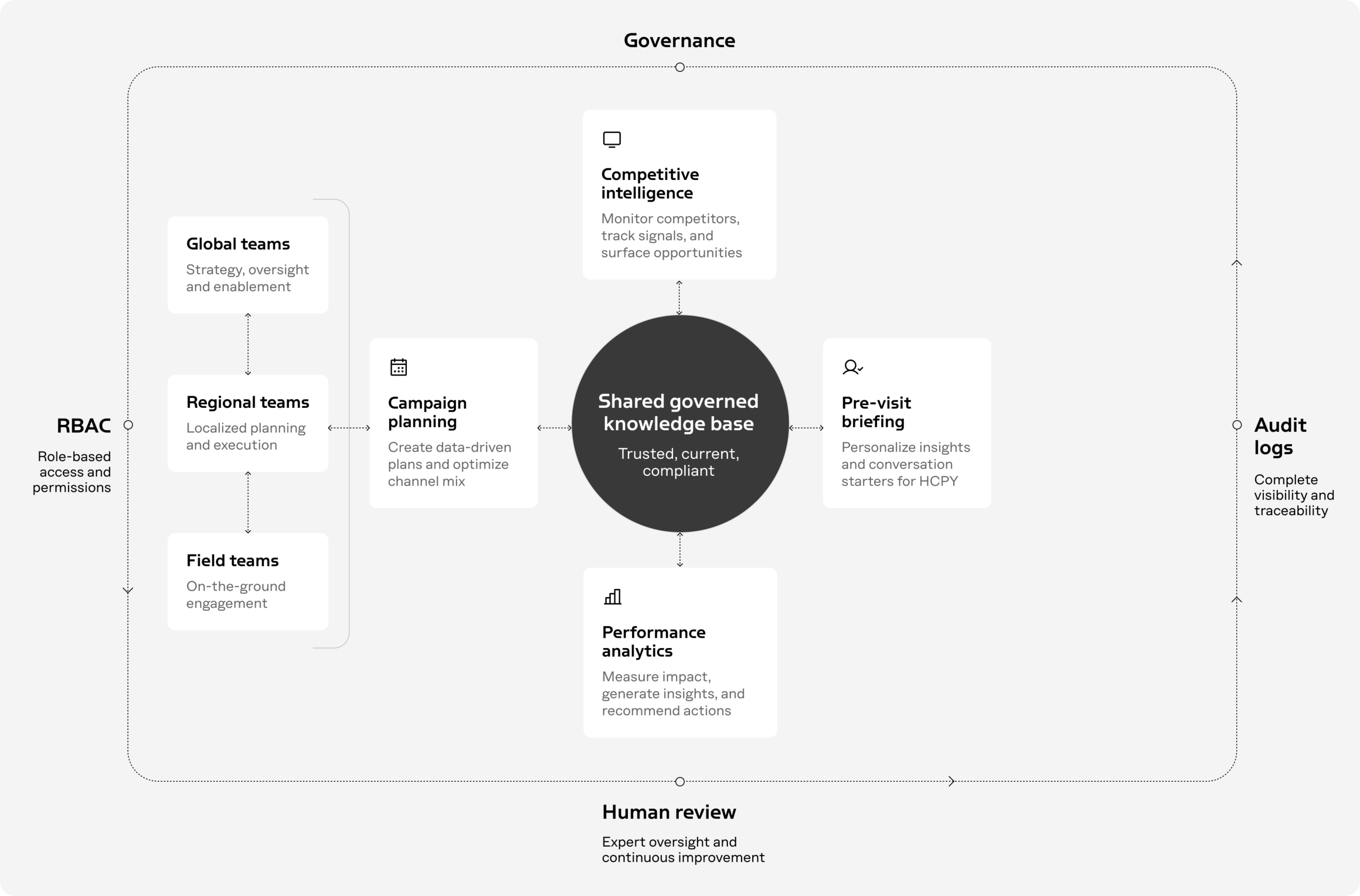
Intellias built a multi-agent marketing platform for a global enterprise operating in more than 90 countries. The goal was to give global brand teams, regional commercial teams, and field personnel a faster, controlled way to work with analytics reports, campaign assets, and research documents spread across the organization.
1. The renewal decision exposed a larger problem
The client paid approximately $80,000 a year for a competitive intelligence platform. It had 108 registered users, but only 9 to 13 were active in a typical month. Many employees still relied on manual exports or external chatbots, which created extra work and increased the risk of confidential information moving outside approved systems. With the subscription approaching renewal, the client needed a more useful and controlled alternative.
2. Proving the value before building the platform
Intellias proposed proving value before committing to scale: a proof of concept built one specialized agent against a tightly scoped knowledge collection, then tested it against the same queries the business already ran through the legacy tool. It matched or exceeded the existing platform in coverage and response quality, giving the client evidence to move on to an MVP.
3. Four agents built around existing marketing work
The MVP introduced four specialized agents:
- Competitive intelligence for finding and synthesizing market information
- Campaign brief planning for creating structured campaign inputs
- Pre-visit briefing analysis for preparing field personnel before customer meetings
- Brand-guided visual creation for producing materials within brand requirements
Each agent addressed an existing task rather than adding a general-purpose chatbot to the marketing stack.
4. Governance built into every interaction
Every agent runs inside the client’s enterprise environment. Role-based access controls what users can see, audit logs provide traceability, and user identity carries through sensitive integrations. New capabilities pass a structured evaluation process before they are released to marketing teams.
Under the hood, the pattern is retrieval-augmented generation over an approved knowledge base. Agents answer from the client’s own documents and cite what they used. Identity passes through to every integration, so an agent can never surface a document the signed-in user could not open themselves. New capabilities pass an evaluation suite before release, the same way production code passes tests. For a marketing leader, this is the difference between adopting AI and adopting risk.
5. An internal capability with broader regional coverage
The legacy competitive intelligence subscription is on track for non-renewal. The internal platform matched the previous tool on tested queries and extended access to regions the third-party service did not cover. What the program has demonstrated so far is functional rather than financial: a low-adoption subscription replaced, regional coverage expanded, and reliance on external, ungoverned tools reduced. It also gives global and regional teams a shared, governed way to access marketing intelligence instead of relying on separate manual processes.
6. Business results without overstating attribution
A regional product launch conducted through the platform’s awareness phase generated approximately:
- 1.1 million impressions
- 1,600 validated leads
- More than 1,000 completed diagnostic surveys
For context: these figures come from a single regional awareness phase. The validated leads and completed diagnostic surveys are the commercially meaningful numbers, while impressions indicate reach only. They describe the launch supported by the platform and should not be presented as outcomes produced solely by AI. The campaign is now being extended with AI components for personalized content, real-time lead enrichment, and field-team enablement. The program itself has grown from a focused proof of concept into a multi-wave global rollout supported by more than 15 specialists.
What this changes for healthcare marketing teams
The value is far bigger than a new interface for generating content. It is a controlled way to make approved company-wide knowledge usable across global, regional, and field-level marketing work. Teams spend less time searching, exporting, and rebuilding information. Field personnel receive more structured preparation for customer meetings. Regional teams gain access to intelligence that previously did not reach their markets. And sensitive data stays inside the organizational environment, access follows existing user permissions, and every capability is evaluated before release.
One question this rollout raises deserves its own article: the operating model. Who supervises the agents, how agency relationships change, and what skills in-house teams need are decisions, not defaults. The short answer from this program is that agents shift marketing work from production to supervision, and the teams that adapt fastest treat reviewing AI output as a core professional skill rather than a chore.
Compliance across the US and Europe: HIPAA, GDPR, and the EU AI Act
Compliance is the first objection any healthcare leader raises about the value of AI in healthcare marketing, and it deserves a direct answer rather than a reassurance. As agentic AI moves from drafting to scaled campaign work, three areas carry the regulatory weight: patient data, promotional claims, and review history.
In the US: HIPAA and the FDA
For US organizations, HIPAA is not a barrier to AI in healthcare marketing. It defines the obligations that follow the data and determines whether the work can scale safely. If protected health information is involved, marketing use generally requires patient authorization, vendors handling that data need business associate agreements, and de-identified information must meet the legal standard before it can be treated as outside HIPAA. The strategic advantage comes from using AI where compliance is already defined: audience analysis, content operations, and campaign efficiency.
The FDA applies the same promotional standards across every format and production method. Communications must remain truthful, balanced, properly supported, and free from misleading impressions, whether the first draft comes from a marketer, an agency, or an AI model. In September 2025, the FDA announced thousands of warning letters and approximately 100 cease-and-desist letters related to deceptive drug advertising, and confirmed that AI-enabled tools were already supporting its surveillance of drug promotion.
For US providers there is a second live enforcement issue: tracking technologies. OCR guidance on web trackers and a wave of litigation over analytics pixels on hospital websites have turned ordinary retargeting into a HIPAA question. A marketing agent that consumes website behavioral data must treat visitor-level data from authenticated pages or condition-specific content as regulated, which is one more reason consent-based first-party data is displacing ambient tracking across the industry.
In Europe: GDPR, the EU AI Act, and national advertising codes
For campaigns running in Europe, HIPAA is the wrong reference point. The GDPR, which applies across the entire European Economic Area, treats health data as special-category data under Article 9. Marketing use generally requires explicit consent, and the de-identification routes US teams rely on do not transfer. ePrivacy rules add their own consent requirements for the tracking and profiling that feed personalization. The UK GDPR and the revised Swiss FADP impose the same discipline outside the EEA. Wherever the campaign lands in Europe, an agent that segments patient audiences must be able to show a lawful basis for every data point it touches.
The EU AI Act adds an AI-specific layer on top. From 2 August 2026, its Article 50 transparency obligations apply: people must be told when they are interacting with an AI system, and AI-generated content must be marked as such in machine-readable form. Rules for general-purpose AI models have applied since August 2025, while the Digital Omnibus agreement has deferred most high-risk obligations to late 2027 and beyond. Marketing agents will rarely qualify as high risk, but the transparency, logging, and human-oversight requirements land squarely on the governed-workflow pattern described above. The Act does not reach the UK or Switzerland, which have so far taken lighter-touch, regulator-led approaches to AI, so in those markets data protection law does most of the work.
Promotional rules diverge even more sharply. Direct-to-consumer advertising of prescription medicines is prohibited in the EU under Directive 2001/83/EC, and the same line holds across the rest of Europe: in the UK under the Human Medicines Regulations and the ABPI Code, in Switzerland under the Therapeutic Products Act. The DTC media playbook that dominates US pharma marketing simply does not translate. European campaigns center on HCP engagement and disease awareness, governed by the EFPIA Code of Practice and national codes. For agentic AI the implication is the same as with the FDA, only stricter: claims checking, audit trails, and human sign-off are the condition of operating at all.
Wherever the campaign runs, the sponsor still owns the final message. AI agents belong inside the existing medical, legal, and regulatory process, with clear data controls, source-linked claims, approval steps, and audit logs. Done this way, agentic AI gives healthcare organizations faster, more repeatable campaign production while keeping every output traceable and defensible.
The payoff: ROI, speed, and scale
None of this holds up without numbers. Using AI in healthcare marketing redirects ROI from volume to precision: it connects fragmented data, prioritizes the right audiences, and automates the repetitive campaign decisions that usually bottleneck teams.
The strongest ROI case is operational: fewer manual handoffs, faster campaign execution, shorter review cycles, and better use of staff time across patient acquisition and HCP engagement. The returns show up as tighter targeting, faster content and outreach cycles, and a clearer line from engagement to pipeline and patient demand.
Scale makes this matter. Healthcare and pharma digital ad spend hit $24.8 billion in the US in 2025, up 13% year over year. At that volume, even modest efficiency gains compound.
The Intellias case shows the shape of the return: a low-adoption $80,000-a-year subscription retired, a marketing intelligence function extended into regions the previous tool never reached, and a single regional launch generating more than 1,600 validated leads with no additional regional marketing headcount. Platform delivery ran as a separate program team, so campaign economics and platform economics should be read separately. The industry is adopting a different operating model, built for growth instead of one-off launches.
The Intellias advice for healthcare leaders: deploy AI where the workflow is repeatable, the data is clean, and the outcome is measurable. That is where ROI holds up, because the profit comes from less wasted spend, faster learning cycles, and more precise demand generation, never from strategy documents for their own sake. Compliance and brand judgment stay human-led.