Project snapshot
The client is a world-leading provider of map data and location intelligence operating a complex global map production ecosystem for AI-enhanced automotive navigation systems and AI-powered mapping applications.
Intellias helped the client transform a GenAI proof of concept into a production-ready GraphRAG solution that automates specification analysis, map entity validation, and relationship cross-checking through a unified generative AI assistant.
Business challenge
The client’s map production ecosystem covered more than 100 countries and relied on extensive technical specifications defining map attributes, entity models, validation rules, and relationships between map objects.
Engineers had to manually search fragmented documentation and cross-check complex entity dependencies. This made validation slow, inconsistent, and difficult to scale across teams and markets.
The client required an automated solution that could understand both unstructured documentation and structured map relationships. It also needed to provide grounded, traceable answers rather than generic LLM responses, while supporting automated quality evaluation and future enterprise-scale deployment.
Solution
Together with the client, Intellias developed a GenAI-powered GraphRAG platform that combines document retrieval, vector search, knowledge-graph reasoning, and automated validation.
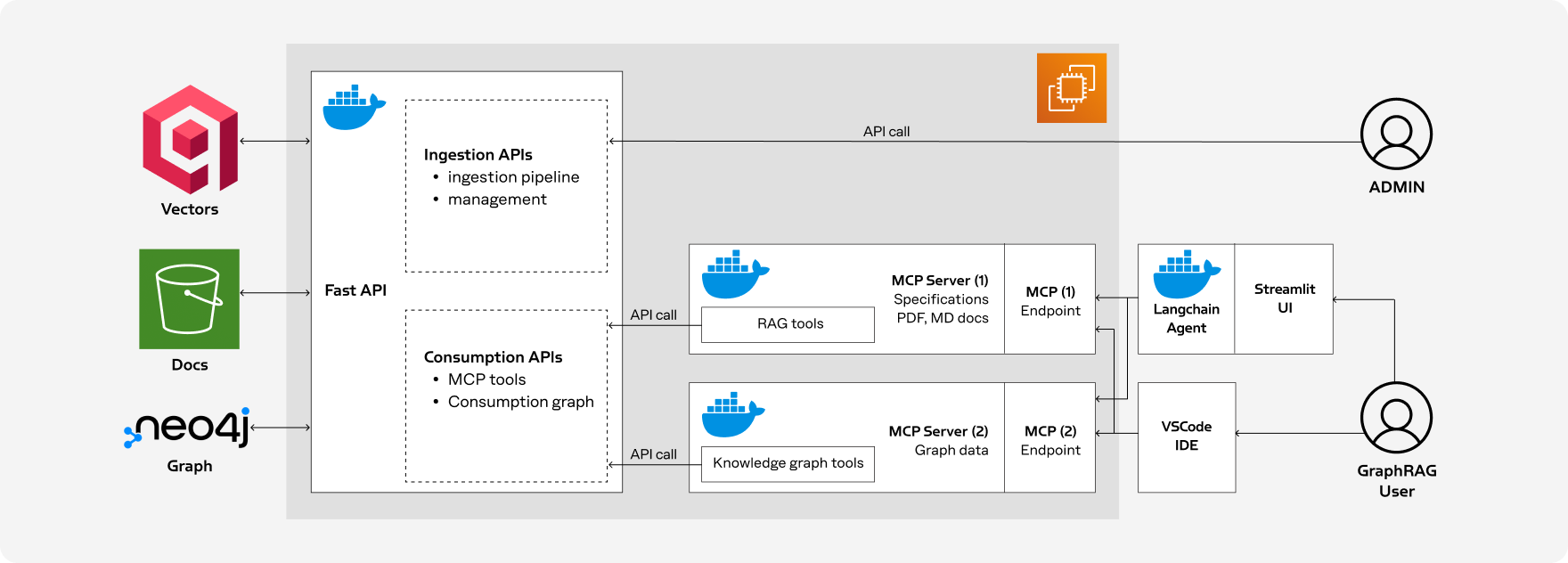
Starting from an initial proof of concept, Intellias transformed the Gen AI automotive solution into a production-ready MVP delivered as containerized Docker components running on a single AWS EC2 instance.
Document-grounded AI assistant
Intellias built a data ingestion pipeline that preprocesses, structures, and loads more than 5,000 pages of AI map production documentation.
The AI map assistant retrieves relevant specification content and uses it as contextual evidence when answering engineering questions. This approach improves response accuracy and ensures generated outputs remain grounded in the client’s technical documentation.
Hybrid GraphRAG knowledge layer
The knowledge GraphRAG solution combines two complementary retrieval mechanisms:
- Qdrant vector search for semantic retrieval across unstructured documentation
- Neo4j knowledge graph for reasoning across more than 4,000 connected map entities
The hybrid GraphRAG architecture enables the assistant to identify relevant documentation while also tracing dependencies, relationships, and validation rules between map entities.
This allows users to ask complex questions that require both textual understanding and structured reasoning, such as identifying applicable attributes, checking entity compatibility, or validating relationships between map objects.
Agentic GenAI workflows
Intellias implemented LangGraph workflows orchestrated through Model Context Protocol (MCP) servers.
These workflows allow the AI-native mapping assistant to select and execute reusable tools for document retrieval, graph queries, map validation, and response generation. FastAPI services expose these capabilities through APIs, making them available to developer tools and other enterprise applications.
Automated response quality evaluation
To make GenAI output measurable and repeatable, Intellias implemented an automated evaluation framework using MLflow.
The AI map production framework validates responses against a client-curated golden dataset and applies an LLM-as-judge approach to assess answer relevance, accuracy, and consistency.
This gives the client a structured way to compare model configurations, detect quality regressions, and validate changes before releasing them to users.
Flexible LLM integration
The solution uses AWS Bedrock for managed access to enterprise-grade foundation models. It also supports optional deployment of open-source models through Ollama.
This model-agnostic architecture allows the client to evaluate different LLMs based on quality, cost, security, and deployment requirements without rebuilding the core platform.
Integrated developer experience
The AI assistant is accessible through:
- VS Code integration for engineering teams
- A lightweight Streamlit interface
- Reusable FastAPI endpoints
- MCP-compatible tools for future AI agents and applications
This brings Gen AI capabilities directly into existing engineering workflows instead of requiring users to switch between multiple documentation and validation systems.
System architecture
Technologies:
Python, FastAPI, MCP/FastMCP, LangGraph, LangChain, AWS S3, AWS Bedrock, AWS EC2, MLflow, Qdrant, Neo4j, Streamlit, RAG/GraphRAG
Business outcome
The solution replaced fragmented manual search and cross-checking with a single geospatial AI assistant capable of working across technical documentation and map entity relationships.
By applying generative AI in automotive, engineering teams can now retrieve relevant specifications, analyze dependencies, and validate map structures through natural-language queries. Automated evaluation provides a consistent quality baseline and reduces reliance on biased manual review.
The modular architecture also gives the client a foundation for broader adoption, including additional validation tools, AI agents, map production workflows, and enterprise interfaces. The target platform is designed to support more than 1,000 daily active users.
Key impact
- Faster access to map specifications and validation rules
- Graph-based reasoning across complex entity relationships
- More consistent GenAI output through automated quality evaluation
- Reduced manual effort in documentation search and cross-checking
- Flexible support for managed and open-source LLMs
- Scalable AI-powered mapping architecture designed for enterprise adoption
4,000+
Map entities cross-checked with a unified AI assistant
5000+
Pages of tech documentation available through GenAI-powered retrieval
1,000+
Daily active users supported by scalable platform architecture